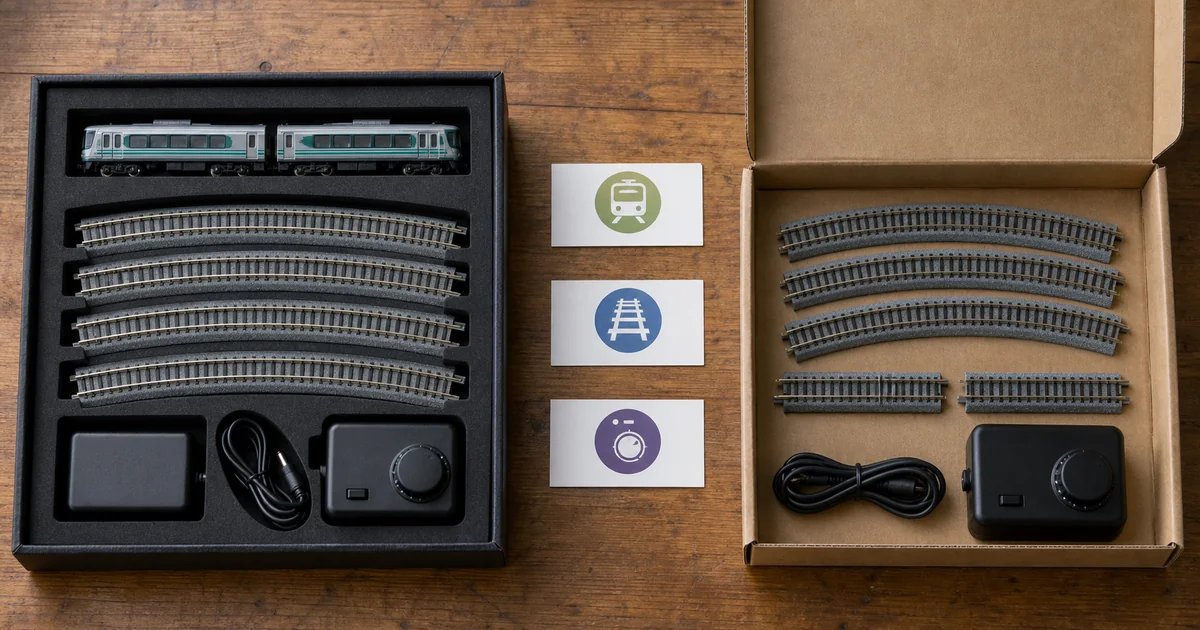
AI-generated illustration, not a photograph of a specific product
The most common mistake with a first N scale purchase is not picking the wrong brand. It is buying a box that cannot move.
"Starter Set", "Basic Set", "M1", "My Plan", "Rail Set" — on a shop listing they all read like entry-level products. Some contain a train and run the moment you unpack them. Others contain only track. One of them does not even include a controller. This page sorts them out so you do not open the box and discover there is nothing to put on the rails.
Six kinds of box — which have a train in them?
This table is the whole point of the article. Read the "train?" column and you have avoided most of the ways this goes wrong:
| Box type | Train? | What is inside | Who it suits |
|---|---|---|---|
| Starter Set (KATO 10-001 / 10-002) | ✓ Yes | Train + R315 track + Standard SX controller + power supply | First purchase — runs out of the box |
| Basic Set SD (TOMIX 90194) | ✓ Yes | Train + C280 track + N-600 controller + feeder + power supply | First purchase — the TOMIX equivalent |
| Train basic set (e.g. KATO 10-1697S) | ✓ Train only | Rolling stock and nothing else | You already have track and power |
| Add-on set (e.g. 10-1698 / 10-1699) | △ Extra cars | Intermediate cars; usually no powered car | Extending a formation you own |
| M1 / M2 / My Plan | ✗ No train | Track + controller + power supply | You have stock, or want to choose it yourself |
| Rail Set (e.g. TOMIX 91025 / 91027) | ✗ Track only | Track; may include neither controller nor feeder | Already running — extending the layout |
Our advice: for a first purchase, go straight to a set that includes a train. You will have something running the same day, nothing will be missing, and that early success matters more than saving a little money. Be especially wary of the notably cheap "M1", "My Plan" and "Rail Set" listings — they look like bargains, but the price is low because there is no train in the box. You will spend the difference later, with an extra wait. The trainless sets are the right answer only once you already know which locomotive or unit you want.
What is in each box, and what it costs
| Part number | Cars | Contents | Japanese list price |
|---|---|---|---|
| KATO 10-001 (N700S Starter) | 4 | M1-equivalent R315 track + Standard SX | ¥25,740 |
| KATO 10-002 (E5 Starter) | 3 | M1-equivalent R315 track + Standard SX | ¥22,000 |
| TOMIX 90194 (Basic Set SD) | 4 | Hankyu 2000 series + C280 + N-600 + feeder | ¥31,900 |
| KATO 20-852 (M1) | — | R315 basic oval + Standard SX | ¥11,000 |
| KATO 20-853 (M2) | — | R315 oval + passing siding + Standard SX | ¥19,800 |
| TOMIX 90949 (My Plan) | — | C280 layout + N-600 + feeder | ¥11,000 |
| TOMIX 91025 / 91027 (Rail Set) | — | Track only, no controller or feeder | ¥8,360 / ¥13,200 |
Japanese manufacturer list prices including tax, rechecked on the current official pages 2026-08-25. They are reference figures, not local offers; exchange rates, import costs and seller stock are outside this comparison. A live manufacturer page documents a product but does not prove it is available where you shop.
A starter set is a short train, not a full-length one
The other common surprise: the train in a starter set is a runnable short formation, not the prototype's full length.
KATO's 10-001 N700S Starter contains four cars. The real train is sixteen. Getting there means adding 10-1698 (four cars) and 10-1699 (eight cars). The same pattern applies to the others:
- KATO 10-002 — the E5 "Hayabusa" set is three cars (the same stock as the 10-1969 basic set). The prototype runs as ten, so you would add 10-1970 (three cars) and 10-1971 (four cars).
- TOMIX 90194 — the Hankyu 2000 series set is four cars, and TOMIX's own product page states that adding the separately sold 97218 (four cars) recreates the prototype's eight-car formation.
This is a design decision, not a shortcoming. A short formation is cheaper, takes far less space, and runs perfectly well. Starting with four cars and extending once you know you enjoy it is a much better order of operations than committing to a sixteen-car train and a table to match before you have run anything.
Starter set, or buy the pieces separately?
A reasonable question: would buying a track set and a train separately come out cheaper? Usually not — the starter set is normally slightly ahead. Using KATO's N700S:
| Route | What you buy | Total |
|---|---|---|
| Starter set | 10-001 — train, track and controller in one box | ¥25,740 |
| Assemble it yourself | 20-852 M1 (¥11,000) + 10-1697S four cars (¥15,840) | ¥26,840 |
So if you happen to like the train that comes in the starter set, buying it is both simpler and marginally cheaper. Assembling separately makes sense when the starter sets do not offer the train you want, or when you need a different track arrangement than the oval they supply.
How to choose and commission a starter set in six steps
- Record the exact product number. Copy the maker, product number and full name from the current official page; do not decide from a retailer's generic starter-set label.
- Audit the four run-now groups. Confirm rolling stock, track, controller and the correct power supply are each explicitly listed. Treat an unlisted group as missing.
- Check radius and usable surface. Compare the supplied curve and published track footprint with the chosen train, then add clearance for overhang, controller and edge protection.
- Approve the power chain. Read the supplied adapter's rating plate and confirm its input suits local mains and its output and polarity match the specified controller.
- Assemble and inspect before power. Join track fully, place the feeder correctly, clean visible debris, inspect wheel seating and keep turnouts simple for the first test.
- Run the first-loop acceptance gate. Start at zero, increase power gradually, test both directions and stop if there is heat, odor, arcing, repeated derailment or unstable pickup.
The exact-box audit: five lines to copy before checkout
Retail titles are inconsistent and product photos can be reused. Put this ledger beside the listing; a blank cell is a reason to pause, not to infer:
| Ledger field | What to record | Evidence that passes |
|---|---|---|
| Identity | Maker + exact part number + full official name | Retail listing matches the current manufacturer page |
| Rolling stock | Powered vehicle and total cars | Motorized car or locomotive is explicitly listed |
| Track plan | Curve radius, straights, feeder and turnouts | A closed first-run path and power connection are documented |
| Control chain | Controller, adapter and any feeder cable | Every required item is named, not merely pictured |
| Expansion target | Future train, turnout, siding or full formation | The chosen system and available surface can accept it |
Four Go / No-Go gates before the return window closes
1. Inventory gate
GO when every official item is present and undamaged. NO-GO for a missing feeder, adapter, joiner, wheelset or powered car.
2. Electrical gate
GO only after the adapter input, controller requirement, output and polarity form one documented chain. NO-GO on plug-shape guesswork.
3. Geometry gate
GO when joints close fully, the oval fits with edge clearance and the train's stated minimum radius is met. NO-GO if track must be forced.
4. First-run gate
GO after stable low-speed laps in both directions. Stop for heat, odor, arcing, repeated derailment or a fault that follows one vehicle or joint.
Three constraints to confirm before ordering
- Radius. The R315 or C280 in the box describes the curve supplied, not what your future trains can manage. Long stock often needs more. Check the minimum radius stated for any model you plan to add — see minimum radius and layout size.
- Space. A published layout size is the footprint of the track. TOMIX gives 90194 as 560 × 1,120 mm (about 22 × 44 in), and on top of that you need room for body overhang on curves, somewhere to put the controller and adapter, and a margin so nothing rolls off the edge.
- Power. The controller and power supply are two different things — the controller varies speed, while the adapter feeds it. When importing a Japanese-market set, do not assume the supplied adapter suits local mains: approve its printed input range, specified output, polarity and connector as one chain.
Which type should you buy first?
If you own nothing and like one of the current bundled trains, choose an all-in-one KATO Starter Set or TOMIX Basic/First Set whose exact contents pass the audit. If the train matters more than the bundle, choose that train first and pair it with KATO M1/M2 or TOMIX My Plan after checking its minimum radius. If you already own a compatible controller and stock, an expansion Rail Set can be sensible — but it is not a first-running box.
Brand comes after the operating plan. Sketch the loop before it arrives: the track planner will tell you whether the oval fits the surface, the radius guide covers vehicle geometry, and KATO vs TOMIX explains the track, feeder and turnout-control commitment you are making.
Railway-culture answer: the all-in-one box follows Japan's floor-layout tradition
KATO's official history says UNITRACK was developed around easy, stable assembly for layouts that could be built on a living-room or tatami floor and packed away again. TOMIX says its brand began in September 1976 to make serious model railways accessible to beginners and developed vehicles, track and control equipment as a system. That history explains the modern starter box: it is a portable operating system, not merely a discounted train.
From permanent layouts to a railway in one box
Open the note for the Japanese housing and system-design context behind today's starter sets.
Sources
Checked 2026-08-25. Box contents, car counts, curve radius, controller, footprint and Japanese list prices follow the linked KATO and TOMIX pages. This article compares documentary contents, not stock, delivered condition or retailer pricing. Where the official page does not prove an item is included, the audit treats it as missing.
- KATO UNITRACK Starter Sets — current all-in-one definition, examples and list prices
- KATO UNITRACK M1/M2 — R315 track-and-power contents and explicit statement that vehicles are not included
- KATO N700S product page — 10-001, four-car base and add-on references, price and R315
- KATO E5 Hayabusa product page — 10-002, three-car base, two add-on sets, price and R315
- TOMIX 90194 Basic Set SD (four cars, ¥31,900; the page notes 97218 extends it to the prototype eight-car formation)
- TOMIX 90949 My Plan — track and controller, no train
- TOMIX 91025 siding Rail Set — cannot be used alone and does not include a feeder
- TOMIX 91027 grade-separated Rail Set — track oval possible, but no feeder, controller or train
- KATO brand history — Japanese housing, floor layouts and the development of UNITRACK
- TOMIX official history — the brand's September 1976 origin
- TOMIX system history — the development of control equipment around a beginner-friendly railway system
Check the oval fits before the box arrives
Frequently asked questions
Do all boxes called Starter Set or Basic Set include a train?
The name alone is not a guarantee, but every example checked here does: KATO 10-001 and 10-002 Starter Sets and TOMIX 90194 Basic Set SD all contain the stated train, track, controller and power supply, so they run straight out of the box. Read the contents list anyway — a retailer describing something as an entry set does not make it one.
What is the difference between a train basic set and a starter set?
A train basic set contains only rolling stock — no track, no controller, no power supply. It is meant for people who already have a running layout and want another train. A starter set contains the train plus everything needed to run it. If you own nothing yet, a basic set will leave you with a train you cannot move.
Do KATO M1, M2 and TOMIX My Plan include a train?
No. KATO 20-852 (M1), 20-853 (M2) and TOMIX 90949 (My Plan) are track-and-controller packages: an oval of track, a controller and a power supply, with no rolling stock at all. KATO's own listing for M1/M2 states explicitly that vehicles are not included. They look cheap next to a starter set precisely because there is no train in the price.
Can I run a TOMIX Rail Set on its own?
No. Rail Sets such as 91025 and 91027 are track only — depending on the set they may include neither a controller nor a feeder, and they certainly do not include a train or a power supply. They exist for people who already run a layout and want to extend or reconfigure it.
Is the KATO 10-001 N700S Starter a complete 16-car train?
No, it contains four cars. The prototype is a 16-car train, and reaching that requires add-on sets 10-1698 (four cars) and 10-1699 (eight cars) on top. This is deliberate rather than a shortcoming: a short formation costs less, takes far less space and still runs properly, so you can start now and extend later.
Is a starter set better value than buying track and a train separately?
Usually yes, slightly. Taking KATO's N700S as the example: the 10-001 starter set is ¥25,740 at Japanese list price, while buying 20-852 (M1) at ¥11,000 plus the 10-1697S four-car set at ¥15,840 comes to ¥26,840 — marginally more for the same result. Assembling it yourself only makes sense when you want a train the starter sets do not offer, or a different track arrangement.
The set includes R315 or C280 track — does that mean any N scale train will run on it?
No. That figure describes the curve supplied, not what your rolling stock can handle. Whether a given model gets round depends on the minimum radius its manufacturer states for it. Long vehicles such as Shinkansen sets and large locomotives often need more, so check the model rather than assuming the curve in the box suits everything.
Will a Japanese starter set work with my mains supply?
Check before you plug it in. A Japanese-market adapter may have a Japanese plug and an input range intended for that market. Read its rating plate and confirm the input suits your mains; also keep the official controller, adapter output and polarity as one verified chain. A plug physically fitting an outlet does not prove electrical compatibility.
How do I know whether a starter-set listing is current?
Search the exact manufacturer product number on the current KATO or TOMIX product site and compare the official name, contents and listed price with the retailer page. A live official page documents the product, but it does not guarantee stock in your country; availability is a separate check with the seller.
Should a beginner choose a KATO or TOMIX starter set?
Choose the train and track system that fit the operating plan rather than a brand winner. KATO Starter Sets and TOMIX all-in-one Basic or First Sets can both supply a complete first loop. The lasting decision is the sectional-track geometry, feeder and turnout-control ecosystem you will expand later.
Can I run KATO trains on TOMIX track or TOMIX trains on KATO track?
Often the rolling stock can run on the other maker's 9 mm track, but the label alone is not proof. Check the exact model's minimum radius, wheel and coupler clearance and power requirements. The two roadbed-track systems do not form a direct mechanical joint, so keep one track backbone or use a deliberately engineered boundary.
What should I do if a used starter set has no original adapter?
Do not substitute a generic adapter by plug shape. Identify the exact controller, then use its official documentation or manufacturer support to confirm the required adapter, output voltage, current capacity, polarity and connector. Keep the set unpowered until the entire power chain is verified.