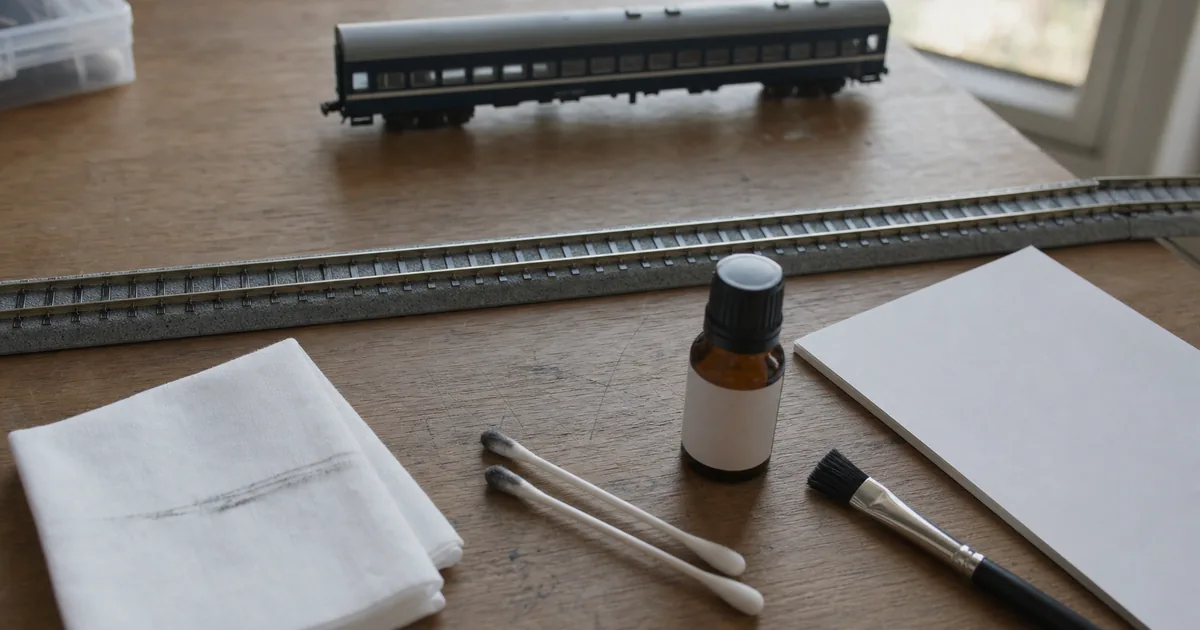
A stuttering N scale train does not automatically mean dirty track. The fault may follow one location, one vehicle, one running direction, a turnout route or the distance from a feeder. Cleaning before you localise it can hide the useful evidence and leave the real electrical or mechanical fault untouched.
Cleaning is only one branch: if the result points beyond contamination, use the N scale troubleshooting guide. A slowdown that grows with distance from the power connection belongs in the feeder and voltage-drop guide, not in a bottle of cleaner.
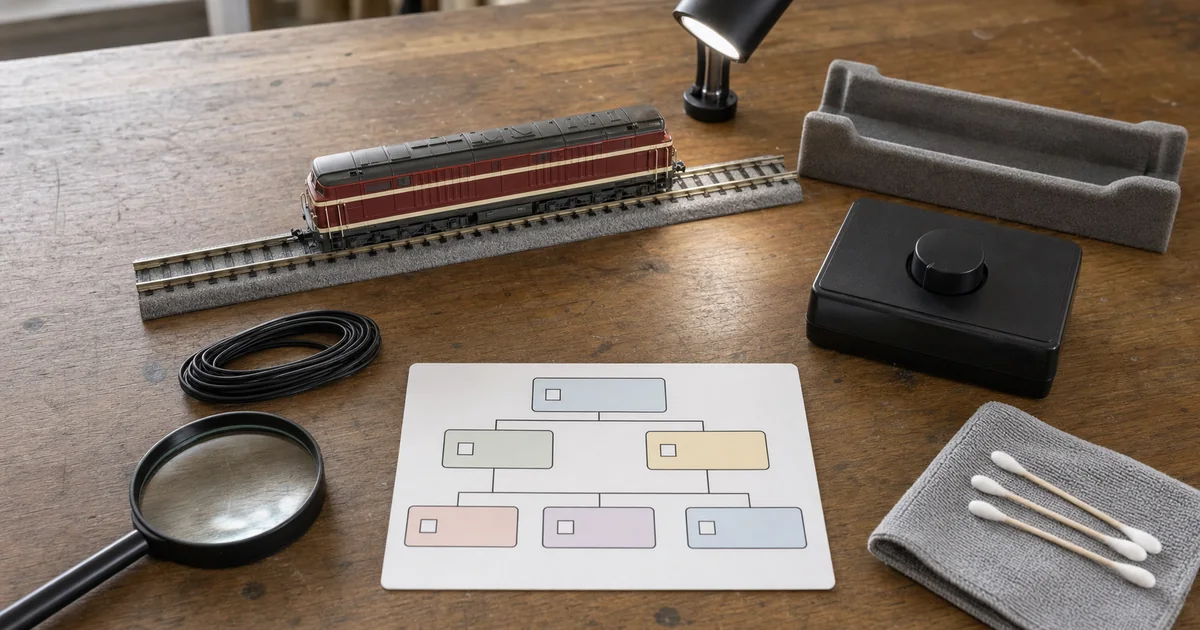
Five-step diagnose-and-clean workflow
The visible steps below match the HowTo structured data. They separate a brief powered diagnostic test from the power-off cleaning work.
1. Power down and screen for danger
Set the controller to zero and disconnect power. If you see heat or smoke, smell burning, encounter repeated breaker trips or notice abnormal sparking, leave the system disconnected and seek qualified service.
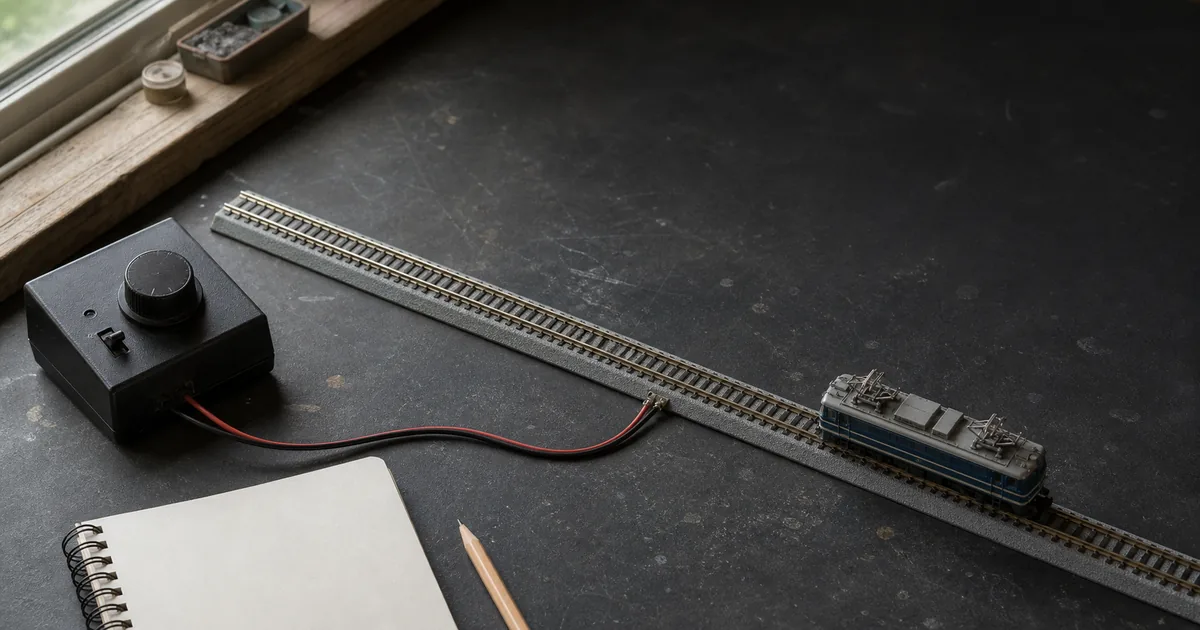
2. Cross-test the location and the vehicle
Only if no stop condition is present, reconnect for a controlled low-speed test. Run a known-good train through the problem section, then run the problem train elsewhere. Treat the result as a priority signal, not final proof, and disconnect power again before cleaning.
3. Clean one confirmed target
Follow the instructions for the exact track or vehicle. For verified rail contamination, put a small amount of the specified cleaner on a soft cloth or swab and wipe only the affected railhead. For a vehicle-side issue, clean the wheels as its instructions describe. Do not flood turnouts or electrical parts, force powered wheels, or change a second variable.
4. Retest under the same conditions
After any label-required drying or waiting time, use the same train, direction and speed. Record whether the symptom improved, stayed the same or moved.
5. Escalate beyond cleaning
If cleaning does not help, inspect joiners, turnout contacts and feeder voltage drop. A worn motor, seized gear, broken part or any electrical stop condition needs repair, not more cleaner or power.
Exclusive tool 1: the 60-second fault-localisation matrix
This is a diagnostic heuristic, not a claim that one pass proves the cause. Test both directions where practical and compare at low speed. A vehicle that fails only on one turnout can expose an interaction between wheelbase, pickup path and geometry.
| Known-good train at suspect location | Suspect train elsewhere | Priority interpretation | First action |
|---|---|---|---|
| Fails | Runs normally | Location first | Inspect railhead, joiners, turnout route and feed at that location |
| Runs normally | Fails | Vehicle first | Inspect wheels, pickups and mechanism on that vehicle |
| Fails | Fails | Unresolved | Use a second known-good vehicle and a second known-good section; there may be two faults |
| Runs normally | Runs normally | Interaction or intermittent | Repeat the original train/location combination in both directions at the same speed |
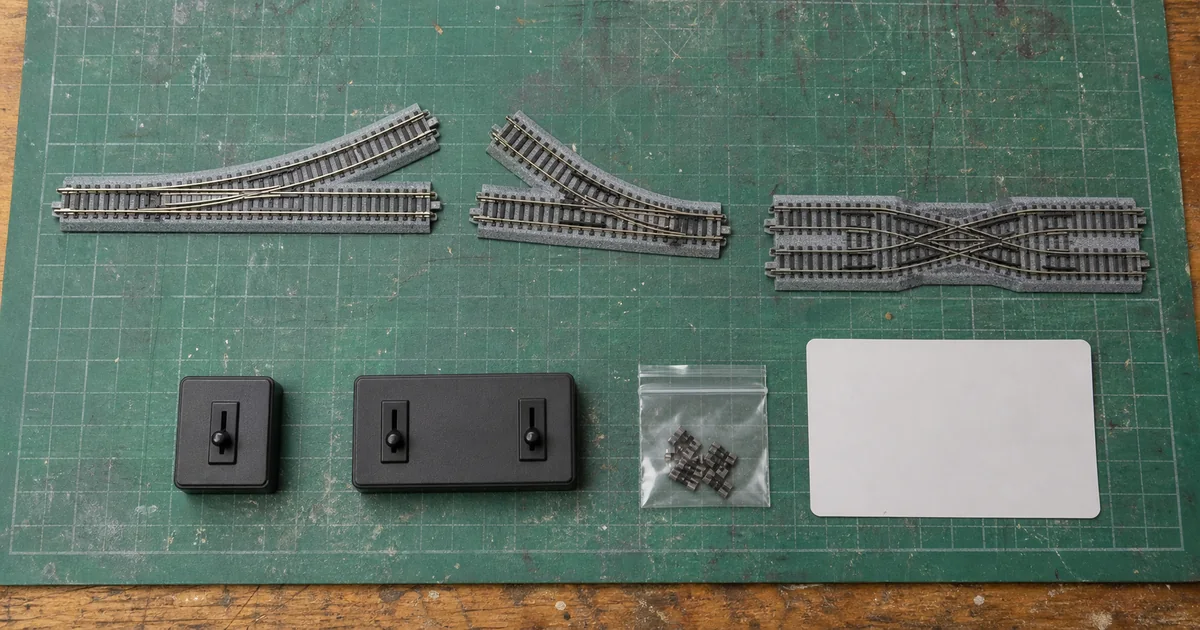
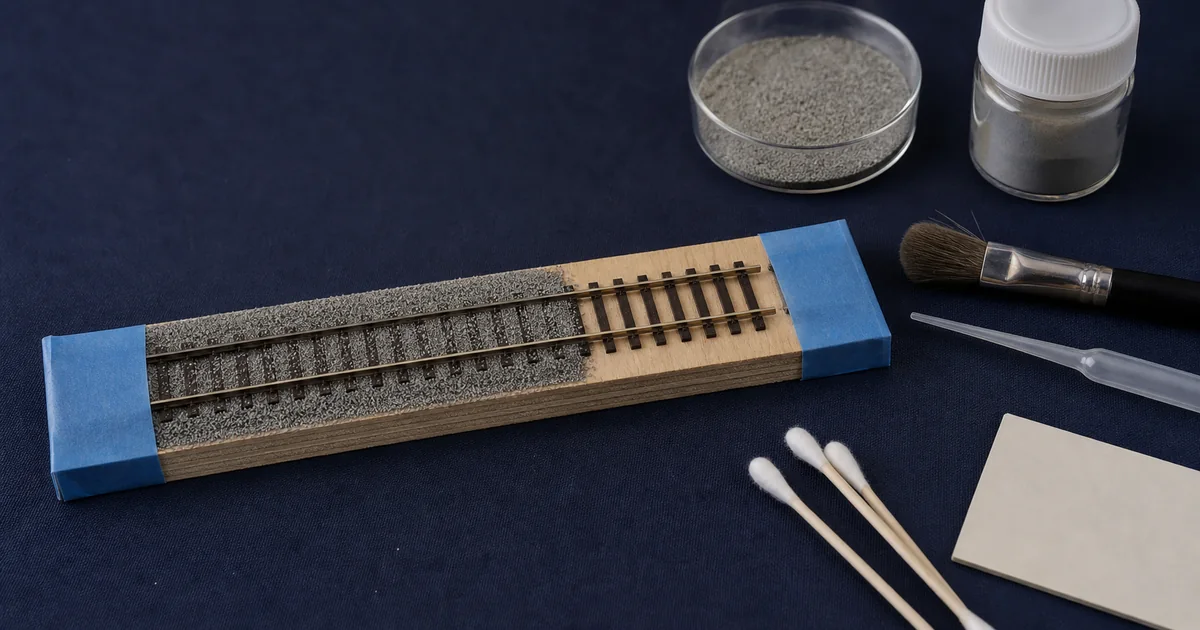
Other patterns redirect the diagnosis. If several trains slow progressively farther from the feeder, compare voltage supply rather than repeatedly cleaning. If only one turnout route fails, check the exact point mechanism, contact path and geometry with the TOMIX Finetrack point guide. If the problem appeared after ballasting or scenery work, disconnect power and look for glue, fibres or loose particles before adding liquid; the ballast guide maps the sensitive turnout areas.
Which cleaning method does the job?
| Method / product | Documented purpose | Power state | Important boundary |
|---|---|---|---|
| KATO 24-023 Uni Cleaner | Small amount on cloth, swab or brush for rail, wheel and gear-part cleaning | Off for manual work | KATO's material statement belongs to this product; do not extend it to every solvent, print, paint or adhesive |
| KATO 24-021 Uni Clean Oil | Very small amount for documented rotating or sliding lubrication after dust is removed | Off while applying | It is oil, not rail cleaner, and does not belong on railheads, wheel treads or pickups |
| TOMIX 6403 Rail Cleaner | Small amount on cloth or swab for rail and wheel contamination; also used as specified by cleaning accessories | Off for manual work | TOMIX says not to use Rail Cleaner on the body or floor plate |
| TOMIX 6415 Wheel Cleaning Rail | The vehicle runs over motor-driven vibrating wet or dry cleaning heads | Powered as instructed | The cleaning head does not propel the vehicle or turn stationary wheels |
| TOMIX 6425 / 6426 Cleaning Cars | Suction fan plus interchangeable wet or dry cleaning discs while hauled | Powered as instructed | Not self-propelled; a powered vehicle, such as a locomotive, must haul the car while its cleaning mechanism works |
How to clean N scale track without mixing brand rules
KATO explains that tiny sparks at the wheel–rail interface form carbon residue that accumulates on rails and wheels. Its Unitrack maintenance page also says Uni Cleaner removes dirt and oxidation from metal surfaces. Color therefore cannot tell you that every black mark is rust or that every mark is carbon. The practical goal is a clean electrical contact surface.
KATO: use cleaner, not paper sanding
KATO says to apply a small amount of 24-023 to a cloth, cotton swab or brush and wipe the target. Its Unitrack maintenance page explicitly rejects paper sanding of conductive rail surfaces: scratches can collect contamination, promote sparking and reduce conductivity; repeated abrasion removes metal and creates filings that may cause faults. That is a KATO boundary, not a universal quotation from every brand.
TOMIX: 6403 first; fine abrasive only within its own fallback
TOMIX's basic method is 6403 on a small folded cloth or swab. Its current FAQ says to try 6403 first and, only if running still does not improve, use a fine abrasive followed by Rail Cleaner. That narrow TOMIX fallback does not cancel KATO's prohibition, and it does not authorize any grit, block or abrasive on a different rail system. Follow the documentation for the exact track in front of you.
The cited KATO and TOMIX procedures specify their own cleaners and do not authorize IPA or WD-40 as universal substitutes. This does not prove every formulation is always harmful; it means there is no reliable cross-product concentration or compatibility rule for every paint, plastic, rubber part, adhesive or electrical assembly.
How to clean N scale wheels and pickups
Free-rolling coach wheels can be rotated gently while the tread is wiped with the specified fluid. Powered wheels are different: TOMIX says they do not rotate by hand like trailing wheels and illustrates removing the motor bogie, then moving it over cloth-covered rail. Because disassembly differs by model, the exact vehicle instruction takes priority; do not invent a release method or force the drivetrain.
TOMIX 6415 is an alternative designed for powered operation. The vehicle runs over a motor-driven vibrating cleaning head, with dry and wet heads available; use a small amount of Rail Cleaner on the wet head only as the product instructions direct. The head does not sit under a stationary locomotive and spin its wheels.
If wheel cleaning does not change the symptom, inspect the pickup path and gears. Dirt or a displaced contact may interrupt current; trapped debris may bind a drive. Do not call either cause “common” without fleet data. Compare what actually changed, and stop before an unfamiliar dismantling step.
TOMIX cleaning cars: hauled, powered maintenance tools
TOMIX 6425 and 6426 use the same stated cleaning functions in different liveries: a fan can vacuum dust and fine debris, and replaceable discs provide wet or dry cleaning. They are not self-propelled, so a powered vehicle, such as a locomotive, must haul them. However, “not self-propelled” does not mean the car has no motor or powered mechanism—the fan or disc still performs work and the product offers power-mode choices.
Use a cleaning car for the job its manual describes, not as proof that every stall is dirt. A route that repeatedly fails at one turnout or far from a feeder still needs electrical and geometric diagnosis. A cleaning car also cannot remove a glued ballast stone from a flange path; inspect track after scenery work before running powered equipment.
Why full-size railways grind rails while KATO says not to sand model track
Short answer: full-size rail grinding is measured profile maintenance, not a precedent for hand-sanding model track. RTRI uses rail-irregularity, traffic-tonnage, axle-box-acceleration and profile data to plan where, when and how many grinding passes are needed. KATO addresses a different system: uncontrolled sanding of a tiny conductive model railhead can leave scratches, promote sparking, remove material and create conductive debris.
Where oil belongs—and where it does not
KATO's abnormal-noise procedure starts by removing dust trapped in the gear. Only then does it call for an extremely small film of 24-021 at the noisy gear; the older product page gives one drop as an example. KATO also warns that excess oil attracts dust and may impair pickup. That example is not a schedule for every mechanism.
TOMIX's general FAQ does not recommend routine owner oiling because oil may collect dust and cause poor electrical pickup. This is not permission to ignore a model-specific manual, nor is KATO's oil rule transferable to TOMIX. When the cause is unclear or the noise remains, stop and use the maker's repair route.
Exclusive tool 2: cleaning escalation and STOP matrix
| Symptom | Least-invasive verified action | Identical retest | Next non-cleaning check | STOP / repair gate |
|---|---|---|---|---|
| Several trains fail at one location | Diagnostic wipe, then maker's full rail routine if confirmed | Same known-good train, direction and speed | Joiner, turnout path, feeder and local voltage | Heat, smoke, repeated trip or damaged conductor |
| One train fails in several places | Clean documented wheel surfaces | Same train, route, direction and speed | Pickup path, trapped gear debris, mechanism | Seized gear, worn motor, broken part or unknown disassembly |
| Only lights flicker | Clean documented wheel/contact surfaces | Same car orientation and route | Bogie and lighting contact path | Heat, damaged wire or repeated short |
| Only one turnout/direction fails | Remove loose debris with power off | Each route and direction at the same speed | Point contact, geometry, wheelbase and pickup interaction | Stuck mechanism, damaged blade or abnormal current |
| Slowdown grows with distance | Do not add cleaner without contamination evidence | Compare near and far points | Feeder spacing, joins and voltage drop | Overheating connection or damaged supply equipment |
A result is released only when the symptom improves under the same conditions and no new fault appears. If it moves, changes direction or returns immediately, update the diagnosis rather than applying more liquid.
How often should track be cleaned?
There is no cross-brand calendar interval. KATO recommends Uni Cleaner maintenance before and after running sessions. TOMIX gives cleaning procedures but not one schedule that fits every room, storage pattern or construction phase. Inspect after dusty scenery work, when stock has been stored, and when repeatable symptoms appear. A cover may reduce settled dust, but it does not replace inspection.
Keep the maintenance record short: date; exact vehicle and product number; symptom and location; comparison train; product and quantity description; variables changed; retest train, direction and speed; result; recurrence. The record prevents “more cleaner” from becoming the default and gives a repairer a reproducible fault.
Official and first-party sources
Checked 2026-08-10. Product pages support the named purposes and brand-specific boundaries; the exact manual for your item remains controlling. JR Central's 2016 and JR West's 2020 releases are historical first-party examples, not claims about every railway's 2026 fleet or practice.
- KATO 24-023 Uni Cleaner — carbon residue, rail/wheel/part cleaning, application and product-specific material statement.
- KATO Unitrack maintenance supplies — oxidation removal and KATO's paper-sanding warning.
- KATO abnormal-noise FAQ — remove gear debris first, minimal oil film, excess-oil and service boundaries.
- KATO 24-021 Uni Clean Oil — intended lubrication points and very-small-quantity example.
- TOMIX rail and vehicle maintenance — cloth/swab cleaning and powered-wheel handling.
- TOMYTEC/TOMIX FAQ — full-line maintenance, fine-abrasive fallback, oiling and repair boundaries.
- TOMIX 6403 Rail Cleaner — rail/wheel cleaning purpose and accessory use.
- TOMIX 6415 Wheel Cleaning Rail — powered vibrating wet/dry heads and vehicle operation.
- TOMIX 6425 Cleaning Car — non-self-propelled vehicle, fan/disc functions and power modes.
- TOMIX 6426 Cleaning Car — current livery variant with the same stated cleaning functions.
- TOMYTEC repair service — service route for faults beyond user maintenance.
- RTRI rail-irregularity management — measured corrugation and post-grinding evaluation.
- RTRI ROOPSYS-TM — data-led planning of grinding locations, timing and pass patterns.
- JR Central 2016 rail-grinding release — controlled removal per pass and night-work context at the time.
- JR West 2020 rail-maintenance release — grinding/milling methods, rail life, work and noise goals at the time.
Cleaning did not solve it?
N scale track and wheel cleaning FAQ
What is the safest way to clean N scale track?
Set the controller to zero and disconnect power before manual cleaning. Apply a small amount of the cleaner specified for the track system—such as KATO 24-023 or TOMIX 6403—to a soft cloth or cotton swab and wipe the railhead. Reconnect power only for the controlled retest or for a powered cleaning accessory used exactly as its instructions require.
How do I tell dirty track from dirty wheels?
Cross-test rather than treating the first result as proof. If several known-good trains fail at the same location, inspect that location's railhead, joiners, turnout and feed first; if one train fails in several locations while another train runs normally, inspect that vehicle's wheels, pickups and mechanism first. A one-train, one-location failure can be an interaction between the vehicle and the track, so test both directions before concluding.
Is the black deposit on the rail rust?
Color alone cannot identify it. KATO says tiny wheel-to-rail sparks create carbon residue that accumulates on rails and wheels, while its maintenance page also says Uni Cleaner removes dirt and oxidation from metal surfaces. Treat the goal as restoring a clean electrical contact surface, not assigning all black material to one chemistry.
Can I use sandpaper on N scale track?
There is no cross-brand answer. KATO explicitly tells users not to sand its conductive rail surfaces because scratches, sparking, metal loss and filings can make performance worse. TOMIX's current FAQ says to try 6403 first and, only if running still does not improve, use a fine abrasive and then Rail Cleaner; follow the rule for the exact track system in front of you.
Can I use IPA or WD-40 instead of model railway track cleaner?
The KATO and TOMIX procedures cited here specify their own cleaners and do not authorize IPA or WD-40 as universal substitutes. That does not prove every formulation is always harmful, but it provides no reliable concentration or material-compatibility rule for every paint, plastic, rubber part or adhesive. Use a substitute only when the exact manufacturer documentation permits it.
How often should N scale track be cleaned?
KATO recommends Uni Cleaner maintenance before and after operating sessions. TOMIX instructs users to clean the rails when removing track contamination but does not publish one calendar interval that fits every layout. Inspect according to dust, construction work, storage conditions and symptoms, and do not turn routine cleaning into routine sanding or dismantling.
Must the power always be off while cleaning?
Power should be off for manual wiping, debris removal, accessory setup and vehicle dismantling. Powered cleaning equipment is the deliberate exception: TOMIX 6415 powers a vibrating head while the vehicle runs over it, and 6425 or 6426 performs cleaning work while a powered vehicle hauls it. Operate those products only as their own instructions specify.
Can I turn powered locomotive wheels by hand to clean them?
Do not force powered wheels as though they were free-rolling coach wheels. TOMIX's general maintenance page says powered wheels do not rotate by hand and shows the motor bogie being removed and moved over cloth-covered track; the exact vehicle instruction remains the authority for dismantling. TOMIX 6415 offers a powered alternative in which the vehicle runs over vibrating cleaning heads.
Are TOMIX 6425 and 6426 self-propelled?
No. Both must be coupled to and hauled by a powered vehicle, such as a locomotive. Their cleaning functions include a suction fan and interchangeable wet or dry discs, so “not self-propelled” does not mean “no powered cleaning mechanism.”
When should I oil a model locomotive?
Do not make oiling a universal calendar task. KATO says to remove dust from a noisy drive gear first, then use only a very small amount of 24-021—its product page gives one drop as the example—and warns that excess oil attracts dust and can impair pickup. TOMIX's general FAQ does not recommend owner oiling because it may attract dust and cause poor electrical collection.
Can rail cleaner be used on the locomotive body?
Product boundaries differ. KATO says 24-023 does not harm plastic, rubber or metal, but that does not guarantee every painted, printed or glued surface; TOMIX says its vehicle bodies and floor plates should be wiped with a soft dry cloth and not cleaned with Rail Cleaner. Follow the exact cleaner label and vehicle instruction.
What should I check if cleaning does not fix the stutter?
Stop repeating the same cleaning step with more liquid. Retest with the same train, direction and speed, then inspect joiners, turnout contacts and feeder performance if the location is common, or wheels, pickups and gears if the vehicle is common. TOMIX specifically notes that dust may be trapped in the drive gears and that motor deterioration is possible when maintenance no longer restores normal running; unresolved faults belong in repair, not more cleaning.