“KATO or TOMIX?” sounds like a product-ranking question. For a layout builder, it is really a system-boundary decision: which sectional-track geometry, feeder interface, turnout control and power chain should become the backbone of the layout? The train brand is often more portable than those infrastructure choices, but even rolling stock has documented exceptions.
What this comparison answers—and what it does not
This page compares KATO UNITRACK and TOMIX FineTrack as Japanese N-gauge layout backbones. It does not rank every KATO train against every TOMIX train, declare one maker more accurate, or promise that a familiar-looking plug, coupler or accessory crosses between systems. Vehicle-by-vehicle accuracy belongs in a review of that exact release; system choice belongs here.
System question
Which geometry, turnout control, feeder and documented digital or lighting path solves the layout you actually intend to operate?
Product question
Does this exact train, coupler, lighting board, decoder or adapter work at this exact boundary? A brand answer cannot replace a part-number answer.
If you are still choosing your first powered loop, begin with the Japanese N scale exact-SKU checklist. If your question is only how to join the two roadbeds, go directly to the KATO–TOMIX track adapter guide.
Exclusive tool 1: the five-gate backbone scorecard
Evaluate hard stops before preferences. A pretty roadbed, familiar controller handle or discount starter box cannot compensate for a missing turnout, an unsupported digital path or a train that fails the curve.
| Gate | PASS evidence | HOLD or FAIL | Decision use |
|---|---|---|---|
| 1. Existing system | Track, feeders, turnout controls and power equipment are identified, working and reusable. | Condition, connector family or exact product is unknown. | Switching is justified only if a later gate reveals a real unmet requirement—not because another brand has a desired train. |
| 2. Geometry | The same operating plan closes with named current parts, required track spacing and accessible turnouts. | A drawing substitutes “similar” lengths, ignores approach pieces or depends on an unavailable geometry. | Build the layout twice in the track planner; compare like with like. |
| 3. Train fit | Exact vehicles pass maker radius guidance, clearances, turnouts and any magnetic-equipment check. | Fit is inferred from N gauge, car length or another production run. | The longest, widest and operationally most demanding train controls the gate. |
| 4. Electrical and control | Feeder, controller, specified supply, turnout controls, lighting and any DCC path are documented. | A plug happens to fit, a voltage is guessed or an unsupported conversion is assumed reversible. | Use one maker-matched power chain unless exact instructions establish a boundary. |
| 5. Service boundary | Current replacement parts, local or realistic ordering route, return terms and maintenance access are known. | A critical part is available only in a photo, an old list or an unverified bundle. | Check availability on the day of purchase; do not turn today's stock into a timeless brand claim. |
Use PASS, HOLD and FAIL. Preference scores begin only after every hard requirement passes. If both plans pass, then roadbed appearance, control feel and local support can break the tie honestly.
248/33 versus 140/37: compare planning grids, not one number
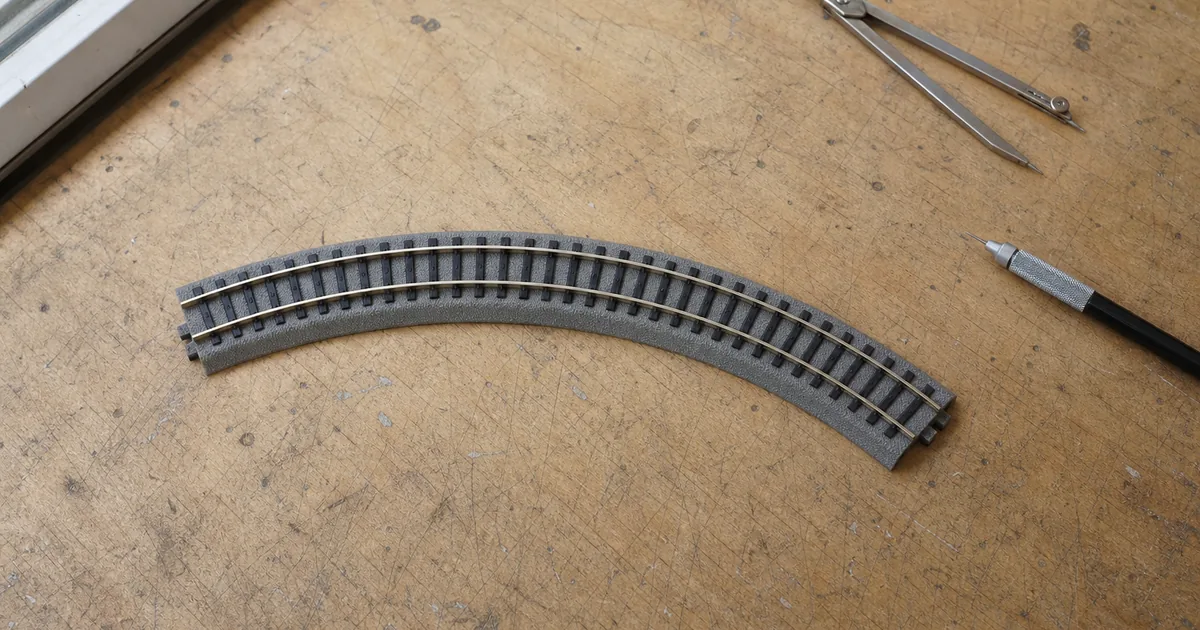
KATO's current UNITRACK guide uses a 248 mm basic straight and a 33 mm double-track spacing. TOMIX defines a 140 mm basic straight, an 18.5 mm basic roadbed width, a 37 mm double-track spacing and a 55.5 mm island-platform spacing; its basic C280 curve derives from twice the 140 mm module. These are internally coherent but different planning languages.
| Published reference | KATO UNITRACK | TOMIX FineTrack | What it actually changes |
|---|---|---|---|
| Basic straight | 248 mm | 140 mm | How plans close, where fractional pieces appear and how station lengths are assembled. |
| Standard double-track spacing | 33 mm | 37 mm | Station throats, parallel curves, platforms and total multi-track width. The difference accumulates across several tracks. |
| Basic roadbed width | Use the exact official drawing; this guide does not infer one universal width. | 18.5 mm for the basic rail stated by TOMIX. | Whether an adapter condition, platform edge or scenery boundary physically fits. |
| Curve choice | Both catalogs include multiple radii and special systems; no single “standard” radius clears every vehicle. | The exact train's maker guidance controls, not brand folklore. | |
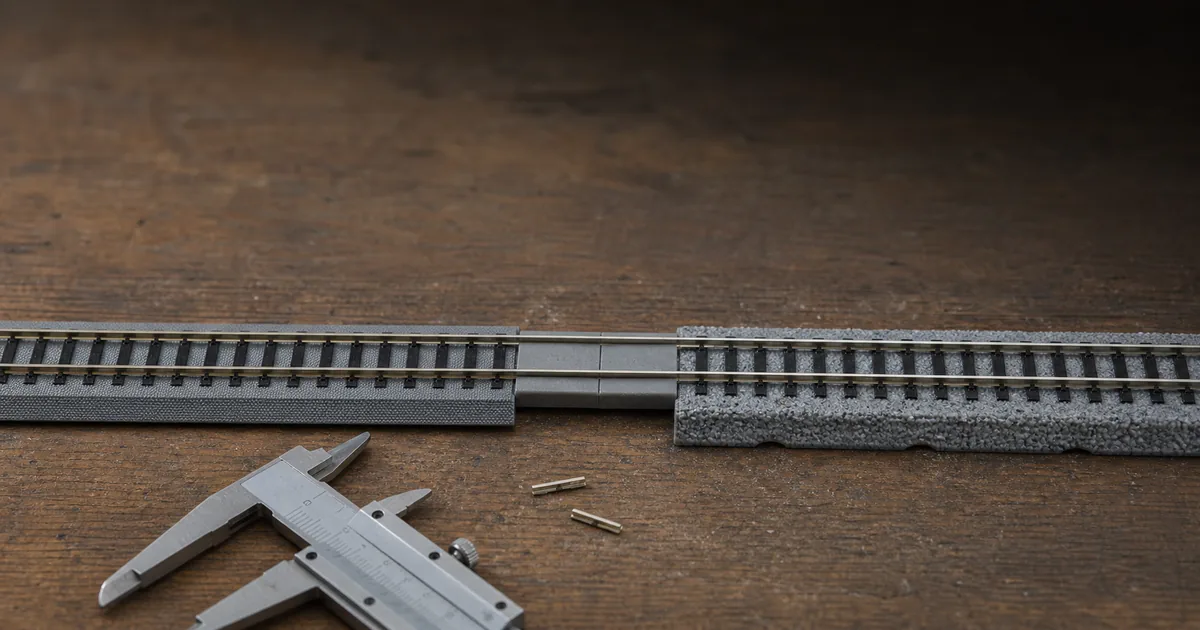
An adapter changes the joint, not the grid. A pair of parallel 33 mm UNITRACK centre lines does not continue as 37 mm FineTrack centres without a deliberate 4 mm total spacing transition—or 2 mm to each side if the change is kept symmetrical. That arithmetic is a ROKHELM planning inference from the two official dimensions, not an adapter specification. Dry-fit a straight transition and pass the longest vehicle before fixing it.
The 4 mm difference does not prove which complete layout is smaller. A compact branch, long station, multi-track yard and high-speed double track ask different questions. Put the exact train and operation into both plans, then measure the completed footprint with access and vehicle overhang. The radius and baseboard guide covers that fit test.
Official adapters bridge a joint—not the two geometry systems
The native UNITRACK and FineTrack roadbed joints are different. Both manufacturers document boundary parts, but the part names matter:
| Part | Official role | Do not confuse it with | ROKHELM boundary check |
|---|---|---|---|
| KATO 20-045 | 62 mm Joint Track; KATO says it can connect to flexible or other-brand track when the other roadbed is no wider than 19 mm. | KATO 24-818. | Verify roadbed width, railhead alignment and the exact joint instructions. |
| KATO 24-818 | Terminal UniJoiner that replaces a UniJoiner to add a feeder where a feeder track will not fit. | A KATO-to-TOMIX mechanical adapter. | Document it as a feed point, not a track-system transition. |
| TOMIX 1529 | S35-J joint rail with wood-tie appearance; TOMIX says joiner exchange permits connection to other-brand track. | A universal guarantee for every roadbed height or geometry. | Follow the included joiner/tool instructions and inspect the finished rail joint. |
| TOMIX 1530 | S35-J-PC joint rail with PC-tie appearance and the same documented other-brand connection purpose. | A different electrical standard from 1529. | Choose appearance only after the mechanical boundary is proven. |
Cross-brand trains: a useful starting point with real exceptions
KATO's power-pack FAQ says other makers' vehicles can run, while TOMIX says other makers' N-gauge vehicles can generally run on FineTrack and notes exceptions. That is strong evidence that track brand does not automatically restrict train brand. It is not proof for every vehicle, curve, turnout or magnetic accessory.
The exception most comparison pages miss is magnetism. KATO warns that a slotless motor's magnetic field may affect another maker's magnetic turnout or uncoupler track. KATO separately documents demagnetizing plates and magnet-boosting sheets as possible countermeasures for relevant combinations. That makes the correct decision sequence:
- Identify the exact powered vehicle and whether it uses the relevant slotless motor.
- Identify whether the suspect turnout or uncoupler uses magnetic holding or actuation.
- Read the current countermeasure and fit guidance for the exact parts.
- Test that train slowly through the actual location in both directions before hiding or duplicating the boundary.
Also check exact minimum radius, body and equipment clearance, turnout behavior and permitted voltage. “Both are N gauge” answers the nominal rail spacing; it does not answer the operating envelope.
Exclusive tool 2: the cross-brand boundary risk matrix
This matrix separates a likely operating starting point from a verified system. It also shows which unknown should stop the purchase.
| Boundary | Initial status | Evidence needed | STOP or HOLD condition |
|---|---|---|---|
| Other-brand analogue N vehicle on track | HOLD until exact checks | Maker voltage, radius, clearance, turnout and powered-vehicle details. | Exact model is excluded, binds, shorts or has unresolved magnetic interaction. |
| KATO slotless motor over another maker's magnetic track equipment | HOLD | KATO warning/countermeasure plus a controlled test of the actual combination. | Turnout or uncoupler changes state, vehicle attraction occurs or the relevant countermeasure is unknown. |
| Native UNITRACK-to-FineTrack joint | FAIL without adapter | 20-045 or 1529/1530 instructions, fit, alignment and continuity. | Forced native joiner, vertical step, loose rail or hidden untested transition. |
| Feeder, controller, turnout or accessory interface | FAIL by appearance alone | Exact maker wiring diagram, output, connector and specified power supply. | Forced plug, improvised supply, unverified splice or voltage outside the vehicle/system limit. |
| Coupler between brands | HOLD per car end | Head family, mount, exact part and dynamic curve/turnout test. | TOMIX TN to another brand is claimed compatible despite TOMIX's stated boundary. |
| Interior lighting | HOLD per vehicle | Exact car instruction, lighting part, pickup and controller behavior. | Track brand or voltage alone is used as the compatibility claim. |
| DCC conversion | HOLD per model | Official ready/friendly status, decoder, motor isolation, current, space and installation instructions. | No documented path, or an unsupported modification is treated as warranty-safe and reversible. |
Power, stopped lights and DCC are three separate decisions
Analogue running power
An appropriate DC vehicle may be operable from either maker's documented N system, but that does not make the complete power chains interchangeable. KATO says power pack and track should basically be from the same maker; feeders and turnout controls are system equipment. TOMIX warns that a supply capable of exceeding its defined DC 12 V can damage a motor or circuit board and create heat or fire risk.
KATO Standard SX is a PWM controller whose track output depends on the specified adapter: KATO publishes 0–12 V with N-scale adapter 22-082 and 0–16 V with HO adapter 22-083. Use the N-scale adapter for N scale. KATO warns that maximum output with the HO adapter may damage vehicle products, including other brands. Never choose a supply because the plug fits. For larger layouts, plan feed points with the feeder and voltage-drop guide.
Lights while stopped
KATO says Standard SX can illuminate some vehicles while stopped, depending on the vehicle. TOMIX says stopped constant lighting requires both a constant-light-compatible vehicle and a power unit with that function. Therefore “KATO has it” or “TOMIX has CL” is not a buying answer. Record the exact controller, exact car and exact lighting part, then test that documented combination. The interior-light compatibility guide keeps those parts separate.
DCC support
KATO offers an official DCC path for vehicles marked DCC Friendly: the corresponding friendly decoder can be installed without soldering. KATO says a non-Friendly vehicle requires decoder wiring and soldering, and decoder choice still depends on scale and controlled functions. TOMIX's current FAQ states that its products do not support DCC.
Couplers and vehicle accessories do not follow the track logo
TOMIX calls its Arnold type a world-common form but also says cross-brand vehicle coupling is generally unsupported except for some freight cars; it explicitly says TN couplers have no coupling interchangeability with other brands. KATO lists multiple coupler families and vehicle-specific replacement routes. A familiar shape is not enough.
For each car end, record factory head, mounting interface, intended mate and exact candidate part. Then test straight pull and propel, actual minimum curve, turnouts and S-curves. The four-gate Japanese N coupler guide provides that worksheet. Apply the same exact-vehicle discipline to interior lights, current-conducting couplers and replacement bogies.
Compare one complete layout, not two starter-box prices
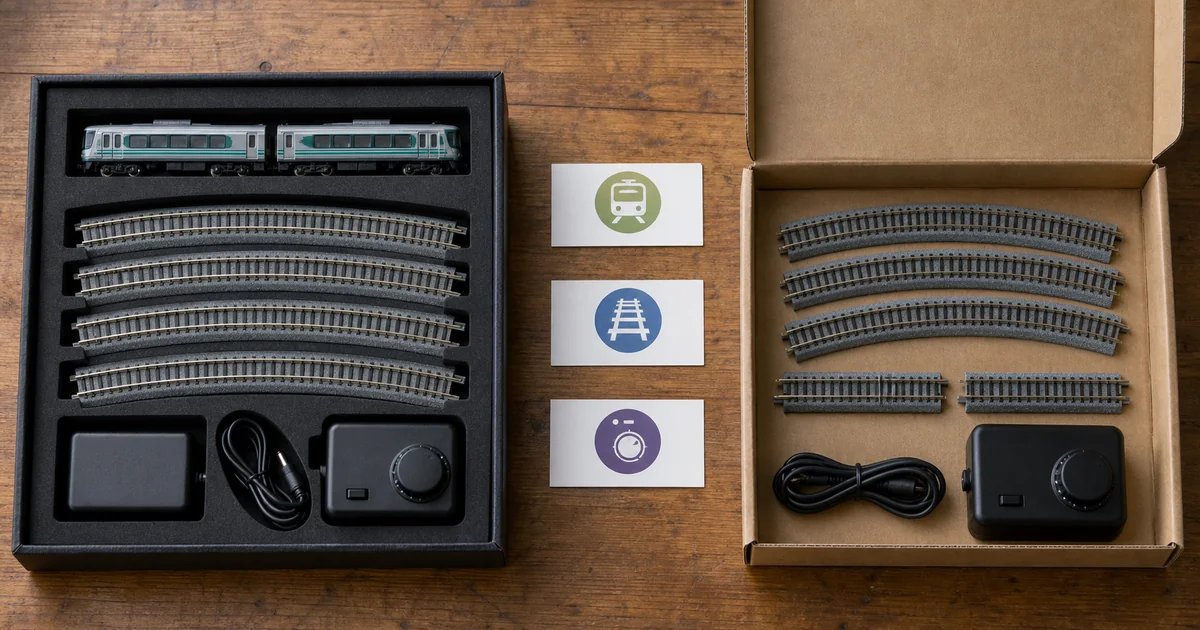
Starter sets seldom contain equivalent geometry or the same train, so a box-price contest answers the wrong question. Draw one operating plan and make a complete list for each system on the same day.
| BOM row | Record exactly | Common hidden gap |
|---|---|---|
| Track geometry | Every straight, curve, turnout, crossing, approach and official adapter by current part number. | Turnout companion pieces or fractional track needed to close the same plan. |
| Control chain | Controller, specified AC adapter, feeder, turnout switches and extensions. | Power supply or one turnout switch omitted from the headline box contents. |
| Vehicle requirements | Exact train, radius evidence, coupler, lighting and documented decoder path. | An accessory part is assumed to fit an entire brand rather than one release. |
| Boundary and upkeep | Official adapter, spare joiners, cleaning access and system-specific spares. | A hidden transition or two unlabelled feeder ecosystems. |
| Landed purchase | Seller, date, currency, delivery, tax/import charge and return route as separate rows. | An undated universal price or a train-only box compared with a complete starter system. |
Do not publish one result as “KATO is cheaper” or “TOMIX is cheaper.” Stock, bundles and location change. The durable conclusion is the method: equivalent job, exact products, same-day totals and explicit missing parts. The starter-set contents guide helps classify boxes before they enter this BOM.
Exclusive tool 3: the system-boundary passport
A mixed layout is not finished when a train crosses the joint once. Give every cross-brand boundary one record and reopen it whenever the accepted configuration changes. This prevents a replacement controller, newly added vehicle or moved adapter from silently invalidating an old result.
| Passport field | Record at acceptance | Reopen trigger | Release evidence |
|---|---|---|---|
| Physical joint | Adapter part number, native joiner removed or retained as instructed, railhead alignment, support and accessible location. | Adapter, joiner, underlay, track height or nearby scenery changes. | Hand-roll the demanding vehicle, then make slow powered runs both ways with no wheel climb, rocking or loose joint. |
| Geometry | Approach pieces, curve and turnout sequence, centre-line transition, platform/structure clearance and board-edge margin. | A parallel road moves, an S-curve or turnout is added, or the longest/widest vehicle changes. | The actual consist clears the complete route hauled and propelled where that is an intended move. |
| Power and control | Controller, specified supply, feeder side, polarity convention, isolation and turnout-control family. | Controller, AC adapter, feeder, wiring, sectioning, DC/DCC mode or lighting load changes. | Correct direction and control are repeatable; no protection trip, heat, odor, arcing or unexplained voltage boundary appears. |
| Vehicle exception | Exact powered vehicle, minimum-radius source, slotless-motor status, coupler and fitted lighting/decoder parts. | A different motor revision, magnetic turnout/uncoupler, coupler, lighting board or decoder enters the route. | Every exception passes its own maker evidence and controlled route test; unknown remains HOLD. |
| Service state | Acceptance date, source URLs, spare joiners/adapters, cleaning access and the name or label used on the wiring plan. | A source disappears, a product is revised/discontinued, maintenance access is hidden or a fault recurs. | The record still identifies a current replacement or a documented contingency without dismantling scenery to diagnose the joint. |
Six steps to choose the backbone
1. Inventory the system you already own
List track, feeders, turnout controls, power equipment and reusable rolling stock by exact product number. Existing equipment creates switching cost, but it does not settle a missing-geometry or safety requirement.
2. Fix the operating job and board limits
Record the longest train, exact minimum-radius evidence, station and turnout work, lighting or DCC needs, and the measured board. A brand preference cannot rescue a train that does not fit.
3. Draw the identical target layout twice
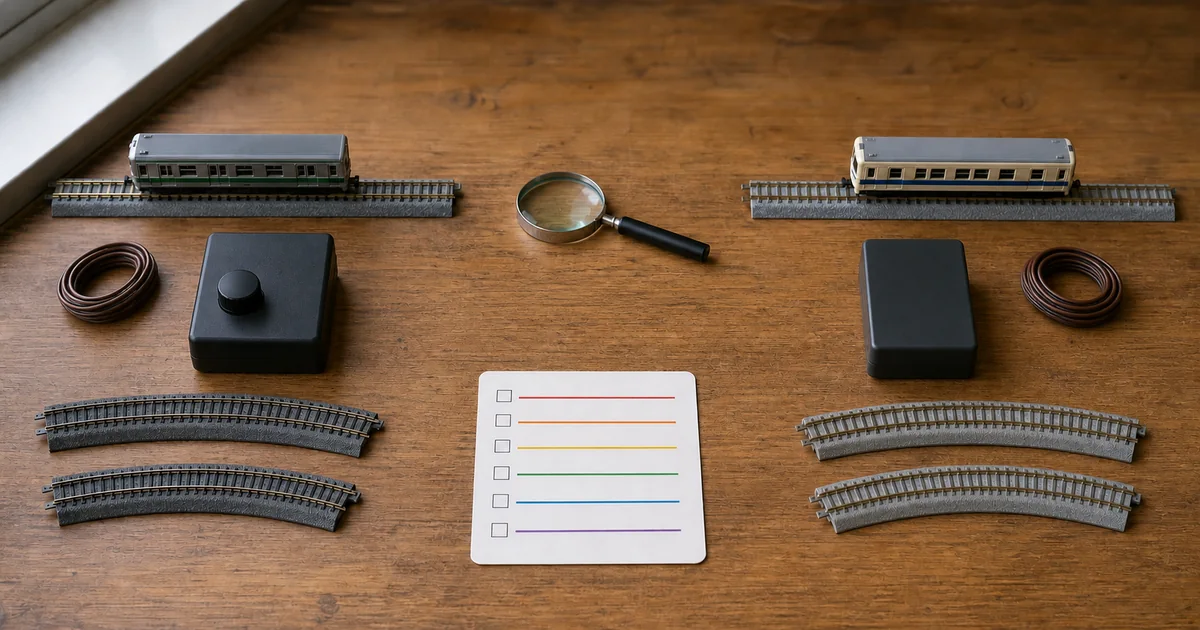
Build one UNITRACK plan and one FineTrack plan for the same operating job. Compare actual geometry, track spacing, turnout locations and access instead of comparing unrelated starter ovals.
4. Build two complete exact-SKU lists
Include every rail, turnout switch, feeder, controller, specified power supply, official adapter, spare and required vehicle accessory. Record source, date, currency, delivery and return terms separately.
5. Pass every cross-brand boundary
Check vehicle radius and clearance, slotless-motor magnet risk, track adapters, feeder and turnout interfaces, couplers, lighting and DCC against current manufacturer evidence. Unknown is HOLD, not compatible.
6. Choose one backbone and test one boundary
Choose the system that passes every hard requirement with the simpler complete plan. If both systems are necessary, place one accessible official adapter boundary and test the longest train slowly in both directions before expanding.
A practical decision table
| Your real constraint | Decision rule | Evidence to keep |
|---|---|---|
| You already own a reliable system | Keep it unless the target plan fails a hard geometry, electrical or support gate. | Inventory, working baseline and cost of only the missing parts. |
| A particular train is the priority | Choose track only after the exact model passes radius, turnout, voltage and magnetic checks. | Product page, instruction sheet and controlled test record. |
| A station or yard is the priority | Draw the complete throat, platform spacing and turnout controls in both systems. | Plan file and exact parts list; one straight or spacing number is insufficient. |
| DCC is a hard requirement | Favor exact vehicles with a documented decoder route; do not turn a brand reputation into readiness. | Ready/Friendly marking, decoder instructions and installation boundary. |
| You genuinely need both track catalogs | Use one accessible official transition and keep control/feeder documentation explicit. | Adapter instructions, labelled wiring and slow-speed bidirectional test. |
| Both plans pass | Use handling preference, appearance and current local replacement access as tie-breakers. | Same-day availability and return evidence, not timeless claims. |
Why the two track numbers tell a modelling-culture story
Railway-culture answer: the familiar 248/33 and 140/37 figures are not arbitrary catalog numbers. KATO's current UNITRACK guide defines a 248 mm straight module and 33 mm double-track spacing. TOMIX defines a 140 mm basic straight—about one car long—and derives 37 mm double-track and 55.5 mm island-platform spacing from an 18.5 mm roadbed width. Each is a coherent planning grid, but they are different grids: an adapter can bridge one rail joint, not make parallel geometry interchangeable.
Official and first-party sources
Checked 2026-08-25. Product catalogs, compatibility statements and support policies can change. Each source controls only the system or product it names; the ROKHELM scorecard, boundary matrix, system-boundary passport and one-accessible-transition rule are editorial tools.
- KATO UNITRACK — current system design, 248 mm module and 33 mm spacing
- TOMIX FineTrack — 140 mm, 18.5 mm and 37 mm planning dimensions
- TOMIX 91030 — official 55.5 mm island-platform track spacing
- KATO FAQ — 20-045 Joint Track and the 19 mm roadbed-width condition
- TOMIX 1529 — S35-J wood-tie joint rail
- TOMIX 1530 — S35-J-PC joint rail
- KATO FAQ — power pack, track-system and other-maker vehicle boundaries
- TOMIX official FAQ — cross-brand running, couplers, lighting, 12 V and DCC support
- KATO FAQ — slotless-motor characteristics and magnetic-equipment warning
- KATO FAQ — demagnetizing plate and magnet-boosting sheet
- KATO FAQ — DCC and DCC Friendly route
- KATO FAQ — DCC Friendly vehicle and decoder boundary
- KATO FAQ — non-Friendly vehicle conversion requirements
- KATO Standard SX — PWM, output and stopped-light boundary
- KATO USA UNITRACK Catalog — Standard SX 0–12 V and 0–16 V transformer-dependent track output
- KATO UNITRACK control equipment — adapters, feeders and 24-818 role
- KATO AC adapters — N/HO output boundaries and vehicle-damage warning
- KATO Brand History — UNITRACK's 1980s room-and-floor design context
- TOMIX 40th History — FineTrack in the 2002 product chronology
Draw the same layout in both systems
Frequently asked questions
Is KATO or TOMIX better for a beginner?
Neither brand is a universal winner. If you already own a working track, feeder and control system, keeping that backbone usually avoids switching work unless it cannot deliver a required geometry or control function. Starting from zero, draw the same intended layout in UNITRACK and FineTrack, build complete exact-SKU lists, then choose the system that passes every hard requirement with fewer unresolved boundaries.
Can TOMIX trains run on KATO UNITRACK, and vice versa?
Often, but not as a blanket guarantee. KATO says other makers' vehicles can run with its power-pack and track ecosystem, and TOMIX says other makers' N-gauge vehicles can generally run on FineTrack while noting exceptions. You must still verify the exact vehicle's radius, clearance, voltage and special risks such as a KATO slotless motor interacting with another maker's magnetic turnout or uncoupler.
Can UNITRACK and FineTrack connect directly?
Their native roadbed joints do not connect directly. KATO documents the 62 mm 20-045 Joint Track for flexible or other-brand track with roadbed no wider than 19 mm. TOMIX 1529 and 1530 are 35 mm joint rails whose joiners can be exchanged for connection to other-brand track. Use the exact adapter instructions and treat the junction as a planned, accessible boundary.
What is the difference between KATO 20-045 and 24-818?
KATO 20-045 is a 62 mm Joint Track used to connect UNITRACK to suitable flexible or other-brand track. KATO 24-818 is a Terminal UniJoiner that replaces a UniJoiner to add a feeder where a feeder track will not fit. It supplies power; it is not the mechanical KATO-to-TOMIX track adapter.
Are KATO and TOMIX power packs interchangeable?
Do not treat the complete power chains as interchangeable. An appropriate analogue DC vehicle may run from either maker's documented system, but feeder plugs, turnout controls, accessory interfaces and power supplies remain exact-product questions. KATO says the power pack and track should basically be from the same maker; TOMIX warns that supplies capable of exceeding its defined DC 12 V can damage motors or boards and create heat or fire risk.
Can a KATO slotless-motor train affect TOMIX turnouts?
It can affect another maker's magnetic turnout or uncoupler in some combinations. KATO warns that slotless-motor magnetism may influence other-brand magnetic track equipment and documents demagnetizing plates or magnet-boosting sheets as possible countermeasures. Check the exact vehicle and track product, then test that boundary before committing a fleet or hidden route.
Which system takes less layout space?
Neither brand is always smaller. KATO's published planning grid uses a 248 mm base straight and 33 mm double-track spacing; TOMIX uses a 140 mm base straight, 18.5 mm roadbed width and 37 mm double-track spacing. Available radii and special track pieces also differ. Draw the same train, station and operating plan in both systems; one isolated dimension does not determine the finished footprint.
Which system has more useful special track?
That depends on the exact operating job and the current catalog. Convert the requirement into named geometry—such as a specific turnout, tram section, compact curve, crossing or platform spacing—then verify that exact part and its restrictions. A longer catalog is not useful if the one critical geometry in your plan is absent or incompatible with your train.
Which system has the clearer official DCC path?
KATO provides an official DCC path for models marked DCC Friendly and says those vehicles can accept the specified friendly decoder without soldering; non-Friendly conversions require wiring and soldering. TOMIX's current FAQ says its products do not support DCC. That is an official-support boundary, not proof that every unofficial modification is physically impossible, and it is a reason not to assume a warranty-safe conversion.
Which system supports train lights while stopped?
Both makers publish conditional paths, so this is not a simple brand win. KATO says its PWM Standard SX can light some vehicles while stopped, depending on the vehicle. TOMIX says stopped constant lighting needs a constant-light-compatible vehicle and a power unit with that function. Verify the exact controller, vehicle and lighting part together.
Should I mix UNITRACK and FineTrack on one layout?
Mix them only when a documented requirement justifies the extra boundary. ROKHELM's conservative design rule is one accessible official adapter junction, straight approaches where possible, separate documentation for each feeder and turnout-control system, and a full slow-speed test in both directions before scenery hides anything. Multiple scattered transitions increase diagnosis and maintenance work.
Must I switch track systems to buy the other brand's train?
Usually no, but verify the exact vehicle. Rolling stock is more portable than track, feeders or turnout controls, and both makers describe cross-brand N-gauge running in qualified terms. Check radius, clearance, voltage, coupler needs and the slotless-motor magnetic exception; buying one desired train is not by itself a reason to replace a working track backbone.