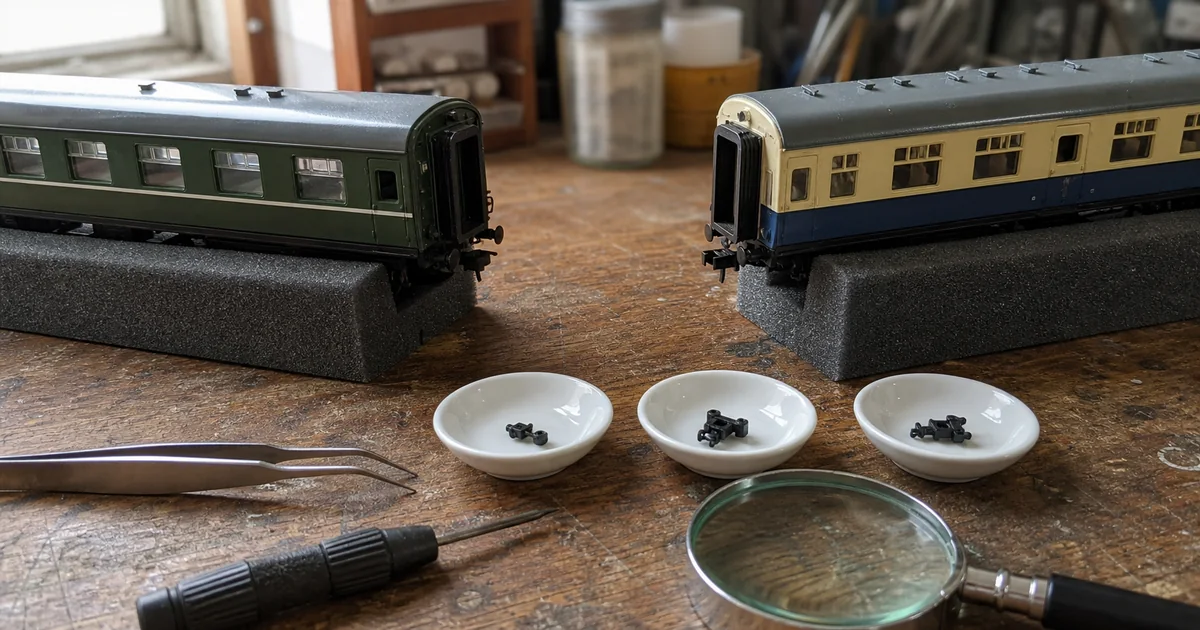
The useful question is not “Can KATO couple to TOMIX?” It is “Can this exact end of this exact vehicle couple to that exact end, using a documented mount, and still work on my layout?” N scale does not define one coupler. A shared brand, a familiar silhouette or a bench-top click cannot answer the full question.
Separate a coupler problem from a running problem: if the train also stalls, flickers or derails, use the N scale troubleshooting guide before changing parts. If you are still choosing a system rather than one interface, begin with KATO vs TOMIX.
Evidence ladder: a product number beats a photograph
The same train name can appear in different production runs, sets and car configurations. Write down the retail catalog number from the box or instruction and the individual car identity separately. Do not assume a number moulded under a car is the retail product number.
| Evidence level | What it can establish | What still needs checking |
|---|---|---|
| 1. Exact current instruction, parts chart or product page | The named vehicle, end, option or replacement | Read every condition, required holder/bogie and exception |
| 2. Maker fit chart or dated old/new table | A conditional mapping for listed products | Check date, footnotes and excluded vehicles |
| 3. Maker family page or standard | Family names, head or receiver geometry | It does not automatically authorize your vehicle conversion |
| 4. Shop title, image or “same N scale” | A search clue only | Return to first-party evidence; do not cut or bulk-buy |
TOMIX's old/new TN list is a useful example of a bounded source: it is dated December 2014, lists old/new TN part-number mappings and vehicle-specific exceptions, and is not a current universal TN compatibility chart.
Exclusive tool: the four-gate compatibility ladder
“Compatible” should mean four separate things, not one. Only four passes justify that word.
1. Mates
The exact two heads are supported by a maker or applicable standard. A forced click, shared scale or similar outline is not evidence.
2. Mounts
The exact holder, base, bogie or body interface is documented for that vehicle end, including any required modification.
3. Aligns
Height, centering, shank length, swing and car-end clearance are correct with no preload, droop or collision.
4. Survives
One boundary passes slow pull and propelled running on straight track, the real minimum curve, turnouts and S-curves in both directions.
| Status | Evidence | Action |
|---|---|---|
| PASS | All four gates are documented and tested | Release one boundary, then repeat per end |
| HOLD | A mount, pairing, exception or layout result is unknown | Keep the factory part; research or test without cutting |
| STOP | The maker rules out the pairing, the interface differs, or irreversible work lacks exact instructions | Use a documented alternative or run separate consists |
Arnold and NEM: the head and the receiver are different claims
Arnold's own history says it launched 1:160, 9 mm Rapido models in 1962 and that the Rapido coupler later became a European N scale standard. That history explains why the familiar shape appears across brands; it does not prove every installed car end will work together.
MOROP shows the missing distinction. NEM 356 defines an N scale coupler head. NEM 355 separately recommends a receiver for replaceable heads in TT and N under stated conditions. A standard-looking head does not prove the vehicle has that receiver, the right height, a maker-approved conversion or enough curve clearance. TOMIX independently calls Arnold a world-common standard used by other manufacturers, yet the same FAQ says other-brand vehicles generally cannot couple except some freight cars. Treat Arnold as a research starting point, not a blanket guarantee.
KATO and TOMIX family map: what the official pages actually say
| Maker / category | First-party boundary | Do not infer |
|---|---|---|
| KATO Coupler N | One of four optional categories on KATO's overview | That it is KATO's close-coupling family or cross-mates with the other three |
| KATO Coupler N JP | A separately listed category; 11-721 N JP A does not fit two-axle freight wagons | That N JP A/B, Coupler N or every freight mounting is interchangeable |
| KATO close-coupling | A separate category; number 2 long/short parts replace specified older hook-equipped body mounts and use a recommended-vehicle list | That “close-coupling” authorizes every KATO coach or mount |
| KATO magnetic / knuckle | KATO's magnetic knuckle has a trip pin and its own suitable-vehicle list; individual product pages may separately supply an exchange KATO knuckle | That every knuckle magnetically uncouples or is a universal KATO replacement |
| TOMIX Arnold | A world-common type also used by other manufacturers | Guaranteed coupling of any two cross-brand vehicle ends |
| TOMIX TN | Multiple real-coupler styles and body/bogie mounts; no coupling interchangeability with other brands | That similar TN shapes or TN-to-KATO pairs are compatible |
| TOMIX current-conducting | Described for Shinkansen, combining mechanical and electrical connection | One universal interface: the 98755 page excludes basic set 92852 because their couplers differ |
| Dummy end | Convertible only where the exact instruction lists an optional TN part | That a similar hole pattern or front-end shape authorizes modification |
Product examples: specific evidence stays specific
KATO's E26 Cassiopeia page shows why the decision is per end. The two outer formation ends are factory Arnold and include exchange KATO knuckles, while intermediate ends use factory body-mounted KATO close couplers with jumper pipes. KATO's 43-series Kiso page gives other per-car combinations, including vehicles with Arnold at both ends, Arnold at one end and N JP B at the other, or N JP B at both ends. Those pages establish those exact products only.
TOMIX 0391 is equally narrow: the page identifies a black, 24-piece, tight-lock automatic-style TN set, S-coupler-compatible, primarily for passenger coaches with bogie mounting. It does not authorize body mounting, every coach or a universal Arnold-to-TN conversion.
1925: Japan treated coupler compatibility as a network migration
Short answer: RTRI says roughly seven years of preparation preceded the Taisho 14 conversion of about 3,000 locomotives, 8,000 passenger cars and 50,000 freight wagons over several days. JR Freight dates the simultaneous freight-wagon work on the Honshu lines, the Sanuki Line and connecting-company lines to 17 July 1925. It is misleading to reduce the whole project to “every Japanese rail vehicle changed everywhere in one day.”
Exclusive tool: map the mixed-fleet boundary, not the whole brand
Preserve working internal couplings in a fixed formation. Change only the boundary that must meet another consist: locomotive to first coach, set to set, or one transition car. Start with an endpoint map, not a shopping list.
Loco · end 2 ⇄ Coach A · end 1 | Coach A · end 2 ⇄ fixed consist
| Release-sheet field | Record | No-Go condition |
|---|---|---|
| Vehicle identity | Maker, full catalog number, individual car | Train nickname or unidentified loose model only |
| Boundary | Car and end, factory family and mount, intended mate | “Convert the whole train” without an endpoint map |
| Candidate part | Exact part plus product/manual/fit-chart URL | Photo match or shop title only |
| Four gates | Mates, mounts, aligns, survives | Any failed or unresolved gate |
| Layout test | Minimum radius, turnout/S-curve, pull/propel, both directions; electrical version if relevant | Straight-track click only |
| Recovery | Original parts, reversibility and logged result | Cutting without an exact instruction or replacement path |
Useful outcomes are not limited to “convert everything.” Keep factory internal ends; change only one documented external boundary; designate one verified transition car; or leave two formations separate when no supported interface exists. TN to a non-TOMIX coupler is a STOP under TOMIX's stated rule.
Choose the lowest-risk action for the actual goal
| Goal | Lowest-risk evidence path | Stop when |
|---|---|---|
| Restore a broken factory end | Current maker-specified replacement or documented successor for that catalog number and end | Only a similar-looking loose part is available |
| Make a dummy end operational | Follow the exact instruction only when it lists the optional coupler | The instruction lists no conversion |
| Convert Arnold to TN | Use the TN number stated on the exact package/instruction and accept its route limits | Cutting is required but no exact instruction or recovery part exists |
| Replace an old TN part | Use the December 2014 part-number table as a clue, then verify the current part and vehicle exception | “Shape compatible” is the only evidence |
| Mix KATO and TOMIX | Prove the exact external boundary; preserve fixed internal ends | One end is TN or either exact interface remains undocumented |
Six-step coupler release workflow
This is a conservative ROKHELM diagnostic protocol, not a claim that manufacturers publish one universal test. Follow the exact installation instruction first.
1. Map every boundary
Record the maker, exact product number, car, end, factory coupler family and mount, intended mate and actual minimum radius. Preserve the original part and photograph the factory arrangement.
2. Pass the documentation gate
Find the current maker product page, instruction or parts chart that names the exact vehicle or catalog number, car end and candidate part. If all you have is a train name, photo or shop title, stop.
3. Pass the mounting gate
Confirm whether the interface is bogie-mounted, body-mounted, a dummy end or a replaceable receiver, and whether the holder, base, bogie or cutting step is explicitly documented. Do not cut an unverified pocket.
4. Pass the mating gate
Establish that the exact two coupler heads are supported by the maker or an applicable standard. Same scale, brand or appearance is not proof; TOMIX TN to another brand fails TOMIX's stated rule.
5. Pre-check the operation gate
Before buying a fleet quantity, compare the actual minimum curve, turnouts, S-curves and any electrical-coupler version with the exact product restrictions. A straight-track click is not an operating result.
6. Install one boundary and verify
With power off, check height, centering and car-end clearance. Then pull and propel two cars slowly on straight track, broad and minimum curves, turnouts and S-curves in both directions. Add cars one at a time and log the result.
Stop on binding, a lifted car end, repeated uncoupling, lost centering, wheel lift, car-end collision or unfamiliar resistance. More speed is not a repair. Use the curve-radius guide to document the route and the troubleshooting guide when a failure appears only in one direction or location.
Parts sourcing: verify availability before disassembly
Availability, pack size and successor parts change. Search by the complete vehicle and coupler numbers, check the maker page again on the day you order, and buy one conversion boundary before a full-fleet quantity. Do not substitute a lookalike just to finish a disassembled vehicle.
- Confirm whether the listing is a current option, ASSY/spare part, old stock or an unidentified loose part.
- Keep the package and fit notes until the route test passes.
- For a fixed set, order only the ends you intend to change; internal factory boundaries may need no work.
- If the exact documented part is unavailable, reassemble the factory end and defer the project.
Official and first-party sources
Checked 2026-08-10. These sources support the category names, exact examples, standards boundary, TOMIX restrictions and railway-history context. Product specifications and fit lists may change; recheck the instruction for your exact catalog number before purchase or modification.
- KATO optional coupler overview — Coupler N, N JP, close-coupling and magnetic categories; number 2 and 11-721 limits.
- KATO E26 Cassiopeia — Arnold/knuckle-option outer ends and close-coupled intermediate ends.
- KATO 43-series Kiso — documented per-car and per-end Arnold/N JP B combinations.
- KATO magnetic knuckle FAQ — trip pin, uncoupler track and suitable-vehicle list.
- TOMYTEC/TOMIX FAQ — Arnold, TN and current-conducting categories; cross-brand, dummy, mount, curve and irreversible-work boundaries.
- TOMIX N Information Room No. 310 — Shinkansen current-conducting couplers combine mechanical and electrical connection.
- TOMIX 0391 — black 24-piece, S-coupler-compatible, coach/bogie-mount example.
- TOMIX 98755 200-series add-on set — current-conducting coupler version incompatibility with 92852.
- TOMIX old/new parts appendix (December 2014) — old/new TN part-number mappings and vehicle-specific exceptions.
- MOROP NEM 355 — recommendation for a replaceable-head receiver in TT and N under stated conditions.
- MOROP NEM 356 — N scale coupler head norm.
- Arnold official history — the 1962 Rapido range and later European-standard coupler context.
- Railway Technical Research Institute: coupler development — preparation, fleet scale, work methods and safety effect of the 1925 conversion.
- JR Freight railway-history panel — the precise 17 July 1925 freight-wagon changeover scope.
Map one boundary before you buy one packet
Japanese N scale couplers: frequently asked questions
What should I record before buying an N scale coupler?
Record the maker, exact vehicle or catalog number, car designation, the specific end, factory coupler family, mount type, intended mate and your layout's actual minimum radius. Use the box, product page and instruction sheet; a train name or photo is not enough.
Are all N scale couplers interchangeable?
No. N describes a modelling scale and gauge family, not a universal coupler interface. Documentation, mounting, mating and operation must all pass for each car end.
Does an Arnold coupler guarantee cross-brand coupling?
No blanket guarantee. TOMIX calls Arnold a world-common standard used by other makers, but also says other-brand vehicles generally cannot couple except some freight cars. Confirm the exact installed ends and test them.
What is the difference between NEM 355 and NEM 356?
MOROP NEM 356 defines an N scale coupler head, while NEM 355 recommends a receiver for replaceable heads in TT and N under stated conditions. A head standard does not prove a vehicle has that receiver, a correct installation or a maker-approved conversion.
Are KATO Coupler N, N JP, close-coupling and magnetic the same family?
No. KATO lists them as four separate optional categories, so do not assume they cross-mate. Exact variants also have limits: KATO says 11-721 N JP A does not fit two-axle freight wagons, and its number 2 close couplers have long and short versions plus a recommended-vehicle list.
Is a KATO knuckle a universal replacement for other KATO couplers?
No. Treat it as vehicle-specific unless the product page or instruction supplies or specifies it. KATO's E26 page, for example, supplies exchange knuckles for the outer Arnold ends while using body-mounted close couplers between cars.
Can a TOMIX TN coupler mate with KATO?
TOMIX says TN couplers have no coupling interchangeability with other brands. Do not call a TN-to-KATO pairing compatible because it can be pushed together or looks similar.
Are all TOMIX TN couplers interchangeable?
No. TOMIX says TN has multiple forms, and visually similar parts can be body-mounted or bogie-mounted. Use the exact part specified for the exact vehicle and end; consult the dated old/new correspondence table only where applicable.
Can every Arnold or dummy end be converted to TN?
No. TOMIX says a dummy end can be changed only when the instruction lists an optional TN coupler, and Arnold-to-TN conversion begins by checking the applicable part on the package or instruction.
Will a TN conversion preserve Mini or Super Mini curve capability?
Not necessarily. TOMIX explicitly warns that a vehicle originally compatible with Mini or Super Mini curves may no longer run on them after TN conversion. Check the real minimum radius before a fleet-wide change.
What exactly is TOMIX 0391 for?
0391 is a black 24-piece tight-lock automatic-style TN set, described as S-coupler-compatible and primarily for passenger coaches with bogie mounting. That page does not make it a universal body-mounted or all-coach replacement.
Are TOMIX current-conducting couplers universally interchangeable?
No. TOMIX describes them as Shinkansen couplers that also link cars electrically, but exact versions matter. Its 98755 page says that add-on set cannot be used with basic set 92852 because their couplers differ.