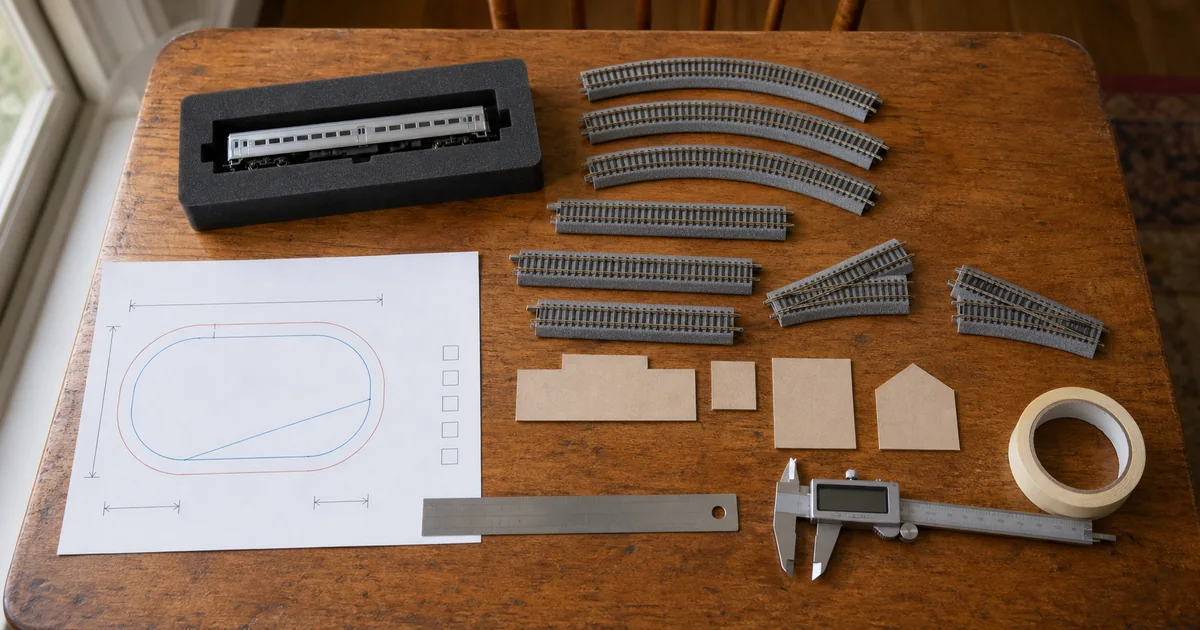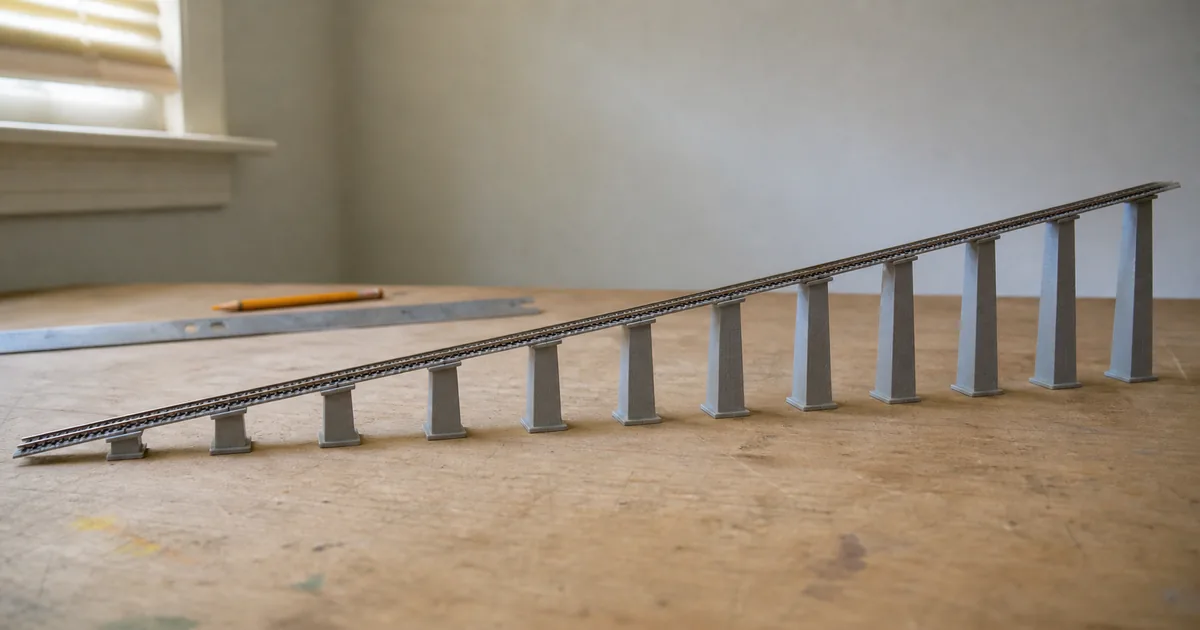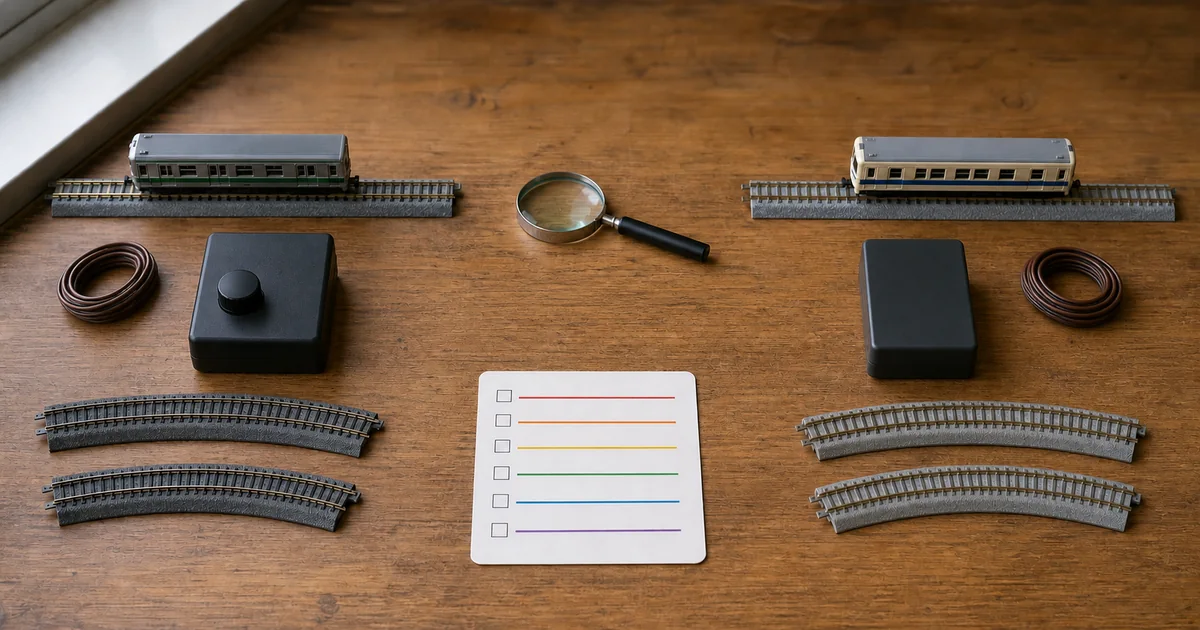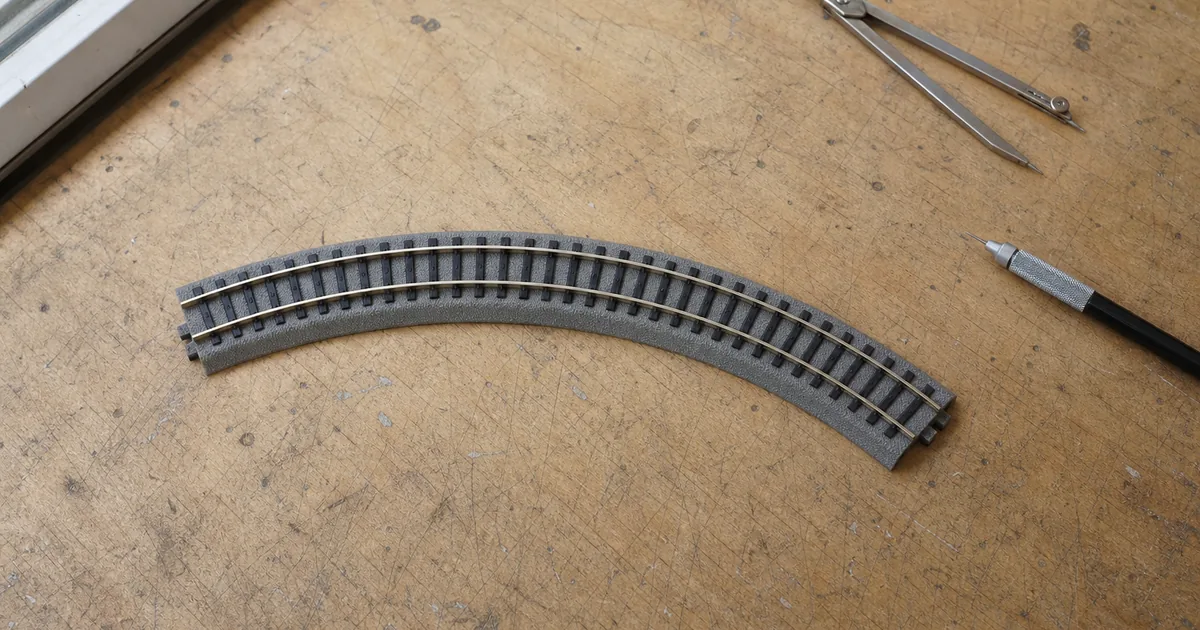
The useful question is not “what is the minimum radius for N scale?” It is “what is the strongest current radius requirement among the exact vehicles and track situations I intend to run?” N scale is not one mechanism, one coupler or one product family. A compact tram, a long coach and an articulated high-speed train can all carry the same scale label while demanding very different curves.
Use the track planner only after the evidence gate. If you are choosing a whole ecosystem, compare UNITRACK and FineTrack; if the curve also climbs, solve the separate grade and transition problem.
The three-gate radius decision
A radius table is useful only when it is prevented from answering questions it cannot answer. Split the decision into three gates:
1. Documentation gate
PASS when a current official product page, instruction sheet, box or compatibility list covers the exact vehicle and track form. HOLD when you have only a train name, photo, retailer copy or another modeler's different product.
2. Geometry gate
PASS when the actual sectional curve, angles, adjoining track and centerline footprint fit the measured board. User-entered margin is only a planning allowance; it is not verified sweep or fall protection.
3. Operation gate
PASS when the real consist clears and runs slowly in every intended direction and orientation. STOP on binding, wheel lift, coupler compression, repeated derailment or contact with a structure.
Only three passes justify fixing the track. This is stricter than “the locomotive made one lap,” because the longest car, the inside platform and the propelled movement may create the actual limit.
How to read KATO R and TOMIX C codes
KATO's R315 and TOMIX's C280 both embed a nominal track-centerline radius in millimeters. A full centerline circle is therefore twice the number across. The letters do not make the roadbed, joint, curve angle or adjoining geometry interchangeable.
Circle centerline width = 2 × radius
Simple oval centerline length = 2 × radius + one straight side
Then add roadbed, tested vehicle sweep, structures, access and deliberate edge protection. Never hide those unknowns inside a generic “safety margin.”
On a curve, a long car's center can move toward the inside while its ends sweep outward. That is why the NMRA publishes a separate curved-track center and obstacle-clearance assistant instead of treating tangent clearance as sufficient. The exact model remains the final test object.
KATO UNITRACK curve families: standard, auxiliary and Compact
KATO's current Japanese curve guide separates ordinary planning curves from auxiliary geometry and Compact curves. A “full range” is not a ladder on which every step serves the same job.
| Family | Current radii shown by KATO | Official planning boundary | What to record |
|---|---|---|---|
| Compact | R117, R150, R183 | Restricted small vehicles; check the product's passability information. If KATO gives no vehicle radius, use R249. | Exact vehicle/product number and Compact clearance statement |
| Standard planning sequence | R216, R249, R282, R315, R348, R381 | KATO says most conventional-line vehicles can pass R282, calls R315 its basic radius and says most vehicles can pass it, and positions R381 for realistic scenes and high-speed Shinkansen running. | Do not turn these catalog descriptions into a guarantee for an unlisted vehicle |
| Auxiliary large-radius pieces | R481-15, R718-15 | Used with #4/#6 turnout geometry, easements and spacing transitions; they are not simply “the next oval size.” | Curve angle and the exact adjoining turnout/track plan |
TOMIX FineTrack: Mini curves and large-radius special geometry
TOMIX identifies C103 as Super Mini and C140/C177 as Mini curves, then directs users to a dedicated vehicle list. The ordinary FineTrack catalog also includes C243, C280, C317, C354 and C391 pieces in multiple angles, while current product listings include larger C541 and C605 pieces for particular track patterns.
| Family | Examples in the current official catalog | Decision boundary |
|---|---|---|
| Super Mini / Mini | C103; C140; C177 | Use TOMIX's exact cleared-vehicle list. Short appearance alone is not approval. |
| Common sectional curves | C243; C280; C317; C354; C391 | Confirm exact angle, track style and vehicle instruction. Nearby KATO radii do not make pieces interchangeable. |
| Large/special geometry | C541; C605 | C541 appears in turnout/spacing and broad-curve uses; C605-10 is an official 605 mm, 10-degree curve. Treat each as plan-specific geometry, not a default oval recommendation. |
The safest TOMIX rule is simple: for C103, C140 and C177, start at the official clearance list; for every other curve, start at the exact vehicle and track documentation. “TOMIX train” is still too broad a test condition.
Footprint calculator: useful math with an honest limit
This calculator reports centerline-based board dimensions plus the planning allowance you choose. The allowance is deliberately not labelled “safe clearance.” It cannot see roadbed width, car sweep, catenary, platform edges, tunnel portals, a fascia or a falling vehicle.
A door requires the same discipline. Measure the actual slab, not a retail category. Subtract real roadbed and clearance needs, then prove the edge condition with the rolling stock. If a derailed car can fall, use a physical barrier or redesign the route rather than trusting arithmetic alone.
A curve can pass alone and fail as part of a route
Manufacturer radius evidence is necessary but may describe a simpler condition than your final layout. Add the surrounding geometry to the test:
| Route condition | Why radius alone is insufficient | Temporary test |
|---|---|---|
| Constant curve in open scenery | Body sweep and coupler angle still vary by vehicle. | Hand-roll, then slow powered test both ways with the real consist. |
| Platform, tunnel, bridge or catenary beside curve | Inside center overhang and outside end sweep can strike different objects. | Mock every obstacle at full height and inspect the worst car from above and rail level. |
| Immediate reverse S-curve | Adjacent cars swing in opposite directions while couplers are offset. | Reproduce both curves and any intended intervening straight; do not invent a universal separator length. |
| Curve into turnout | Changing curvature, frog and point geometry add another interaction. | Test every route, direction and intended hauled/propelled movement. |
| Curve plus grade transition | Vertical and horizontal geometry combine, changing coupler and wheel loading. | Build the full transition and test the longest train under representative load. |
| Hidden curve | A marginal curve becomes a recovery and maintenance problem. | Require generous access and repeatability; if recovery is poor, redesign before scenery. |
This matrix is a diagnostic tool, not a new standard. It makes the untested interaction visible before the layout becomes difficult to change. Pair it with the track-planning release gates and the train-versus-location cross-test.
Exclusive tool 3: issue a curve-route release certificate
A radius label is not a permanent approval. Turn the temporary test into a short, traceable certificate for one recorded train and one recorded route. That makes later scenery, rolling-stock and geometry changes visible instead of quietly inheriting an obsolete “R315 works” claim.
| Certificate field | Record before PASS | Why it matters |
|---|---|---|
| Governing train | Exact SKUs, full consist, longest/widest/most restrictive vehicle, couplers, orientation, and hauled, propelled or both. | PASS belongs to this configuration—not to every vehicle carrying the same scale label. |
| Geometry chain | Curve product, radius and angle; adjoining turnouts; reverse curve or intervening straight; grade transition; surface, bridge or viaduct form. | The radius number cannot describe the interactions immediately before and after the curve. |
| Clearance envelope | Inside center overhang, outside end swing, roadbed, platform/tunnel/catenary mock-ups, board edge, fall barrier and recovery access. | Different parts of the same vehicle can govern the inside and outside clearances. |
| Operating proof | Power-off hand roll, low-speed powered runs both directions, intended hauled/propelled movements, and repeated representative runs of the complete train. | A static vehicle or isolated curve cannot prove coupler and route behavior. |
| Service state | Date, evidence links, result, fault log, hidden-track access and the person who accepted or withheld release. | A dated record separates evidence from memory and shows what must be retested. |
Six steps from vehicle evidence to fixed track
1. Inventory the exact train and operating direction
Record every locomotive and car by manufacturer and exact product number, then identify the longest, widest and most restrictive vehicles. Include the real consist and whether it will be hauled, propelled or run both ways.
2. Find current manufacturer radius evidence
Read the current product page, instruction sheet, box and official compatibility list for each critical vehicle. Record surface, viaduct or special-track limits separately. If evidence is missing, mark the radius HOLD rather than guessing from scale or car length.
3. Choose a candidate track geometry
Select an available KATO or TOMIX curve that satisfies the strongest documented requirement. Include the actual curve angle, adjoining turnouts, reverse curves, grades and structures; the radius number alone is not a complete route.
4. Calculate only the centerline footprint
Use twice the centerline radius for a circle, then add the oval straight once to its length. Treat any entered margin as a planning allowance only; the calculator does not know roadbed width, car overhang, catenary, platforms or fall protection.
5. Build a temporary clearance gate
Dry-lay the complete risk area and mock up platforms, tunnel mouths, catenary and board edges. With power off, hand-roll the most demanding vehicle to inspect inside and outside sweep before performing powered tests.
6. Test, record and then fix the track
Run the real consist slowly in both directions and in every intended operating orientation. Test the curve with adjacent turnouts, S-curves and grade transitions, log the result, and fix track or scenery only after the same setup repeatedly passes.
Railway-culture answer: real curves are radius plus speed and cant
Full-size railway engineers do not judge a curve by radius alone. RTRI describes tilt control using curve location, radius, cant and vehicle speed to predict lateral acceleration, while JR Central describes the Tokaido Shinkansen as a high-speed route with curves kept to a minimum. The modeling lesson is an analogy, not a scale conversion: radius belongs to a system of vehicle and route conditions, so prototype appearance cannot replace the model maker's operating evidence.
Official and first-party sources
Checked 2026-08-25. Links describe current official track geometry, compact-curve restrictions, curved-clearance methodology and the railway-engineering context used above. The three-gate decision, compound-risk matrix and route release certificate are ROKHELM editorial tools derived from those boundaries; they are not manufacturer or NMRA standards.
- KATO UNITRACK curve-line guide — standard, auxiliary and Compact radii
- KATO UNITRACK Compact — restricted vehicles, R249 fallback and CV1 footprint
- TOMIX FineTrack lineup — Super Mini and Mini curve definitions
- TOMIX — vehicles cleared for Super Mini and Mini curves
- TOMIX C605-10 product page — 605 mm radius and 10-degree angle
- NMRA RP-7.6 — curved track center and obstacle-clearance assistant
- Railway Technical Research Institute — curve radius, cant, speed and tilt control
- JR Central — Tokaido Shinkansen route and high-speed operating context
FAQ
What is the minimum curve radius for N scale?
There is no universal N scale minimum. Use the current manufacturer evidence for the exact locomotive, car, coupler arrangement and track form, then adopt the largest requirement in the real consist. A radius that one tram or short locomotive can pass does not become safe for every N scale model.
Can every KATO train use R117, R150 or R183 Compact curves?
No. KATO describes R117, R150 and R183 as Compact curves for restricted small vehicles and directs users to each product's passability information. Where KATO provides no radius statement for a vehicle, its Compact guidance says to use R249. Check the exact vehicle rather than its length or appearance alone.
What does KATO say about R282, R315 and R381?
KATO's current curve guide says most conventional-line vehicles can pass R282, calls R315 its basic radius and says most vehicles can pass it, and positions R381 for more realistic scenes and high-speed Shinkansen operation. These are KATO planning descriptions, not a substitute for the exact vehicle's instructions.
Can every TOMIX train use C103, C140 or C177?
No. TOMIX identifies C103 as Super Mini and C140 and C177 as Mini curves, and publishes a dedicated list of TOMIX vehicles cleared for them. A vehicle absent from that list is not automatically approved merely because its wheelbase looks short.
Do KATO R and TOMIX C codes measure the same thing?
Both codes include the nominal track-centerline radius in millimeters: R315 is 315 mm and C280 is 280 mm. The systems still differ in available angles, roadbed, joints and adjoining geometry, so matching or nearby radius numbers do not make the track pieces interchangeable.
How do I calculate the board size for an N scale oval?
The centerline width is twice the radius. The centerline length of a simple oval is twice the radius plus the length of one straight side. Add a user-chosen planning allowance on both sides, but do not call that allowance verified clearance until the actual roadbed, vehicles, structures and board edge have passed a physical test.
Does a 4 by 8 foot board fit every KATO and TOMIX curve?
No. A 4 by 8 foot sheet is about 1,219 by 2,438 mm, so a full circle of KATO R718 or TOMIX C605 already exceeds the short dimension before roadbed or clearance is added. Those large radii may be auxiliary or special-purpose geometry rather than the curve you need, but the blanket claim that every catalog curve fits is false.
What radius fits a hollow-core door?
Measure the actual door first; nominal door sizes vary. Subtract roadbed, tested vehicle sweep, structures and a deliberate edge-protection allowance before selecting a centerline diameter. A calculator result based on an arbitrary margin is a planning estimate, not proof that a particular train is safe near the edge.
Why can a train derail even when its stated radius fits?
Radius is only one part of the route. An immediate reverse curve, turnout, coupler compression, grade transition, track joint, structure or a particular hauled-versus-propelled movement can create a failure that a simple constant-radius test does not show. Reproduce the full route and real consist before fixing track.
How much edge clearance should I add around a curve?
Do not use one universal number. Entered calculator margin is only a design allowance. Establish the real envelope with the widest and longest vehicles, inside and outside body sweep, roadbed, nearby equipment, access needs and a physical fall barrier appropriate to the layout.
Should I automatically choose a radius one or two sizes larger than the stated minimum?
A larger radius can reduce visible overhang and may help operation, but one or two catalog steps is not a universal safety rule because step sizes and adjacent geometry differ. Choose the largest radius the complete plan can support, then verify the exact train and route rather than treating an upsizing slogan as evidence.
Can I scale a real railway curve directly down to N scale?
Not as an operating rule. Full-size curve design combines radius with speed, cant, vehicle suspension and route standards, while model vehicles have different mechanisms and manufacturer limits. Prototype data can guide appearance, but the model's documented radius and a physical clearance test control operation.