The comparison search results usually miss
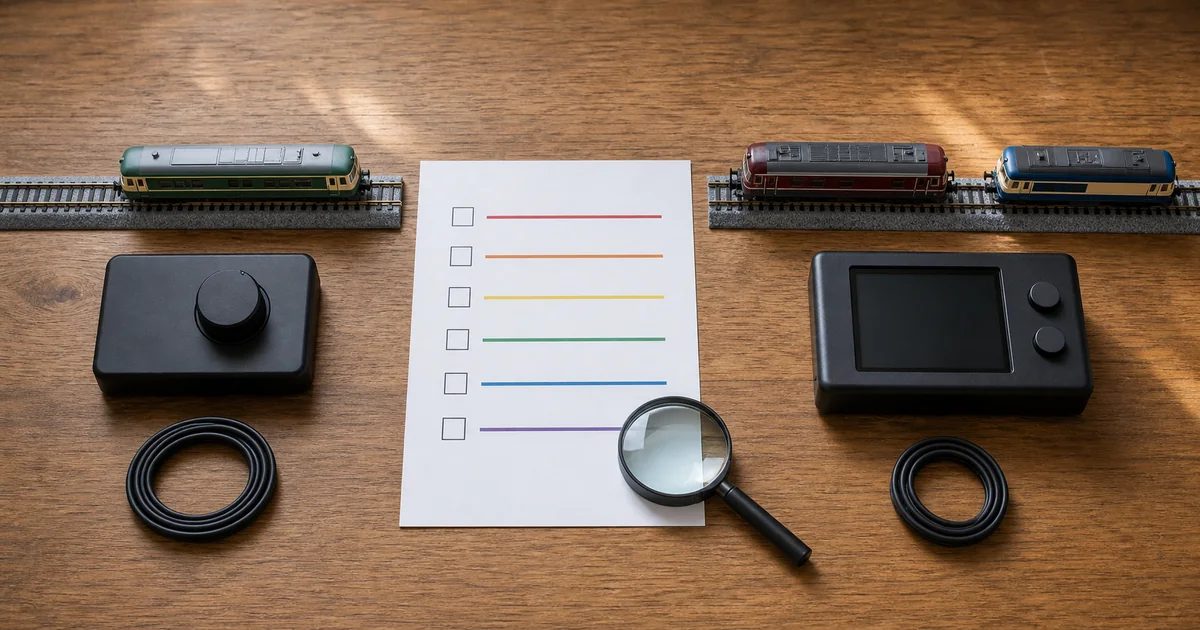
Forum answers often reduce the choice to “SX for N, Hyper DX for big trains.” That hides four separate questions: which regional package you are buying, which supply belongs to it, what draws current at the same time, and whether you need capacity or a different control architecture. The controller cannot solve a missing electrical district, a second independent train, DCC addressing or a locomotive fault.
| Decision | Standard SX | Hyper DX | What does not change |
|---|---|---|---|
| Published controller rating | 1.2 A | 2 A total; traction and accessories share it | Neither rating is a car count or speed rating. |
| Control method | PWM; KATO notes standstill lighting varies by vehicle | PWM, starting-voltage adjustment, two direction controls | Neither is a DCC command station. |
| KATO positioning | Basic N/HO controller with the appropriate adapter | Lit full formations, multiple powered units and HO with more capacity | Exact vehicle compatibility still controls. |
| Supply package | Market-specific; Japan lists body and adapter separately | KATO Japan lists a supplied 15 V/2 A adapter | Never merge part numbers or substitute an unverified supply. |
| Independent trains | One throttle output | One throttle output | Two independent DC routes need isolation and separate documented controls. |
Build a load ledger, not a car-count myth
Unpowered cars mainly add mechanical resistance. Motors, interior-light units and track-powered accessories add electrical demand. Therefore ten unlit coaches behind one motor are not equivalent to a lit multiple unit with several powered cars. KATO itself describes Hyper DX by load types—full formations with interior lights and multiple units—not a universal number of vehicles.
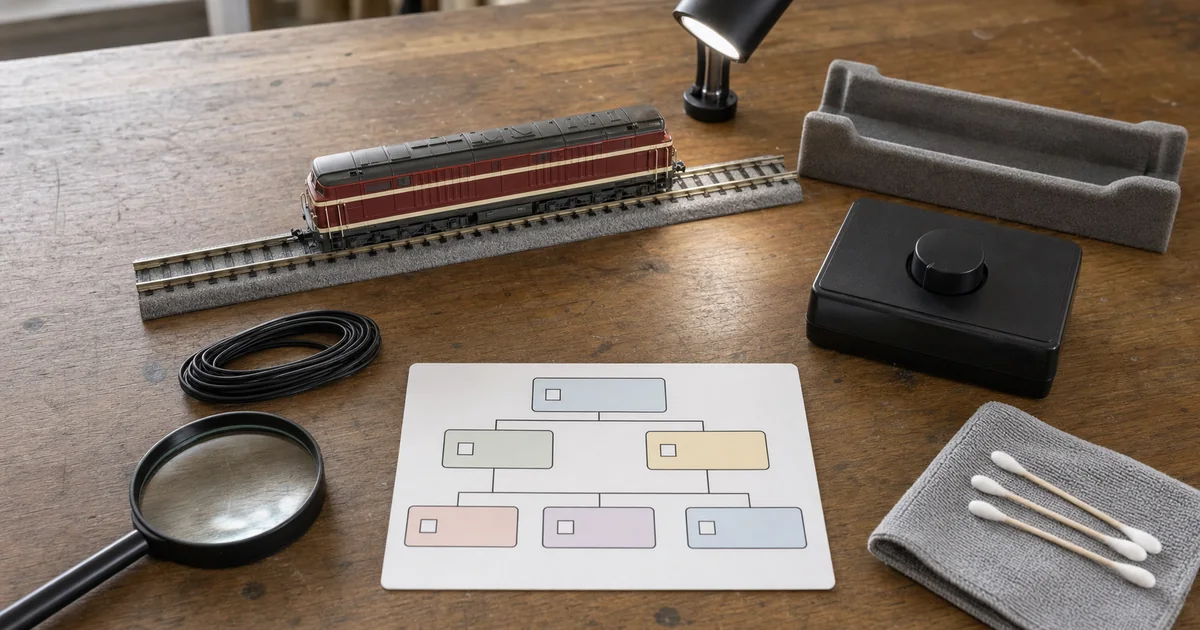
A controller protection trip is evidence, not an invitation to bypass protection. Reduce the layout to one healthy vehicle and one feeder, then reintroduce one load at a time. The troubleshooting matrix helps separate vehicle, location and common-system faults; the interior-light guide treats each car as its own compatibility boundary.
Two amps does not mean faster
Current capacity and track voltage are different specifications. Hyper DX can support more simultaneous load within its documented operating envelope; that does not authorize extra voltage at a locomotive. Speed also depends on the model, gearing and load. Choose capacity from the ledger and stay inside the exact vehicle instructions.
KATO lists Hyper DX track output as DC 0–14.5 V, 29 W, 2 A, with the 2 A shared between running and accessory outputs. It also lists overcurrent protection. Those facts do not guarantee that every N-scale vehicle accepts maximum output. Start at zero, increase only as required, and stop for abnormal heat, odor, smoke, sustained arcing or repeated trips.
The regional package is the first gate
KATO Japan lists 22-018BK as the Standard SX controller body and separately lists 22-082 for N and 22-083 for HO. KATO USA lists a Standard SX package with an AC adapter. Similar names do not make the box contents or documentation interchangeable. Record the full part number, plug region, supply label and manual before buying a replacement.
The adapter rating and controller track rating describe different points in the chain. A 2.2 A label on the N adapter does not turn the Standard SX track output into a 2.2 A controller. Keep every number attached to its component, input/output side and operating condition.
Power-chain passport: keep every rating attached to its component
Complete one passport for the exact box in front of you. It prevents a seller's regional bundle, a Japanese adapter specification and a controller output rating from being merged into one imaginary product. A blank evidence field is a HOLD—not permission to infer from a similar name.
| Passport field | Record the evidence | HOLD when |
|---|---|---|
| Market and package | Maker, full part number, seller region, box contents, manual and product-page check date. | The listing says only “Standard SX” or mixes photos and part numbers. |
| Mains side | Adapter-label input and plug region; never copy this from a controller page. | The adapter is unlabelled, damaged or not documented for local mains. |
| Adapter output | Voltage, current, polarity and connector from the exact adapter label/manual. | Any value or connector is assumed from a similar-looking supply. |
| Controller boundary | Controller input and track/accessory output ratings, including shared-load conditions. | The supply and track-output numbers have been treated as interchangeable. |
| Vehicle boundary | The most restrictive applicable N-scale vehicle or lighting instruction. | Maximum controller output is being used as a universal vehicle limit. |
| Load and district | Simultaneous motors, lights and accessories; feeder, isolation and controller ownership. | A guessed car count replaces the load ledger or two packs can reach the same rails. |
| Acceptance record | Date, test vehicle, zero-start, direction, low-speed response, added loads and exceptions. | There is heat, odor, smoke, arcing, repeated trips or an unexplained exception. |
Substitution gate: know when the passport expires
A passing test belongs to the recorded configuration, not forever to the layout. Reopen only the affected gates whenever one of these changes occurs:
Same name, another region
Reopen package identity, mains and supply evidence. A KATO USA bundle does not prove the contents of Japanese 22-018BK plus 22-082 or 22-083.
Different adapter
Reopen the complete power chain and vehicle-voltage boundary. Matching plugs or a larger current label are not compatibility evidence.
New formation or accessory
Reopen the simultaneous-load ledger and protection test for added motors, interior lights or track-powered accessories.
New district or second pack
Reopen feeder ownership, electrical isolation and cross-feed checks before either controller is connected.
More current is not more independent control
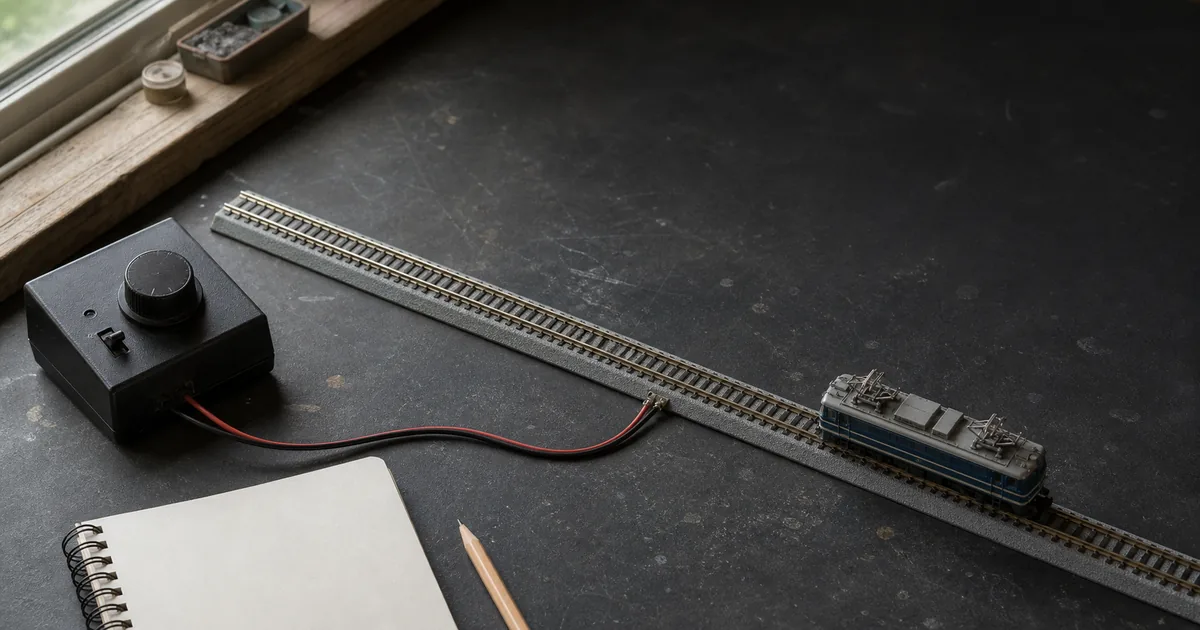
One analogue throttle sends one speed and direction condition to the electrical section it feeds. A 2 A controller can carry more simultaneous load, but it cannot assign a different speed to a second train on the same continuous rails. Independent conventional DC operation needs separately isolated sections and a documented control output for each.
Never connect two controllers to track that remains electrically continuous. Plan isolation and feeders before wiring; do not rely on turnout position alone unless the exact turnout and feed arrangement documents that behavior. If independent addressing on shared rails is the real goal, compare DC and DCC instead of buying a larger DC pack.
Six steps to choose and commission the pack
1. Identify the exact regional package
Record the controller part number, seller region, included power supply and manuals. Do not combine a KATO USA package description with a Japanese adapter list simply because both products say Standard SX.
2. Define the operating job
Write down whether the pack must run one train, two independently isolated routes, a lit full formation, multiple powered units, HO stock or accessories. A larger current rating cannot create a second independent throttle or DCC addressing.
3. Build a load ledger
List each motor, interior-light set and track-powered accessory that can draw at the same time. Use maker current data where available or measure with suitable equipment; do not convert 1.2 A or 2 A into an unsupported universal car count.
4. Verify the complete power chain
Match mains input, AC adapter, controller input, track output, feeder and vehicle voltage to the exact manuals. For Japanese N scale, use the documented N adapter rather than treating the higher-voltage HO adapter as an upgrade.
5. Build the smallest powered test
Connect one documented adapter, one controller, one feeder, a short straight track and one healthy vehicle with power off. Keep other controllers and accessory loads disconnected until the basic chain passes.
6. Prove operation and protection
Power on at zero, test direction and low-speed response, then add one documented load at a time. Stop for smoke, odor, abnormal heat, repeated protection trips, damaged cables or behavior outside the manuals; do not defeat the protection or substitute a supply.
Railway-culture answer: the controller is part of the driving experience
KATO's current controller range shows a cultural progression from a simple power pack, through Hyper DX's starting-voltage adjustment, to the EC-1 one-handle cab controller and smartphone control. KATO describes EC-1 as pursuing the feel, weight and actions of a real cab and links it with the Sound Box. The lesson is that control choice can serve two different goals: supplying a verified electrical load, or recreating the act of driving. Do not pay for the second when the first is still unresolved.
Official and first-party sources
Checked 2026-08-25. Specifications and warnings come from current maker pages; the load ledger, power-chain passport, substitution gate and commissioning gate are conservative editorial tools. Exact manuals and labels for the owned regional package take precedence.
- KATO UNITRACK control equipment — Standard SX, N/HO adapters, Hyper DX, feeders and the EC-1 control range.
- KATO Standard SX product page — Japanese controller identity, 1.2 A rating and adapter-dependent package scope.
- KATO Hyper DX product page — PWM, 2 A shared output, starting-voltage adjustment, lighting and protection.
- KATO AC adapter product page — Japanese N/HO adapter scope and higher-voltage warning.
- KATO USA Standard SX package — regional package with AC adapter.
- KATO USA UNITRACK catalogue — Standard SX 0–12 V N and 0–16 V HO supply-dependent output table.
- KATO power-pack FAQ — controller purpose, capacity, shorts and DC/DCC distinction.
- TOMIX support FAQ — independent first-party 12 V vehicle safety boundary for TOMIX stock.
Choose the control architecture first
KATO power pack FAQ
What is the main difference between KATO Standard SX and Hyper DX?
KATO rates the Standard SX at 1.2 A. Hyper DX is a 2 A PWM controller with starting-voltage adjustment and two direction controls, and KATO positions it for loads such as full formations with interior lights, multiple powered units and HO. The larger rating is capacity for simultaneous load; it is not a promise of higher model speed or independent train control.
Will Hyper DX make an N scale train run faster?
Do not choose it for speed. Vehicle speed depends on applied track voltage and the model's design, while the current rating describes available load capacity. Stay within the exact vehicle and controller documentation; more available current is not permission to exceed a vehicle's voltage limit.
How many N scale cars can Standard SX run?
There is no reliable universal car count. Unpowered cars add mechanical load, while motors, interior lights and track-powered accessories add electrical load. Build a ledger of simultaneous electrical loads and use maker data or suitable measurement instead of treating every car as the same fraction of 1.2 A.
Does Standard SX light trains while stopped?
KATO says Standard SX can illuminate vehicle lights from standstill and support slow running, but explicitly notes that behavior varies by vehicle. PWM capability does not guarantee every light board, capacitor-equipped vehicle or other-brand model will respond identically. Check the exact vehicle and light instructions.
Is KATO Standard SX the same package in Japan and the United States?
Do not assume so. KATO's Japanese listing identifies 22-018BK as the controller body with a separate N or HO adapter. KATO USA lists its own Standard SX package with an AC adapter. Record the exact part number and follow the documentation supplied for that regional package rather than merging two markets' specifications.
Can I use the Japanese HO adapter for N scale?
Do not use it as an N-scale upgrade. KATO lists 22-082 for N at 13.5 V input to the controller and 22-083 for HO at 17 V, and warns that the HO setup at maximum can damage vehicle products, including other brands. Use the exact scale-appropriate combination documented by KATO.
Is the adapter amp rating the same as the track-output rating?
No. The adapter's output describes what it supplies to the controller; the controller's track-output rating describes a different point in the chain. For the Japanese Standard SX, KATO lists a 1.2 A controller rating while the N adapter is labelled 13.5 V, 2.2 A. Keep each number attached to its component and function.
Can one Standard SX run two trains independently on double track?
Not from one throttle. A higher current rating may support more simultaneous load, but it does not provide separate speed and direction commands. Independent conventional DC operation requires separately isolated electrical sections and a documented control output for each. Never connect two controllers to rails that remain electrically continuous.
Can Standard SX or Hyper DX control DCC locomotives independently?
They are conventional DC PWM power packs, not DCC command stations. A DCC locomotive may have manufacturer-documented analogue behavior, but individual addressing and functions require a compatible DCC system and decoder setup. Use the DC-versus-DCC guide before choosing the control architecture.
When is Hyper DX the evidence-based choice?
Choose Hyper DX when the documented simultaneous load or desired starting-voltage control requires its capabilities—for example a full formation with interior lights, multiple powered units or an applicable HO job. Do not buy it solely because 2 A sounds more future-proof; first prove what the intended train and accessories draw.
Can accessories share the Hyper DX 2 A output without limit?
No. KATO states that the 2 A total is shared by vehicle-running and accessory outputs. Add traction and accessory demand to one simultaneous-load ledger, and follow each accessory's connection instructions. A separate terminal does not create a separate unlimited power budget.
When should I stop using a power pack?
Switch off and disconnect for smoke, burning odor, abnormal heat, damaged cable or case, liquid exposure, sustained arcing or repeated protection trips. Also stop before connection if the regional adapter, mains input, controller input, feeder polarity or vehicle voltage limit is unresolved. Do not bypass protection or improvise a supply.