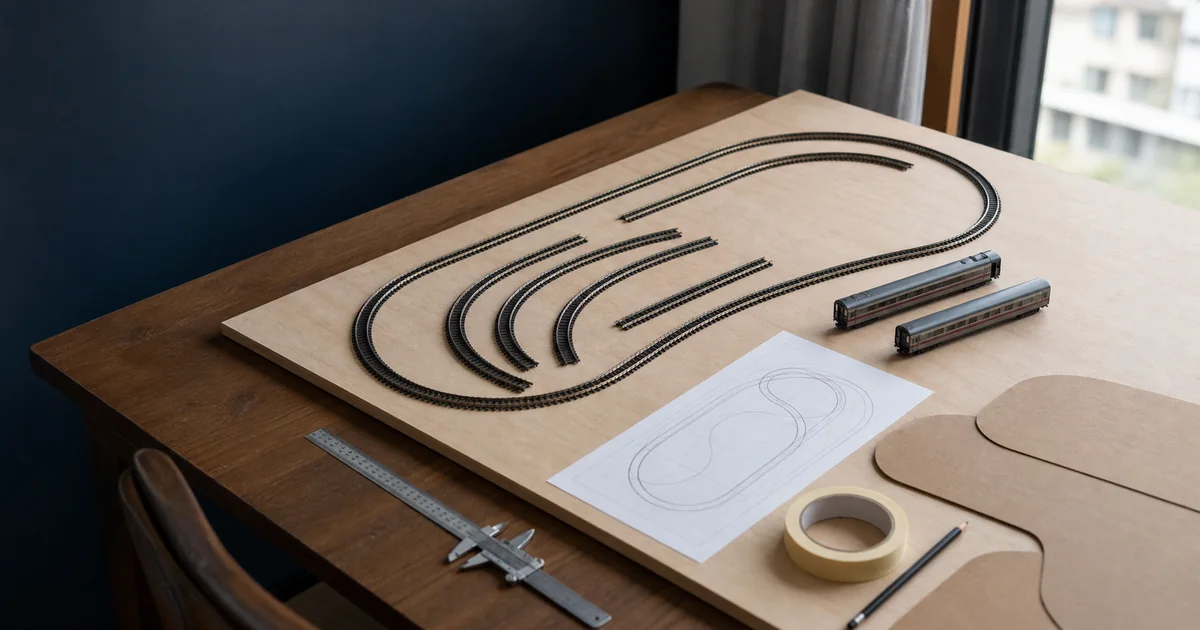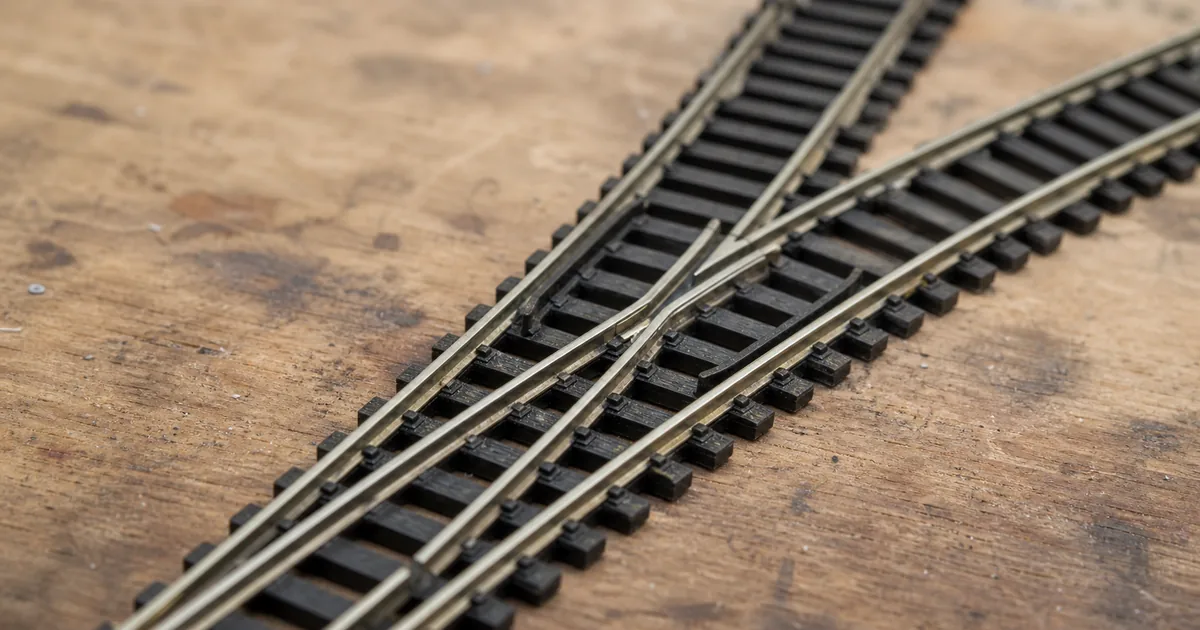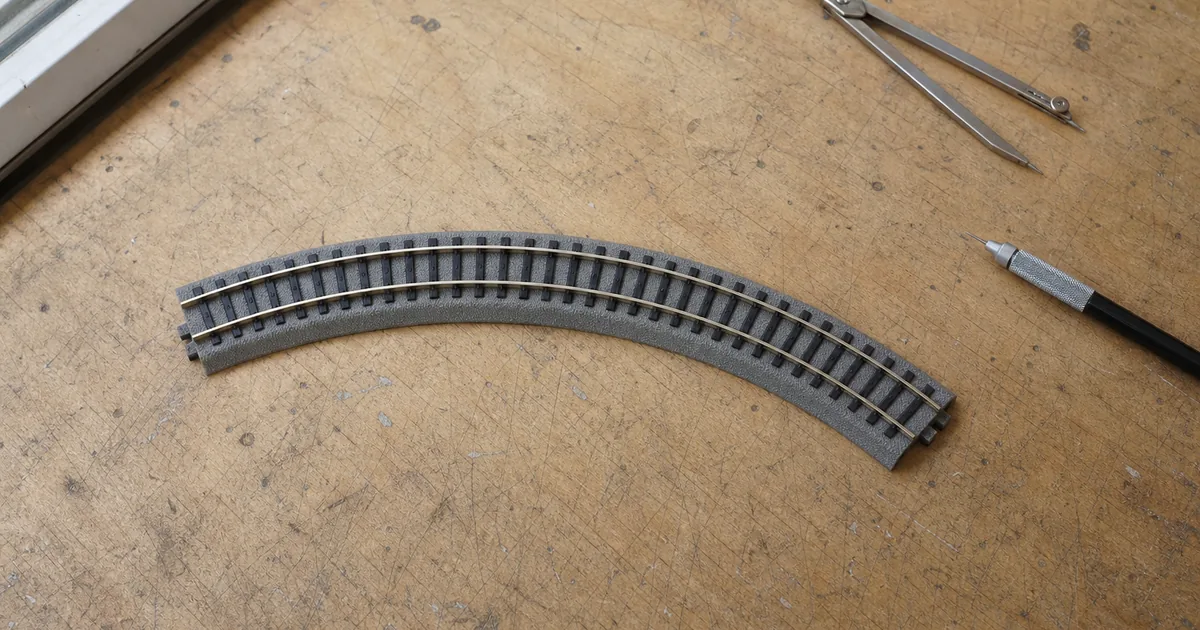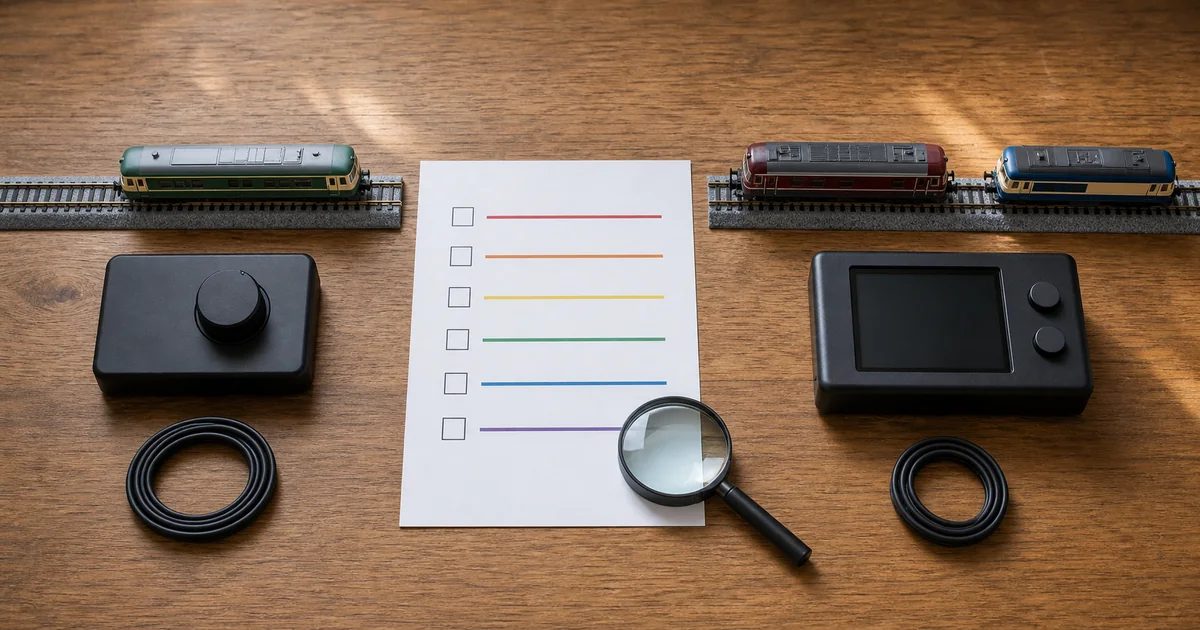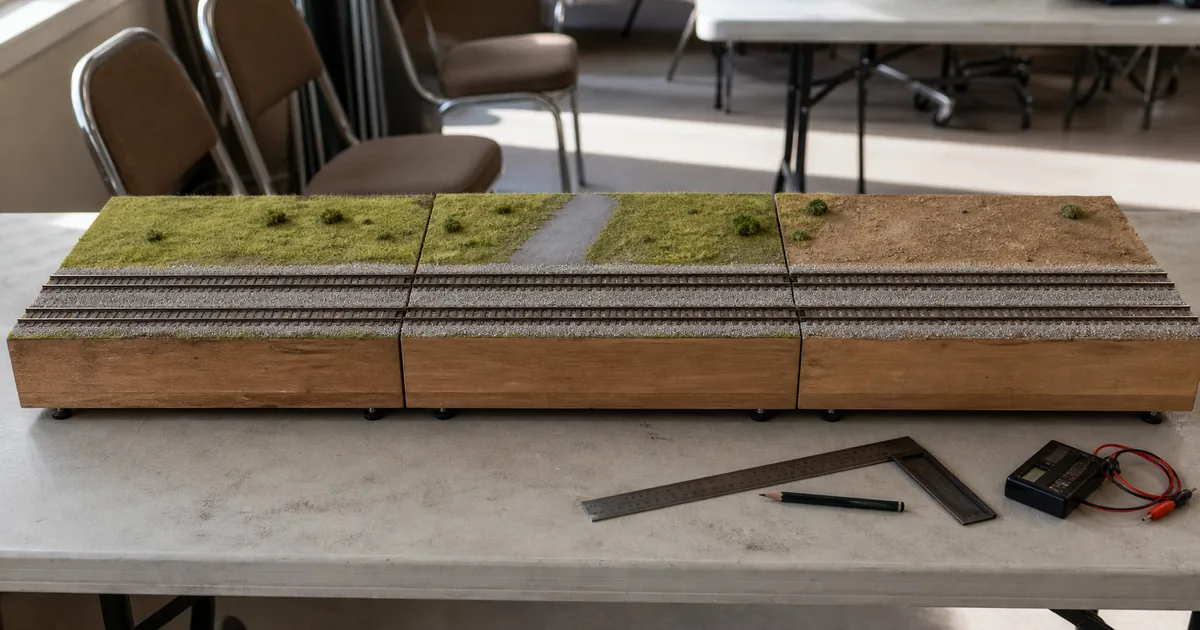
AI-generated illustration, not a photograph of a specific product
T-TRAK is the rare modular standard you can build on a kitchen table and still bring to a show. The catch is that the numbers people quote get mixed up constantly — and a module built on the wrong one does not connect, which you find out on the day, in public.
Four numbers that are not the same number
The thing that catches people is that a single module carries four separate dimensions: the frame outline, the track length, the tabletop-to-railbase running height, and — if you bought a kit — the height of the kit's own woodwork. Treat 310 mm as the frame width and your rails sit recessed, joining nothing. Treat a kit's 60 mm as the running height and your module sits low next to everyone else's 70 mm, so trains bump at the joint. Keep them apart from the start:
Single straight
308 mm frame (12⅛ in)
310 mm of track; 125–365 mm deep; railbase 70–101 mm.
Double straight
618 mm frame (24⅓ in)
620 mm of track; 125–365 mm deep; railbase 70–101 mm.
"Small" corner
365 × 365 mm (14⅜ in)
282R / 315R, 90°; railbase 70–101 mm.
These are the starting dimensions NRail published on the date checked. The general rule for straights is that track length comes in multiples of 310 mm and the frame is 2–4 mm shorter than the target track length; the single and double above both use the 2 mm end. NRail also gives the corner rule directly — the module should be 50 mm larger than the larger radius, which is how a 315 mm radius corner becomes 365 mm square.
The four-gate acceptance card: when is a module really ready?
A dimension on a drawing is only one gate. Before scenery hides the work, give the module four separate verdicts. A single No-Go means stop and correct that layer; passing geometry cannot excuse reversed feeders, and passing wiring cannot excuse a rail-end step.
1. Geometry
Go: frame, depth, end projection, 1½ in roadbed setback and 33 mm centers match the current interface. No-Go: paint, fascia or scenery obstructs either end.
2. Height and joint
Go: the railbase adjusts to host height and short plus long cars cross a known-good boundary both ways without hop, scrape or coupler load.
3. Electrical
Go: each fed line records continuity, no short and correct BWWB orientation. No-Go: a color convention is accepted without a meter check.
4. Host rules
Go: the organizer has accepted the module's control, labeling, scenery, safety and transport details. No-Go: published geometry is treated as automatic event approval.
Make a module passport before packing
| Record | Write this down | Why the host needs it |
|---|---|---|
| Physical interface | Type, frame width/depth, track centers, current height range | Places the module and identifies transition needs |
| Electrical interface | Fed lines, connector type, BWWB result, last meter check | Prevents guesswork during layout commissioning |
| Operating limits | Sharpest route, clearance restrictions, turnout controls | Keeps unsuitable stock away from special trackwork |
| Service access | Where adjusters, wiring and removable scenery can be reached | Speeds repair without damaging the scene |
Why a 308 mm frame carries 310 mm of track
About 1 mm of rail projects at each end, which is what lets a UniJoiner grip across the seam. NRail's fuller wording allows the frame to be 2–4 mm shorter than the track. That projection is a mechanical interface, not a gap you can size to taste — your frame cuts, paint, edge banding and scenery all have to stay clear of the end faces.
| Module | Frame as listed | Common line track | Typical KATO pieces |
|---|---|---|---|
| Single straight | 308 mm (12⅛ in) | 310 mm | (2) 20-000 & (2) 20-040 |
| Double straight | 618 mm (24⅓ in) | 620 mm | (4) 20-000 & (2) 20-020 |
| "Small" corner | 365 × 365 mm (14⅜ in) | 282R / 315R, 90° | (2) 20-110 & (2) 20-120 |
The piece counts cover both main lines, so a single straight is one 20-000 plus one 20-040 per line. They come from NRail's starting table and are not a template for every junction you might dream up. If you want turnouts, spurs or another brand of track inside the module, protect the two common lines first — Unitrack interface, 33 mm centers, level, clearance — and design inward from there. Curve choice still has to suit your stock; see the radius and space guide, because a compliant module shape does not promise that every car takes the corner.
The 1½ inch setback: measured to what?
NRail places the front common line 1½ inches back from the front edge, measured to the edge of the KATO ballast — the edge of the roadbed, not the rail centerline. That single distinction is worth reading twice, because measuring to the centerline puts your whole layout out by several millimeters. The second line then goes at 33 mm centers. KATO double track already sits at 33 mm, and the notches on the side of a KATO rerailer will set it for you, but after the glue dries you still want a straightedge and a dry fit against a module you know is good.
60 mm and 70 mm are not the same measurement
NRail's 70–101 mm is the adjustable distance from the tabletop to the bottom of the Unitrack. KATO's kit pages list the board assembly itself as 60 mm tall and then supply adjustment bolts, tee nuts and levelling hardware. So once the module is built, set it on a real table and measure up to the railbase, then adjust to the height everyone else is running. The 60 mm on the side of the woodwork never goes on an inspection form.
When the table is uneven, the corner adjusters are there to take out local differences — not to twist the whole module into a potato chip. Check that the frame is square and the top is flat first, then adjust the feet. Run both a short-wheelbase car and your longest car slowly across the joint, in both directions, and watch for a hop, a scrape, or a coupler being loaded.
BWWB: module wiring and layout wiring are different jobs
Looking inward from the outermost rail of the two common lines, the colors run blue, white, white, blue. NRail's own shorthand is "blue to the outside": the front line's blue faces front, the rear line's blue faces rear, so the two whites end up in the middle. Wire each line independently. The hardest way to get it backwards is to give each line its own KATO 24-818 Terminal UniJoiner and then check continuity and shorts with a meter before the scenery goes on.
Not every module has to carry feeders — but any module that does must use KATO-style connectors and follow BWWB. Bus wiring, power districts and whether the layout runs DC or DCC are layout-level decisions, and getting BWWB right on one module proves nothing about them. Worth reading alongside: where the DC and DCC boundary falls.
Buying a kit: what KATO includes, and what you can actually get
| Item | Type | Board outline as listed | Track / feeders |
|---|---|---|---|
| 24-054 | Single straight | 308 × 355 × 60 mm | WS248PC ×1, WS62FPC ×1; two feeder sets included |
| 24-055 | Double straight | 355 × 618 × 60 mm | WS248PC ×2, WS62PC ×1, WS62FPC ×1; two feeder sets included |
| 24-056 | Corner | 363 × 363 × 60 mm | R315 / 282 double-track curves; no feeders |
A note for readers in the United States: those three are KATO's Japanese kits. KATO USA separately lists Woodland Scenics SubTerrain T-TRAK straight and corner kits. They are different product lines, so compare the included track, feeders, board and adjusters — and check current regional availability — rather than assuming a Japanese part number maps directly to the US listing.
The kit route saves real work — the board, matching track and adjusters all arrive matched. And note that the corner kit's 363 mm body does not contradict NRail's 365 mm corner footprint, because the rail ends are meant to project past the frame in the first place. Do not read across the columns and declare a conflict. KATO also warns that MDF should be sealed with an acrylic-based paint before any wet scenery technique; if you are planning water or plaster, mask the end faces, the adjusters and the rail joints first.
Check your module before you cut
Enter the number of 310 mm units, your actual frame width, the depth, the tabletop-to-railbase height and the track centers. This checks against the NRail figures on the date they were read. It does not replace event inspection, woodworking tolerance, a physical dry fit or an electrical test.
Nine steps from cut list to running trains
- Confirm the host interface. Ask the club or event for its current interface, table depth, power and inspection rules.
- Choose the module type. Select a single, double or special module and plan any required compensating or transition piece.
- Separate the critical dimensions. Record frame width, track length in 310 mm units, depth and running height as separate measurements.
- Prove the frame. Dry-assemble it, compare both diagonals, and confirm a flat top and square end faces before gluing.
- Place the common lines. Lay out the front roadbed at the 1½ in setback and the second line at 33 mm centers before permanent fixing.
- Dry-fit the boundary. Join to a known compliant module and confirm rail projection, UniJoiner engagement and alignment of all four rails.
- Wire and test feeders. If the module carries feeders, wire BWWB and record continuity, short and polarity checks for each line.
- Set height and run cars. Set the railbase to host height and cross the joint slowly with short and long cars in both directions.
- Add repairable scenery. Finish scenery only after acceptance and retain access to wiring, adjusters and end interfaces.
If this is purely a home layout that will never meet someone else's module, you can still borrow the modular storage idea freely. Just do not describe something as meeting the standard when it only resembles it. For small-space ideas, see tabletop and shelf layouts.
Why T-TRAK suits people without a train room
The honest appeal of T-TRAK is that it removes the two things that usually stop a layout being built: a permanent space and a finish line. One 308 mm module is a weekend, fits in a drawer, and is complete in itself. You can build a second one next month and a corner next year, and every one of them still works alone on a desk. Compare that with committing a spare room to a plywood grid you have to finish before anything runs.
The second benefit is social, and it is the one people underestimate. Because the interface is standardized, your module joins a layout with modules built by people you have never met. That is a genuinely different hobby from building alone — and it is why the boring dimensional discipline in this article matters. The numbers are not bureaucracy; they are the reason a stranger's train runs across your scenery without stopping.
Railway-culture answer: T-TRAK made modular railroading tabletop-sized
NRail's history places NTRAK's beginning in 1973 and describes its familiar larger, three-track modular interface; T-TRAK first appeared in 2000 as a two-track tabletop system based on 310 mm units. The change was not merely smaller scenery. It moved the shared railway from dedicated floor structures to ordinary tables, making transport, storage and first-module entry much easier while preserving the key modular idea: strangers can connect work through a disciplined boundary.
From NTRAK club engineering to a tabletop interface
Open the note for the short standards-history timeline and the design lesson it leaves builders.
Sources
Last checked 2026-08-24. Standards and product pages change. Where a figure came from a table on the date read, that is what is quoted here; before you cut wood, open the current standard and ask the host for their inspection rules.
- NRail: T-TRAK Standards — module table, 33 mm centers, 1½ in setback, BWWB, feeder requirements
- NRail: Modular standards history — NTRAK and T-TRAK origins and interface summaries
- NMRA: T-TRAK documentation — archived standards documentation and module guidance
- NMRA: NRail special interest group — first-party SIG context
- KATO: T-TRAK module board kits — 24-054 / 24-055 / 24-056 contents and board outlines
- KATO USA: SubTerrain T-TRAK Straight Kit — regional product details; check the page for current availability
Plan the track before you cut the board
T-TRAK: common questions
What is T-TRAK?
T-TRAK is a small N scale modular system that sits on an ordinary table. Two common main lines and a standardized interface let modules built by different people join into one layout. NRail requires KATO Unitrack at the module ends, and what makes modules compatible is the frame size, the track position, the running height and the wiring — not a shared scenic theme.
Is a T-TRAK single straight 308 mm or 310 mm?
Those two numbers describe different objects. NRail lists a single straight as a 308 mm (12⅛ in) frame carrying 310 mm of track. The frame is deliberately shorter than the track so the rail ends project past the woodwork and can be joined to the next module with UniJoiners. Swap the numbers and your rails end up recessed inside the frame, reaching nothing.
How wide is a T-TRAK double straight module?
NRail's starting table gives a double straight as a 618 mm (24⅓ in) frame with 620 mm of track. The underlying rule is what matters: track length comes in multiples of 310 mm, and the frame is 2 to 4 mm shorter than the target track length. Both the single and the double in that table use the 2 mm end of the range. If you plan to exhibit, the host's gauges and rules are the final word.
What is the track spacing on the two T-TRAK main lines?
33 mm, measured center to center. KATO double track is already set to 33 mm, and the notches along the side of a KATO rerailer can be used to set it. NRail also documents the legacy 25 mm arrangement, but anyone using 25 mm is responsible for supplying a transition module back to 33 mm, so new common-line work is much easier to join at 33 mm.
Is a T-TRAK module 60 mm or 70 mm tall?
Those measure different things. The NRail standard is an adjustable running height of 70 to 101 mm (2¾ to 4 in) from the tabletop to the bottom of the Unitrack. The 60 mm on KATO's kit pages is the height of the kit's own woodwork, which then ships with height-adjustment hardware. Once assembled, put the module on a real table and measure to the railbase — do not copy the frame dimension onto an inspection form.
What is BWWB wiring in T-TRAK?
Reading across both common main lines from the outermost rail inward, the feeder colors run blue, white, white, blue — the phrase NRail uses is blue to the outside. Each line is wired independently with its own feeder. Whether the two lines run from different power sources is a layout-level decision, not something the module standard settles. When a module is turned around, judge the order from the outer rail rather than from which side of the table it happens to be on.
Does every T-TRAK module need power feeders?
No. NRail states that not all modules are required to have power feeders. But any module that does have them must use KATO-style connectors, or compatible ones, and must follow BWWB. It is worth building feeders into the larger straight modules while the woodwork is still open; how the whole layout is powered is designed separately.
Can I use another brand of track throughout a T-TRAK module?
The common main lines must present a KATO Unitrack-compatible interface at the module ends, and NRail recommends Unitrack for the common lines throughout. Interior spurs and scenic trackage give you more freedom, as long as nothing changes the geometry, clearance or electrical interface of the two common lines.
What is the difference between KATO 24-054, 24-055 and 24-056?
24-054 is the single straight, 24-055 the double straight, and 24-056 the corner. KATO lists all three as including the MDF board, matching Unitrack, fixing hardware and height-adjustment parts. The single and double include two sets of feeder wires; the corner does not. KATO USA separately lists Woodland Scenics SubTerrain T-TRAK straight and corner kits, so compare contents and current availability on the regional product page rather than assuming the Japanese part number is equivalent.
How far is the first track from the front edge of the module?
NRail sets the front common line 1½ inches back from the front edge of the module, measured to the edge of the KATO ballast — that is the edge of the roadbed, not the rail centerline. The second line is then placed at 33 mm centers from the first.
If I build to the standard, can I join any T-TRAK event?
Not automatically. The published geometry and wiring are what make modules physically and electrically joinable, but an event may add its own rules on control system, rolling stock, scenic completion, labeling, fire safety, table depth or inspection. Ask the host for the current rules and their actual gauges before you cut anything.
Does BWWB prove a T-TRAK layout is safe to power?
No. BWWB is the module feeder-color and polarity convention. Before a layout is energized, the host still needs an assembled-layout check for shorts, continuity, power-district boundaries, controller compatibility and any local operating rule. Passing the module convention does not replace layout-level commissioning.