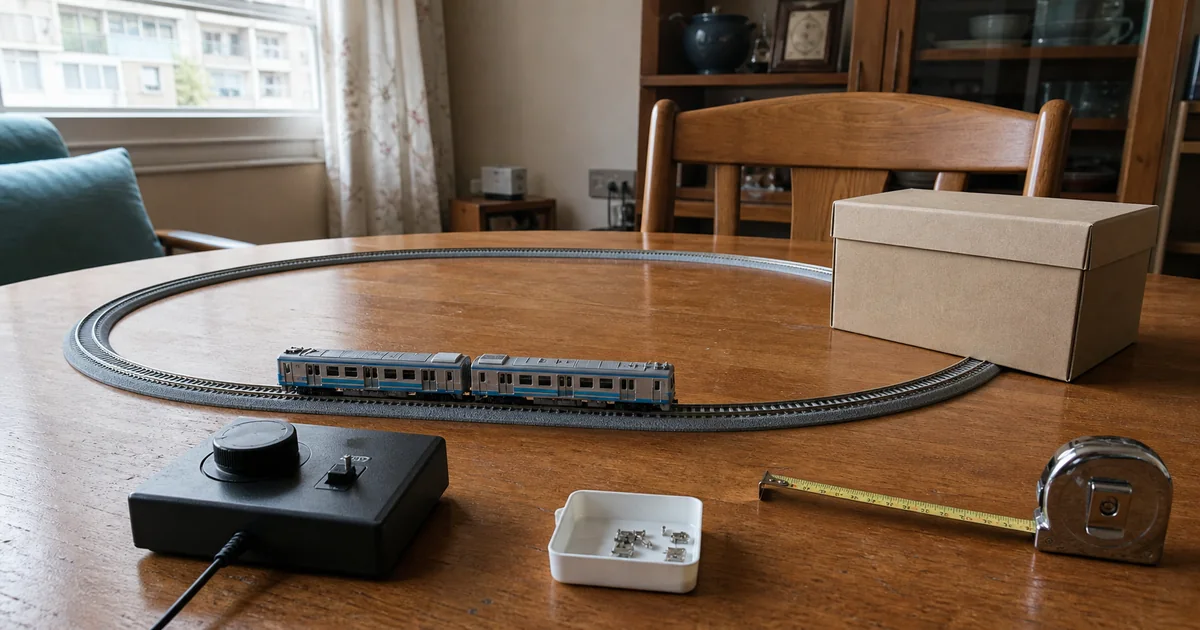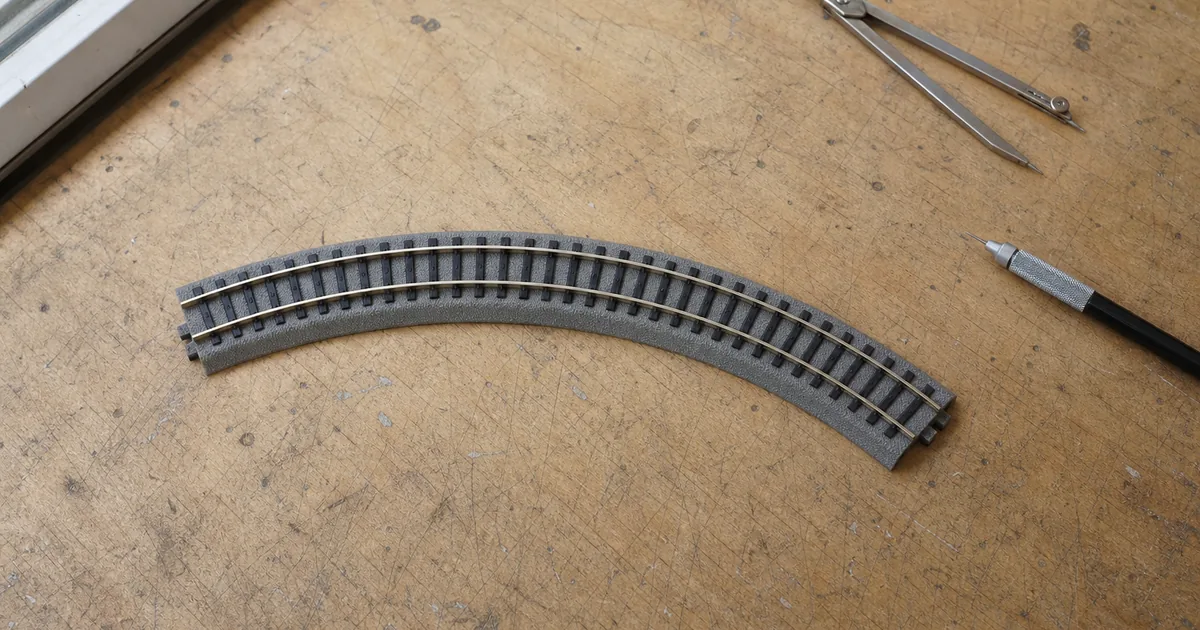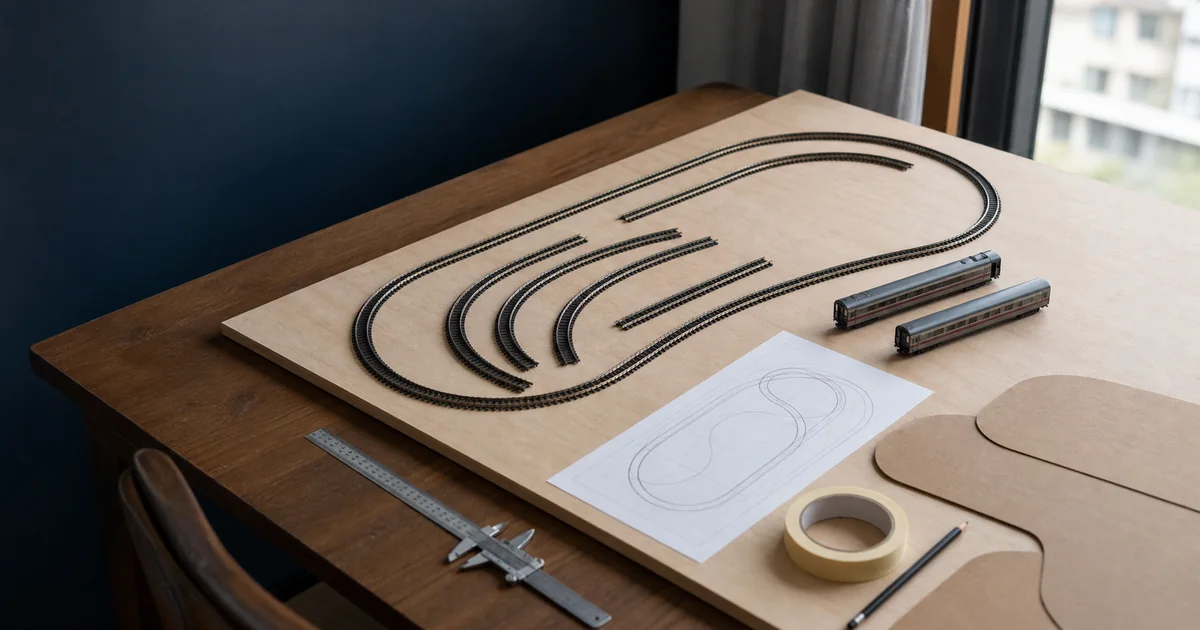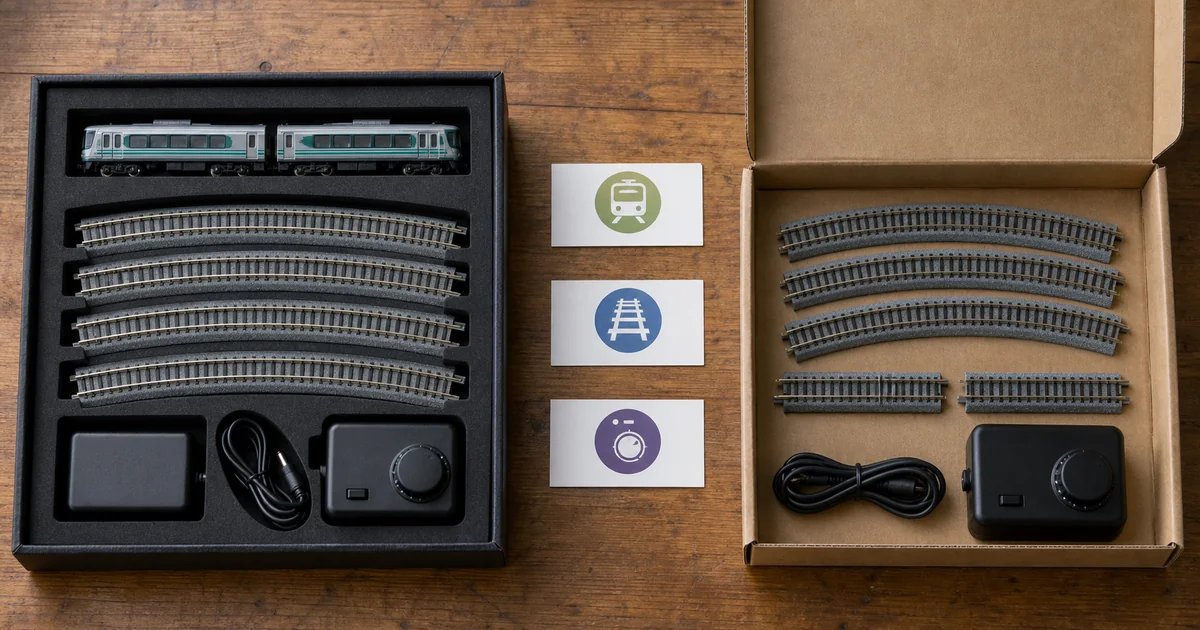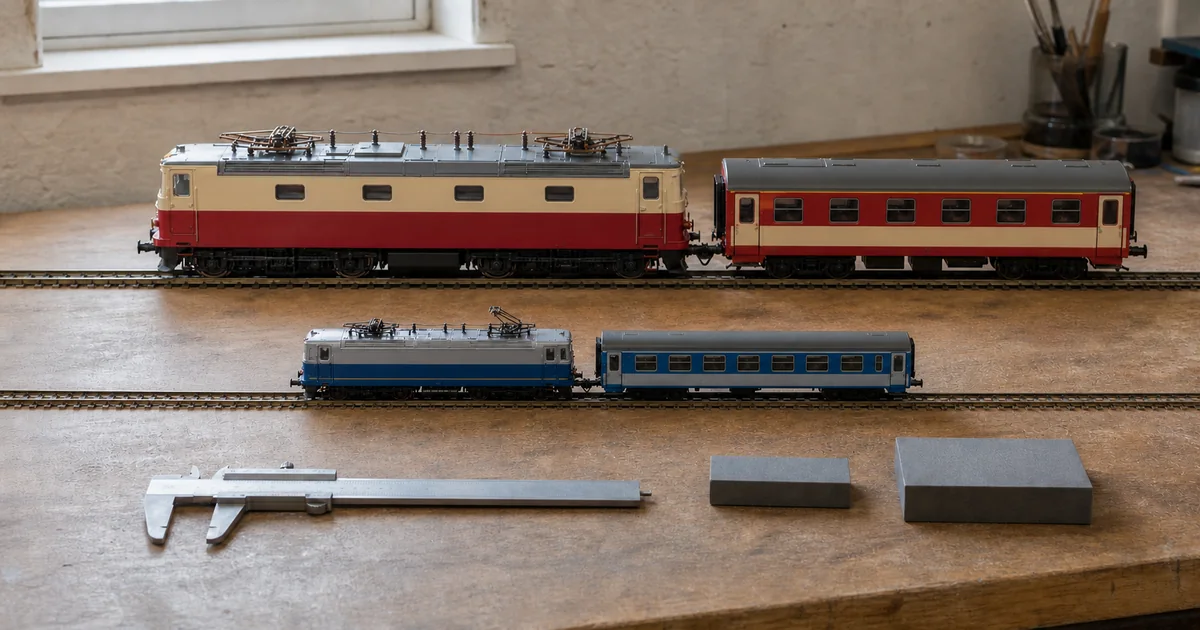
AI-generated illustration, not a photograph of a specific product
The first real fork in this hobby is which scale to build in, and it is an unusually expensive fork to unwind. Every locomotive, every piece of track, every platform and every figure you buy from here on is committed to the answer. So it is worth ten honest minutes now.
What actually separates them
Two numbers drive everything else — the reduction ratio and the track gauge. Space, price and model availability are all downstream of those.
| Comparison | N | HO |
|---|---|---|
| Track gauge | 9 mm | 16.5 mm |
| Scale, Japanese outline | 1:150 (Shinkansen 1:160) | 1:80 |
| Scale, NMRA / European | 1:160 | 1:87.1 |
| A 20 m prototype car | about 133 mm / 5.2 in (1:150) | 250 mm / 9.8 in (1:80) |
| Footprint | A desk or a door blank will do | About 3.5× the area of N |
| Japanese prototype range | Very deep | Comparatively thin |
| Cost | No universal winner: compare the exact train, track, power and scenery basket in your market | |
| Detail and handling | Small and fine | Large, easy to hold, easy to modify |
Put plainly: N can buy more railway length inside a fixed envelope, while HO makes each vehicle physically larger. Larger parts may be easier for some people to view, rerail and modify, but detail and value still depend on the exact product. Price is not a scale law: compare a complete basket for one buildable plan in each scale, not one locomotive or a retailer's category average.
🟢 Choose N when
- The layout has to share a desk, a shelf or a door blank
- You want long trains, Shinkansen, or several trains running at once
- The prototypes you like are best served in N
- Budget is a real constraint right now
🔵 Consider HO when
- You have a spare room or a permanent table
- Handling, detail and modification are the point for you
- Your target prototype genuinely exists in HO
- The per-item price is comfortable
The four-gate scale decision ledger
| Gate | Evidence to record | Pass condition |
|---|---|---|
| Space | Usable length, depth, access, aisle and storage—not room dimensions alone | The drawn plan includes real radius, overhang, roadbed, edge and hand clearance |
| Wanted models | Exact current locomotives, cars, structures and formation | A coherent starter fleet exists without substituting a different prototype |
| Operation | Continuous running, switching, long trains, scenery or close-up display | The plan supports the primary activity rather than merely closing a loop |
| Handling | Normal viewing distance, coupling, rerailing, cleaning and modification | You can perform routine tasks with your real lighting, tools and assistance |
A 15-minute two-scale bench test
This is a decision tool, not a product test. At a shop, club or with borrowed representative models, place one N car and one HO car at your normal viewing distance. Read a small marking, couple and uncouple once, rerail both trucks, and clean a short rail section. Then lay paper templates for the exact published radii inside your measured space. Record which tasks were comfortable and which plan actually fit; do not score a scale on appearance alone.
Our position, stated openly: this site is about N, and that is a bias worth naming. But it comes from a specific fact rather than loyalty — for Japanese prototypes, N is where the catalog is. Compare KATO's and TOMIX's N ranges against their HO ranges and the gap is not subtle. If you are modeling North American or British prototypes the calculus is different, because HO and OO are the mainstream there and the choice is far more even. So do not read "HO is more advanced, HO has better detail" as a reason to start there by default. Start where your space and your wanted models actually intersect. Getting a train running and keeping the hobby alive matters far more than starting at the largest size you can theoretically afford.
Scale does not scale the minimum radius
Plenty of comparisons say "N uses R280, HO uses R490" as though the numbers were derived from the ratio. They are not. Minimum radius is a mechanical property of each individual model — of its wheelbase, its coupler swing, its overhang. Within one scale, a short four-wheel wagon and a full-length coach are worlds apart. Three published examples make the point:
| Specific product | Published minimum radius | Stated condition |
|---|---|---|
| KATO N scale E5 series | R315 (about 12.4 in) | Per the full product instructions and formation |
| KATO HO EF510 | R360 (about 14.2 in) | Locomotive alone; check separately when hauling |
| TOMIX HO 313 series 1300 | R490 (about 19.3 in) | S-curves explicitly excluded |
Notice that the HO locomotive on its own needs only about 14% more radius than an N Shinkansen set — nothing like the 1.875× the scale ratio would suggest. The lesson is to look up the actual item, not to multiply.
Where the 3.5× comes from
If you want a feel for the size difference rather than a claim about it, the arithmetic is one line:
Linear ratio (1:80 against 1:150): 150 ÷ 80 = 1.875×
Area ratio: 1.875² ≈ 3.5×
So an HO train is roughly 1.9 times as long as the same train in N, and the space it sprawls across on a board is about 3.5 times as large. That is why one spare room can hold an N layout with a station, sidings and scenery, and the same room in HO might hold a plain oval. If you are working in 1:160 rather than 1:150, run the same arithmetic with 160 — the 20 m car becomes 125 mm (4.9 in), and against 1:87.1 HO at 230 mm (9.1 in) the ratio is about 1.84 linear, 3.4 by area.
What switching scales really costs
Almost nothing crosses the boundary, and that is the whole reason to decide deliberately. If you move from one to the other, plan on rebuying:
- Track and turnouts: 9 mm and 16.5 mm share nothing. The entire system is replaced.
- Platforms, structures, figures, scenery: different scale, so anything with a visible size relationship to the trains is wrong and has to be replaced or rebuilt.
- Controller and power: usually replaced. The documented exception is the KATO Power Pack Standard SX, which KATO states can be used with the AC adapter matching N or HO. That is a statement about one product, not a general rule for controllers, feeders and connectors.
What genuinely survives is the generic stuff: tools, a decent work light, rail cleaner, paints — and everything you have learned about wiring, cleaning and running. That is not nothing, but it is not a layout either. Choosing once, on the basis of your real space and the models you actually want, is far cheaper than choosing twice.
How to choose N or HO without guessing
1. Measure the usable envelope
Record permanent and setup-only length, depth, access, storage and aisle limits. Do not start from a generic table size.
2. Name the operating goal
Choose continuous running, switching, long formations, scenery, close-up detail or modification as the primary experience.
3. Build a real product shortlist
List exact locomotives, cars, track and structures in each scale from current maker pages. Do not assume catalog depth or price.
4. Draw both plans to scale
Use the shortlisted train's published radius and measured formation length, adding roadbed, overhang, access and edge clearance.
5. Run a handling and visibility check
View and handle representative models if possible. Check reading distance, coupling, rerailing and maintenance with the tools or assistance you will actually use.
6. Apply the no-regret gate
Choose only when one scale satisfies space, wanted models, operation and handling together. If neither does, change the layout concept before buying a fleet.
Railway-culture answer: one gauge can represent different prototypes
Scale and gauge solve different problems. NMRA material defines standard N as 1:160 and HO as 1:87.1, while Japanese makers commonly use 1:150 N and 1:80 HO for conventional Japanese trains on the same 9 mm and 16.5 mm model gauges. Shinkansen and many foreign-prototype N models use 1:160. This is not a mistake: the chosen scale/gauge combination represents prototype railways with different real track gauges.
Why Japanese N is often 1:150
Open the note to separate prototype gauge, model gauge and reduction ratio.
Sources
Last checked 2026-08-24. Manufacturer pages change, and a product page existing does not mean the item is in stock. Before buying, open the exact SKU page and its instructions. We make no current price or availability claim.
- KATO FAQ: N gauge is 9 mm, 1:150, with Shinkansen and foreign prototypes at 1:160
- TOMIX beginners page: N gauge and scale
- TOMIX HO catalog: 1:80 on 16.5 mm
- NMRA Standards and Recommended Practices (S-1.2 Standard Scales, for the 1:87.1 HO definition)
- NMRA Beginner's Guide 2024 (scale/gauge definitions, 1:160 N, 1:87.1 HO and planning goals/resources)
- KATO E5 series (N, R315), KATO EF510 (HO, R360 light engine), TOMIX 313-1300 (HO, R490)
- KATO Power Pack Standard SX: N and HO adapter conditions
Put the train, the radius and the table on one drawing
N scale and HO: common questions
How much bigger is HO than N scale?
Comparing 1:80 Japanese HO against 1:150 Japanese N, the linear ratio is 150 divided by 80, or 1.875 times. Because footprint grows with the square of that, the area ratio is roughly 3.5 times. In concrete terms, a 20 m prototype car comes out around 133 mm (5.2 in) in 1:150 and 250 mm (9.8 in) in 1:80. That is pure scale arithmetic; the finished model length is whatever the product page says.
Is Japanese N scale 1:150 or 1:160?
Both exist. KATO and TOMIX both list N gauge track as 9 mm. Japanese prototypes are commonly 1:150, Shinkansen are 1:160, and KATO notes that foreign prototypes are also 1:160. The gauge is constant; the scale on it is not. Check what the specific product states rather than assuming.
Is HO always 1:87?
No. Japanese HO — TOMIX's current catalog, for instance — is mostly 1:80 on 16.5 mm gauge, while HO as defined by the NMRA and used for North American and European prototypes is 1:87.1 on the same 16.5 mm. Identical track gauge, different scale, because Japanese prototype track is narrower than standard gauge. Which one you are buying depends on the brand and the prototype's country.
Should I choose N or HO for a home layout?
Answer two questions first: how much permanent space you have, and what you want to model. If the layout has to live on a desk, a shelf or a door blank, N is the realistic choice — the same train needs less than a third of the area. If you have a spare room or a dedicated table, and the models you actually want are well served in HO, the extra size buys real detail and much easier handling. For Japanese prototypes specifically, N has by far the deeper catalog, and that alone decides it for many people.
Does HO always need a bigger minimum radius than N?
Directionally yes, but do not scale it by arithmetic. Published examples: KATO's N scale E5 series is rated R315 (about 12.4 in), KATO's HO EF510 is R360 (about 14.2 in) for the locomotive on its own, and TOMIX's HO 313 series 1300 is R490 (about 19.3 in) with S-curves specifically excluded. Each figure belongs to one product under stated conditions. Look up the item you actually intend to buy.
Can N and HO share the same track?
No. N is 9 mm gauge and HO is 16.5 mm. Track, turnouts, power connectors and geometry are all different systems. The fact that both are commonly two-rail DC does not make them mixable — choose one system and buy into it.
If I switch from N to HO, do I need a new controller?
Usually yes. The track definitely changes, since 9 mm is not 16.5 mm, and platforms, structures and figures all have to be re-evaluated because the scale changed. Controllers depend on the model: KATO states that the Power Pack Standard SX can be used with the AC adapter appropriate to N or to HO, which is a documented exception rather than a general rule. Do not assume any controller, feeder or connector carries across.
What actually carries over if I change scales?
Tools, a good light, cutters, a track rubber, paints and your own skills are often scale-agnostic. Rolling stock, track, turnouts, platforms, structures and figures are not. Controllers and feeders require product-specific verification rather than assumption.
Is N scale always cheaper than HO?
No. Scale alone does not determine the price of a particular locomotive, train set, controller or layout. Compare an exact starter basket in each scale, including the train, track plan, power, structures and any required tools; do not extrapolate from one product.
Does HO always have better detail than N?
A larger model can make features easier to see and handle, but detail level depends on the exact product, tooling and viewing distance. Compare the specific models you want rather than treating scale as a quality grade.
Which scale is easier if I have limited vision or dexterity?
Do a hands-on check instead of accepting a universal answer. HO parts are physically larger, but the relevant test is whether you can read markings, rerail wheels, couple cars and perform routine cleaning at your normal workbench with your lighting, magnification and tools.
Can I use N and HO together for forced perspective?
They can appear in one scenic composition as separate, non-interacting layers, but they cannot share track or rolling stock. Keep the smaller scale visually distant, avoid side-by-side reference objects that reveal the mismatch, and treat each powered railway as a separate system.