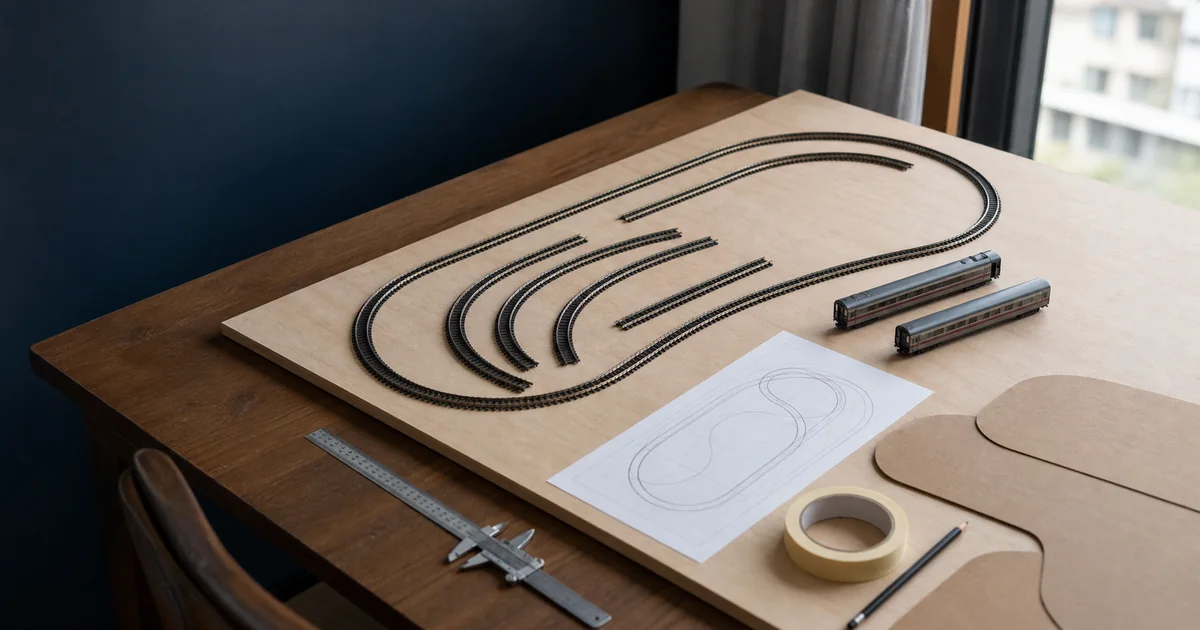
AI-generated illustration, not a photograph of a specific product
"I don't have room for a layout" is the most common reason people talk themselves out of this hobby — and it is usually wrong. A shelf, a coffee table, or a board you stand against the wall when you are done is enough to run trains properly.
What a small space really does is change which choices are open to you. Some of the tightest curves ever made exist precisely for this, but they come with restrictions that catch people out. This page covers how small you can genuinely go, what it costs you, and the traps that only appear when space is tight.
Two decisions to make before buying track
Stock-before-track gate
GO: the exact vehicle's current maker information accepts the planned radius, and the complete formation passes a temporary test. NO-GO: compatibility rests only on the N scale label, body length or a different model's result. Enlarge the radius or choose a shuttle.
Real-footprint gate
GO: the measured envelope contains track centerline geometry plus roadbed, worst-case body swing, scenery clearance, a protective edge margin and hand access. NO-GO: the board width equals 2R or a turnout joint becomes unreachable.
A geometric fit and an operational fit are different things. KATO says its R150 CV1 can be arranged in 325 × 573 mm, yet also warns that ordinary N gauge vehicles are not generally suitable for Compact track. KATO USA separately says its models are designed around R249 with factory couplers and that operation below that radius must be determined for the specific model.
How small is small? The tightest curves available
Both makers produce curves far tighter than their standard ranges, aimed specifically at compact layouts:
| Curve | Maker's positioning | What it is for |
|---|---|---|
| TOMIX C103 | Super Mini Curve | Short stock — tram-type models and similar. TOMIX publishes a cleared-vehicle list |
| TOMIX C140 / C177 | Mini Curve | Still restricted; same cleared-vehicle list applies |
| KATO R117 / R150 / R183 | UNITRACK Compact | Trams, Pocket Line and similarly short vehicles |
As a concrete reference, TOMIX's 91080 Super Mini Rail Set produces a track arrangement of roughly 206 × 346 mm (about 8 × 14 in) — genuinely smaller than a sheet of A4.
Radius is not table size
This trips up almost everyone planning their first small layout. The radius is measured from the center of the circle to the track centerline, so twice the radius gives you the centerline diameter — and nothing else.
The board you actually cut has to add:
- the roadbed edge — the moulded plastic base sits wider than the rails;
- the body overhang as a longer car swings out through the curve;
- any platform, building or scenery alongside the track;
- a margin at the table edge, so a derailment does not end up on the floor.
Never cut a baseboard at exactly 2R. The full arithmetic, with both makers' curves and the resulting board sizes in millimeters and inches, is in minimum radius and layout size.
Four styles that work when a loop will not fit
If the trains you want cannot take a tight curve — or the circle simply will not fit — you have not run out of options. You have run out of one option.
🔄 Plain loop
Just a circuit, with no passing track or long platform. The most space-efficient arrangement there is. Pair it with short stock the maker has cleared, put a coffee on, and watch it run.
↔️ Point-to-point shuttle
Skip the full circle. Give the long edge of the board to a station, an industrial siding or a small yard, and reverse at each end. Far more engaging to operate than watching a loop — this is where small layouts often beat big ones.
🧩 Sectional modules
Assemble when you play, pack away when you do not. Trading storage for setup time buys you a much larger radius and a longer scene than a permanently fixed board of the same footprint.
🖼️ Display plus test track
If what you love is a full-length formation, accept it: build a display scene and a short length of powered track to run it occasionally. You keep the complete train rather than compromising it down to four cars.
Treat the constraint as the theme. A small board suits a single station on a branch line, a tram street scene, or a compact freight siding far better than a compressed main line. Accept the limit and it stops being a limit — it becomes the subject.
Five things that bite in a small space
- Platform length follows your longest train. Couple the longest formation you actually intend to run and measure it physically, nose to tail. Do not multiply one car's length by the car count — the coupler gaps add up and the real figure is longer.
- S-bends need a straight between them. Two opposing curves joined directly twist adjacent cars in opposite directions over a very short distance, which snags couplers and lifts wheels. Insert a straight at least as long as your longest car, or open the radius out.
- Grades get steep fast. Grade % = rise ÷ run × 100. The shorter your board, the steeper the climb for the same height — which is why a multi-level scheme is much harder on a small table than it looks. Work the number out before committing.
- Test power at the far point. One feeder is usually enough for a short circuit, but not guaranteed. After temporary assembly, run slowly at the point furthest from the feeder and through every turnout route. Repeated stuttering or flickering means adding another feed.
- You have to be able to reach the faults. Small layouts get dense, and it is very easy to bury a turnout or a rail joint somewhere your hand does not fit. Before anything is fixed down, check with your hand and a cleaning cloth: can you retrieve a derailment, clean that rail, and get at that turnout? If not, move it.
How to prove the layout before fixing track down
1. Record the usable envelope
Measure length, depth and storage clearance. Reserve an edge margin and space for hands, wiring and removable structures.
2. Choose the operating job
Pick continuous loop, point-to-point shuttle, switching scene, sectional module or display with a short test track.
3. Lock the longest train
Choose the exact locomotive and longest formation. Use the maker's current minimum-radius information; do not infer compatibility from the words “N scale.”
4. Calculate the real footprint
Add roadbed width, body overhang, scenery clearance and a derailment margin to the track-centerline geometry. Never use 2R as finished board width.
5. Assemble temporarily
Lay the whole route without glue, including turnouts, feeders, platforms and opposing curves. Confirm every rail joint and turnout remains reachable.
6. Run the acceptance gate
Run the longest train slowly and at intended speed in both directions and through every route. Check overhang, couplers, voltage at the far point and hand access before committing.
Small is a style, not a compromise
It is worth saying plainly: living somewhere small does not put this hobby out of reach. A 60 × 30 cm shelf (roughly 24 × 12 in), or a board you can stand on its edge in a cupboard, is enough to start. Even a short point-to-point shunting scene is genuinely absorbing to operate — arguably more so than a large loop that just goes round.
A tight space forces you to design every inch deliberately, and some of the most admired layouts in the hobby are also among the smallest. Start with one short train and one small circuit. You will probably find that "small" turns out to be a style you actively like.
When you are ready to draw it, the track planner takes your board dimensions in inches or millimeters and shows whether the arrangement closes — worth doing before any wood gets cut.
Railway-culture answer: compact track changes the subject
KATO positions UNITRACK Compact for UNITRAM, Pocket Line and other small-motor vehicles, not as a smaller substitute for every main-line train. That constraint naturally favors street-running, tram stops and short local-service scenes. Choose a railway whose operating pattern supports short vehicles and close scenery, rather than compressing a long-distance main line until it stops working.
Why a tram scene belongs on a tiny board
Open the note to connect compact track geometry with the operating story, not just the footprint.
Sources
Checked 2026-08-24. Radii, cleared vehicles and plan dimensions follow KATO, KATO USA and TOMIX first-party pages. Vehicle compatibility must be confirmed against that model's current product page and supplied instructions; this article does not infer compatibility outside those statements.
- TOMIX Super Mini / Mini Curve cleared-vehicle list
- KATO UNITRACK Compact (R117 / R150 / R183, vehicle restrictions, and the R249 default where nothing is stated)
- KATO USA FAQ (R249 design radius with factory couplers and model-specific determination below it)
- KATO USA 8.5-inch-radius track plan (first-party example and suggested short formation)
- KATO Compact plan CPT01–05 (official geometry examples)
Draw the outline before you cut the board
Frequently asked questions
What is the smallest table an N scale layout needs?
There is no fixed minimum — it depends on how tight a curve you use and how short your trains are. With TOMIX's C103 super-mini curve and small vehicles, a complete circle of track is smaller than a sheet of A4 paper. But that is the track footprint only: the actual board still needs the roadbed edge, the overhang of the body swinging out on the curve, and a margin so nothing rolls off. Choose the stock and the track first, then mock it up and measure what you really need.
Will every N scale train run on TOMIX C103?
No. C103 is a super-mini radius and TOMIX states plainly that it is not for all vehicles — it is aimed at short stock such as tram-type models. Longer vehicles, Shinkansen sets and ordinary commuter units generally will not manage it. Check TOMIX's published cleared-vehicle list before buying rather than assuming that anything labelled N scale will get round.
Will every N scale train run on KATO R150 and R183?
No. KATO positions its Compact range (R117 / R150 / R183) for trams, Pocket Line models and similarly short stock, and the list of vehicles that can use them is limited. Where a product does not state a minimum radius, KATO's guidance is to treat R249 as the minimum — meaning ordinary stock still wants R249 or larger.
What is the difference between curve radius and table size?
The radius is measured from the center of the circle to the track centerline, so twice the radius is only the centerline diameter. The board you actually cut has to add the roadbed edge, the body overhang of longer cars as they swing out on the curve, any platform or building alongside, and a margin at the table edge so a derailment does not end up on the floor. Never cut a board at exactly twice the radius.
Besides running in circles, what else can I do in a tiny space?
Quite a lot. A plain loop with no passing track is the most space-efficient. A point-to-point shuttle skips the full circle entirely and gives the long edge to a station or a yard, which is far more engaging to operate. Sectional modules let you assemble a bigger radius when playing and pack it away afterwards. And if you love long formations, a static display with a short test track keeps the complete train intact. Small does not mean you cannot play — it means picking the right style.
How do I decide platform and straight length?
Couple up the longest train you intend to run and measure it physically, nose to tail, then compare that against the usable length of your platform or siding. Do not multiply one car's length by the number of cars: the gaps at each coupler add up, so the real total is longer than the arithmetic suggests.
Why do S-bends cause trouble on small layouts?
An S-bend is two curves in opposite directions joined together, which twists adjacent cars the opposite way in quick succession — over a short distance that readily snags couplers or lifts a wheel. The fixes are to insert a short straight between the two curves (at least as long as your longest car), to open out the radius, or to reroute. Whatever you choose, prove it by running your longest vehicle through slowly in both directions.
Is one feeder enough for a micro layout?
Usually, but it is not guaranteed — joints, turnouts and dirt all affect how well power reaches the far side. Once the track is temporarily laid, run slowly at the point furthest from the feeder and through each turnout route. If the train stutters repeatedly or the lights flicker, add another feed of the same polarity following your system's wiring guidance.
Should a micro layout be a loop or point to point?
Choose a loop for continuous watching and a point-to-point plan for operation, a longer scenic run or full-size stock that cannot take compact curves. The better plan is the one that meets your operating goal with stock that passes the maker's radius limits and your temporary-layout test.
How much wider than the track should the baseboard be?
There is no universal extra width. Add the actual roadbed edge, the worst inside and outside body overhang of your longest vehicle, scenery or platform clearance, and a protective edge margin. Mock up the exact track and train before cutting the board.
Can I trust a train that completes one slow lap?
No. Test the longest train in both directions, at crawl speed and intended operating speed, through every turnout route and any reverse curve. Watch couplers and body overhang, check the point furthest from the feeder, and repeat after adding platforms or scenery mock-ups.
Does KATO's 8.5-inch plan prove all KATO trains fit?
No. KATO USA presents an 8.5-inch-radius compact plan with suggested short rolling stock, while its FAQ states that N scale models are designed around R249 with factory couplers and that smaller curves require model-specific determination. A track plan is not a universal compatibility list.