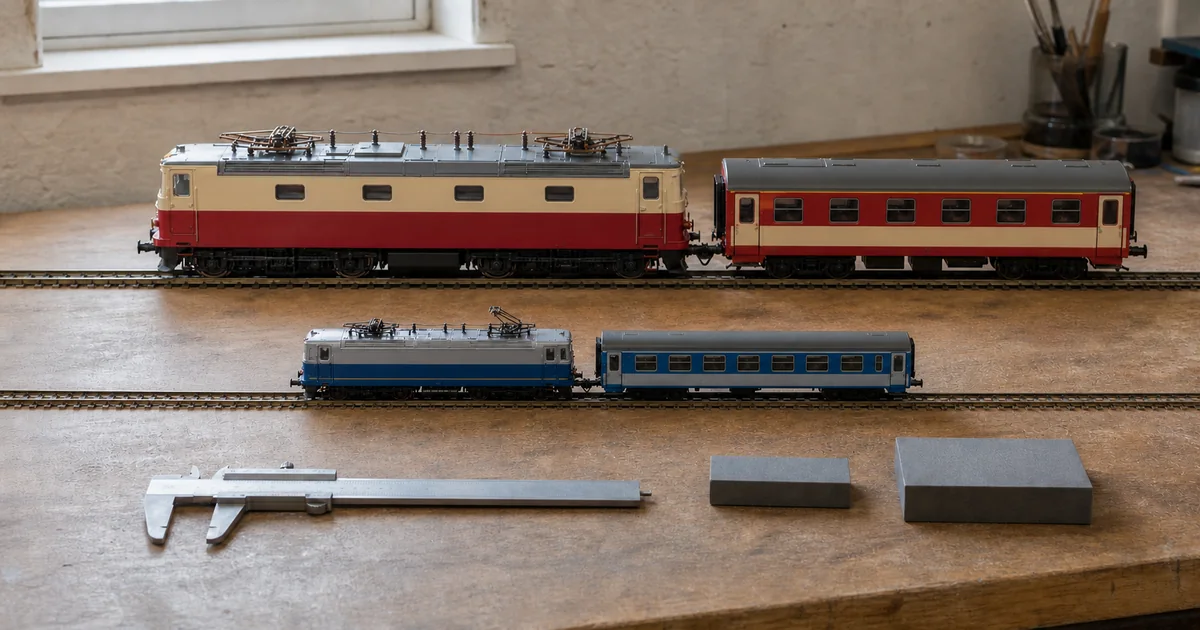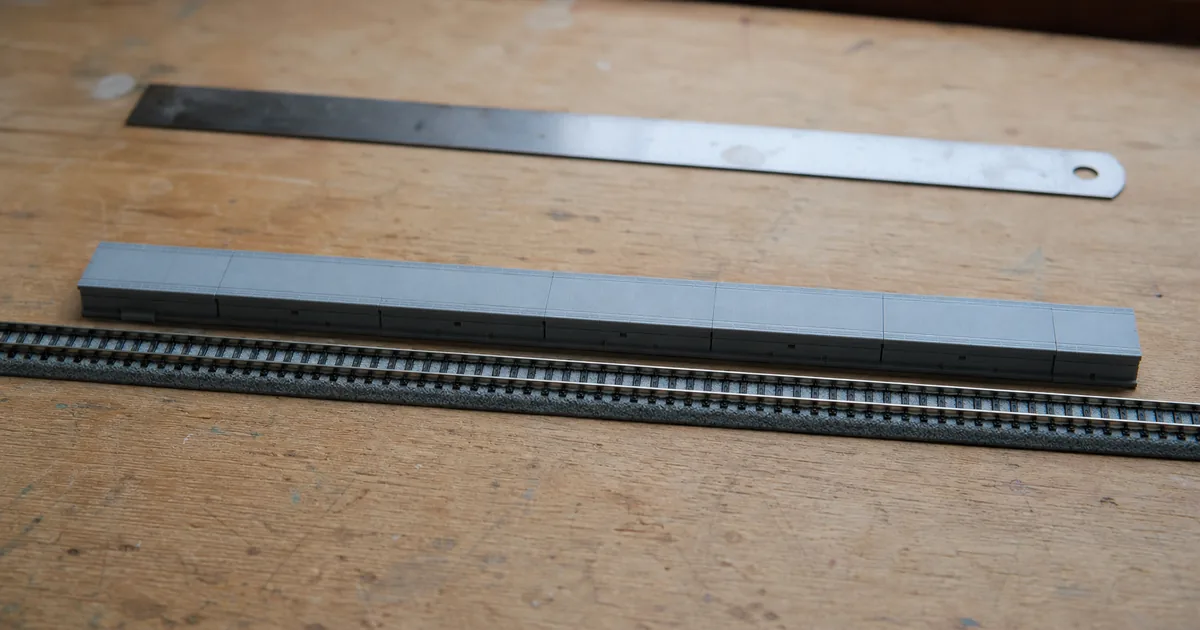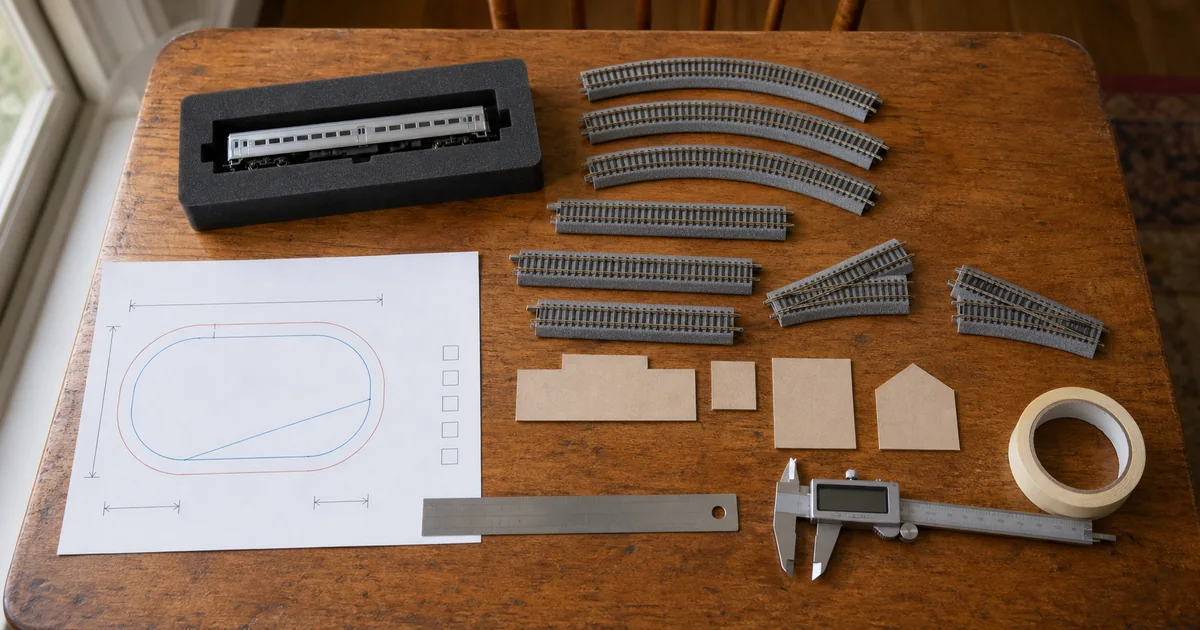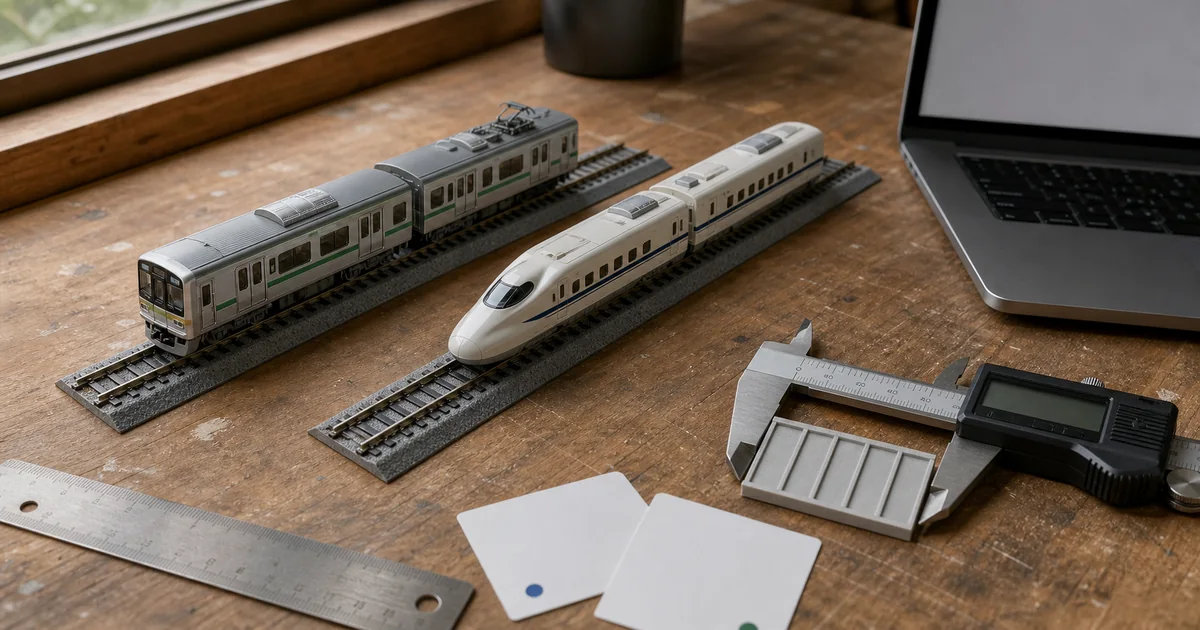
AI-generated illustration, not a photograph of a specific product
Read two product pages for Japanese N scale models and you will see two different ratios. That is not an error on either page, and it is not something you get to average out.
Why one gauge carries two scales
KATO and TOMIX both define N the same way: 9 mm gauge, with Japanese conventional-line prototypes reduced at 1:150 and Shinkansen and foreign prototypes at 1:160. That looks contradictory until you separate three words that people use interchangeably:
| Term | Answers | For N |
|---|---|---|
| Gauge | How far apart the inside faces of the rails are | 9 mm |
| Scale | How many times smaller the model is than the real thing | 1:150 conventional / 1:160 Shinkansen |
| Compatibility | Whether two things will actually run together | Cannot be derived from the two rows above |
The reason both ratios land on 9 mm is that Japanese conventional-line prototype track is narrower than standard gauge. Reduce a narrower prototype by a smaller factor and you arrive at the same model gauge. So "both are N scale" and "both are the same scale" are genuinely different statements. If you are weighing N against a larger scale entirely, see N vs HO.
Real ↔ model converter
Convert in either direction, with metric or imperial units on the input and the output.
Six steps from a ratio to an accepted result
- Identify the exact prototype and product. Read the current product page or box and record whether the item is 1:150 or 1:160; 9 mm gauge alone does not answer that question.
- Choose the conversion direction. Decide whether this is prototype → model, model → prototype, or one already-scaled file → another scale.
- Normalize the units. Put the starting and controlling dimensions in one unit before calculating. Do not mix meters and millimeters inside one formula.
- Calculate with the correct denominator. Divide for real → model, multiply for model → real, or use source denominator ÷ target denominator for scale → scale.
- Record a scale passport. Keep the source, target, controlling dimension, formula and intended use together so the answer does not become an unlabeled number.
- Run the physical acceptance check. Measure the model or print a small test, then approve clearances, interfaces, wall thickness, holes and fit before buying multiples or printing the final part.
The scale passport: stop an unlabeled number becoming a mistake
A correct result can still be used in the wrong place. Keep this compact ledger with the layout plan, CAD file or shopping list:
| Passport field | Record | Acceptance question |
|---|---|---|
| Identity | Prototype, manufacturer, product or file version | Did the source explicitly state 1:150 or 1:160? |
| Direction | Real → model, model → real, or source scale → target scale | Did you use the matching formula? |
| Controlling dimension | One known length, wheelbase, doorway or mounting span | Can it be checked independently after conversion? |
| Intended interface | Platform, structure, vehicle, chassis, coupler or scenery | Which adjoining part sets the scale and clearance? |
| Manufacturing limits | Wall, hole, clip, tab, support and material allowance | Will the scaled feature still print and work? |
| Evidence | Source URL, calculation date and physical test result | Could another builder reproduce the decision? |
Go: identity
The exact product or file has a stated scale and a known controlling dimension.
Go: arithmetic
Units are normalized, direction is explicit and a reverse calculation returns the starting value.
Go: interface
The converted item clears the platform, track, doorway, chassis or neighboring scenery it must meet.
No-Go
Unknown source scale, mixed units, an unverified hole or wall, or a failed side-by-side check means stop and resolve it first.
Our take: the useful part is not treating Shinkansen as 1:150
Most of the time the 6.67% difference is invisible — you are not going to notice it looking at one car. Where it stops being invisible is anywhere you add lengths together. A station, a passing loop, a fiddle yard, a shelf. Eight cars at the wrong ratio is about 67 mm out, which is roughly a quarter of a KATO platform section.
So the practical rule is narrow and worth remembering: match the denominator to the stock that will actually stand there. When you size a platform with the platform length calculator, pick 1:160 for a Shinkansen set and 1:150 for a conventional formation, and the arithmetic will not quietly drift.
A 20 m car, both ways
| Cars | At 1:150 | At 1:160 | Difference |
|---|---|---|---|
| 1 | 133.3 mm (5.25 in) | 125.0 mm (4.92 in) | 8.3 mm |
| 4 | 533.3 mm (21.0 in) | 500.0 mm (19.7 in) | 33.3 mm |
| 8 | 1,066.7 mm (42.0 in) | 1,000.0 mm (39.4 in) | 66.7 mm |
| 16 | 2,133.3 mm (84.0 in) | 2,000.0 mm (78.7 in) | 133.3 mm |
Scale arithmetic from a nominal 20 m prototype car; coupler spacing is not included. Note the sixteen-car difference is exactly one car length — that is not a coincidence, it is the 6.67% compounding.
Rescaling a 3D print between scales
If an STL is already at one scale and you want it at another, you do not divide by the new scale — that would treat the file as though it were full size. You need the ratio between the two:
Rescale percentage = source denominator ÷ target denominator × 100%
| Source | Target | X / Y / Z scale | Change |
|---|---|---|---|
| 1:160 | 1:150 | 106.6667% | 6.6667% larger |
| 1:150 | 1:160 | 93.75% | 6.25% smaller |
Those two percentages are not symmetric, which catches people out — going up 6.6667% and coming back down is not "minus 6.6667%". Use the formula rather than reversing a remembered number.
The 6.67% headline is linear. If the same solid geometry goes from 1:160 to 1:150, projected area grows by about 13.78% and volume by about 21.36%. That does not predict exact resin use or print time — orientation, hollowing and supports matter — but it explains why material and support demand can move faster than length.
This is a geometry tool, not a compatibility check
One boundary worth stating plainly: this converter answers how big something is and how much to scale it. It does not answer whether two things will run together. Two products can both say N scale, both sit on 9 mm gauge, and still differ in wheel flanges, couplers, minimum radius and current pickup — and none of that is derivable from a ratio. Those are per-product questions, answered by the instruction sheet. For couplers specifically, see the coupler compatibility guide; for what a vehicle will take on a curve, the radius guide.
Railway-culture answer: 9 mm was also a housing decision
KATO's first-party history says the company chose to develop plastic 9 mm gauge because it saw a future for the smaller format in Japan's housing environment, then released Japan's first mass-produced N-gauge models in 1965. The practical link to this converter is direct: Japanese N became a compact shared operating gauge, while the model ratio still follows the prototype category — generally 1:150 for conventional lines and 1:160 for Shinkansen.
How compact Japanese layouts helped 9 mm gauge take root
Open the note for the 1960s decision that sits behind today's 1:150 and 1:160 labels.
Sources
Checked 2026-08-25. Gauge and scale definitions follow KATO's and TOMIX's current published descriptions of N gauge. The conversion, area and volume figures are arithmetic shown so you can reproduce them. For any specific product, the current product page, box or instruction sheet takes precedence.
- TOMIX beginners page — 9 mm gauge and the scales used on it
- KATO FAQ: N gauge — 1:150 with Shinkansen and foreign prototypes at 1:160
- KATO brand history — the decision to develop 9 mm gauge and the 1965 mass-production milestone
Now put the number to work
Scale conversion: common questions
Why does N scale have both 1:150 and 1:160?
Because gauge and scale are different things. KATO and TOMIX both define N gauge as 9 mm between the rails, then model Japanese conventional-line prototypes at 1:150 and Shinkansen and foreign prototypes at 1:160. The track is shared; the reduction ratio on it is not. Japanese prototype track is narrower than standard gauge, which is why a different ratio still lands on 9 mm.
How different are 1:150 and 1:160 in practice?
About 6.67 percent in every linear dimension. A 20 m prototype car is 133.3 mm at 1:150 and 125 mm at 1:160 — a difference of 8.3 mm on one car. Over a long formation that adds up: eight cars differ by about 67 mm, more than two and a half inches. It is small enough not to look wrong on its own and large enough to spoil a station or storage-length calculation.
What is the difference between gauge and scale?
Gauge is the distance between the inside faces of the rails, which for N is 9 mm. Scale is how many times smaller the model is than the prototype — 1:150 or 1:160 here. A third thing, compatibility, follows from neither: whether two vehicles can run together depends on wheel standards, couplers, minimum radius and electrical arrangements, and has to be checked per product.
What percentage do I use to rescale a 3D print from 1:160 to 1:150?
106.6667 percent, applied equally to X, Y and Z. The formula is source denominator divided by target denominator times 100 — here 160 ÷ 150. Going the other way, from 1:150 to 1:160, is 93.75 percent, a reduction of 6.25 percent. Note the two percentages are not symmetric, which is why you should use the formula rather than assuming the same number works both ways.
Can I just divide by the new scale to rescale a model?
No, and this is the common mistake. Dividing by the target scale treats the file as though it were full size. A file that is already at some scale needs the ratio between the two scales — source denominator divided by target denominator. Getting this wrong by dividing a 1:160 file by 150 makes it more than a hundred times too small.
Is a uniform rescale safe for a 3D print?
It preserves the geometry's proportions and nothing else. After scaling you have to re-check minimum wall thickness, hole diameters, clips and tabs, and supports, because all of them scaled too. Scaling a body shell up also scales the wheel openings and coupler positions, so it will not automatically fit 9 mm gauge running gear.
Does the same scale mean two models will run together?
No. This converter answers how big something is, not whether it will run. Two products can both say N scale and both sit on 9 mm gauge while differing in wheel flanges, couplers, minimum radius and how they pick up current. Those are per-product questions answered by the instruction sheets, not by a ratio.
Which scale should I use for a station or platform calculation?
Match it to the stock that will actually stop there. Use 1:150 for Japanese conventional-line formations and 1:160 for Shinkansen. On a long train the choice is worth most of a car length, so a platform sized with the wrong denominator can leave the last vehicle hanging off the end.
Is the area or volume difference also 6.67 percent?
No. The 6.67 percent figure is linear. Scaling the same shape from 1:160 to 1:150 makes its area about 13.78 percent larger and its volume about 21.36 percent larger. That is why resin use, mass and support demand can change faster than the headline length suggests.
Can 1:150 and 1:160 scenery be mixed on one layout?
Often, but approve it visually rather than by label alone. A generic tree or distant building can tolerate variation; a platform edge, doorway, railing, vehicle or repeated streetscape makes the difference easier to see. Record which scale governs every close interface and compare the pieces side by side before buying multiples.
What should I measure before rescaling a 3D file?
Choose one controlling dimension that can be checked independently — for example body length, wheelbase, door height or mounting-hole spacing — and record the source scale. After rescaling, verify that dimension and print a small interface coupon where fit matters before committing to the final part.
Is every Japanese N gauge model 1:150?
No. KATO and TOMIX describe 1:150 as the general ratio for Japanese conventional-line N gauge and 1:160 for Shinkansen; KATO also identifies foreign prototypes as 1:160. The current product page, box or instruction sheet controls for the exact item, so record that stated scale rather than guessing from country or 9 mm gauge.