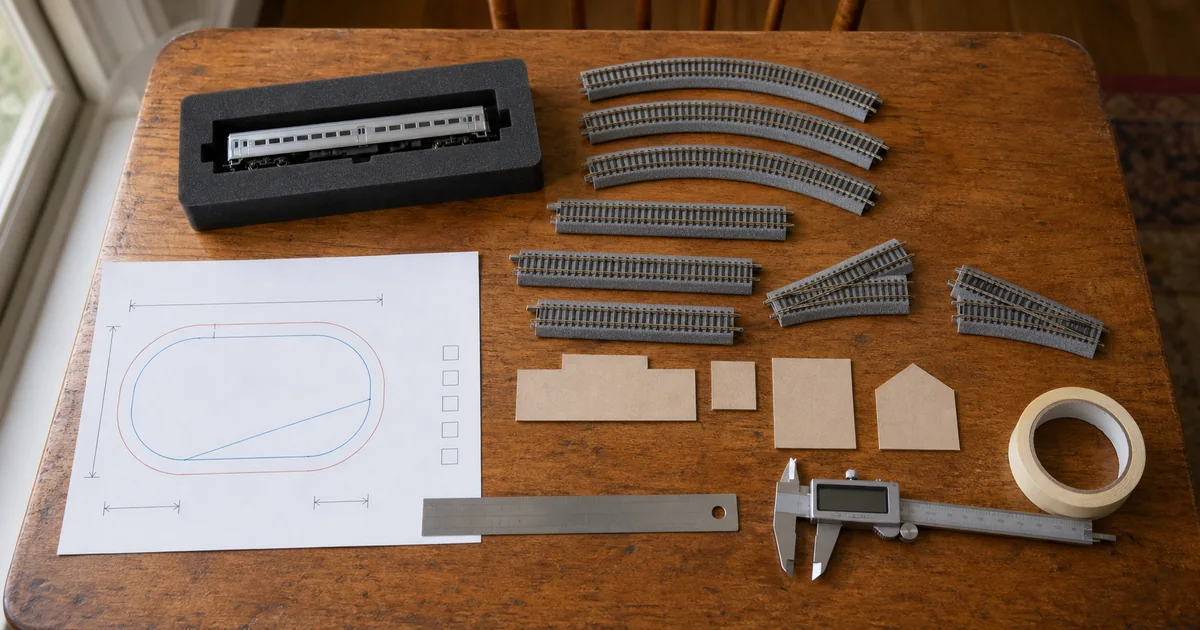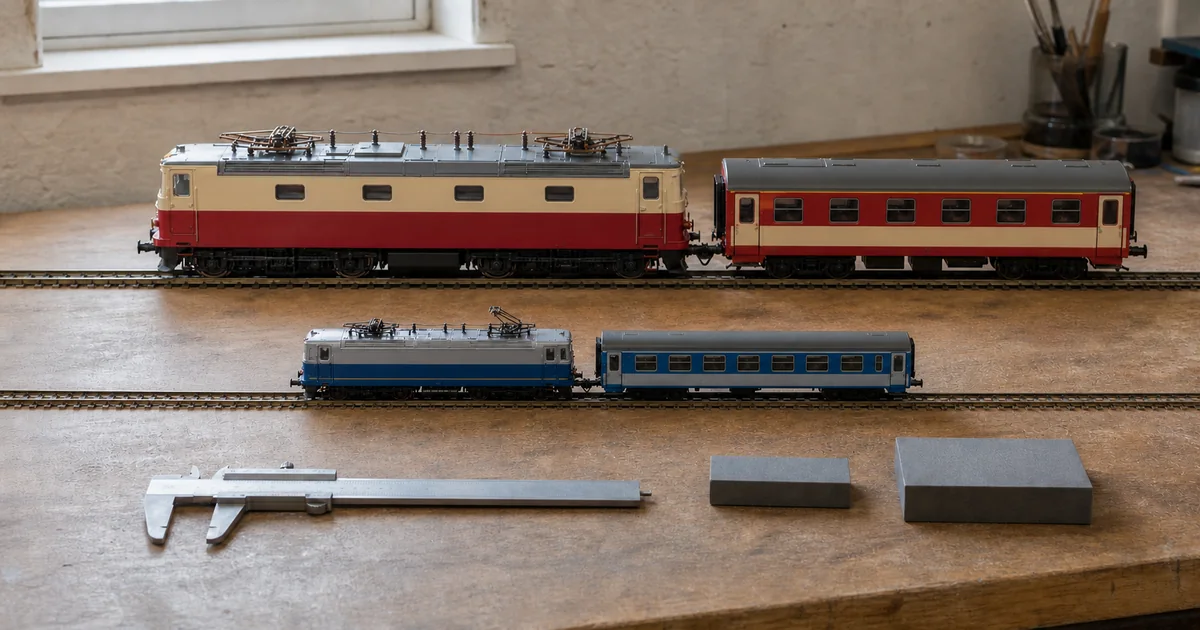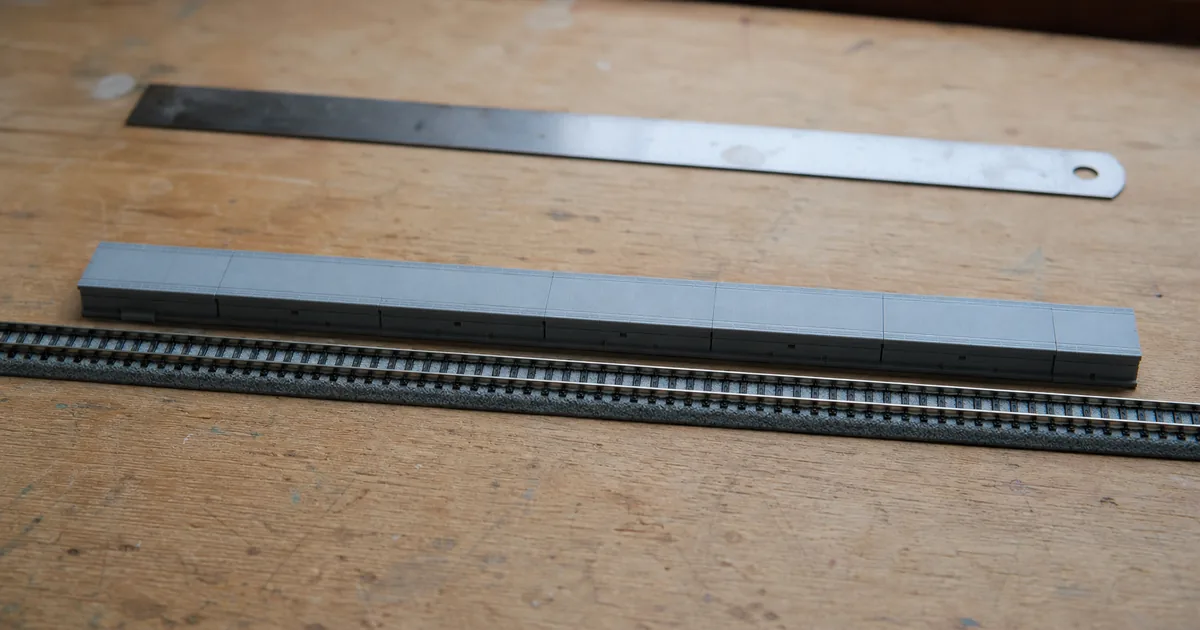
AI-generated illustration, not a photograph of a specific product
Buying the train first and the station second is how most people end up with a platform two cars too short. The fix is arithmetic, and it takes about a minute — but only if you do it in the right order and use the right number for train length.
Three ways to get train length, in order of accuracy
- Measure the coupled train. Put the whole formation together and measure end to end. This is the only method that includes the couplers you actually run, and it is the number to buy against.
- Add up published model lengths. Take each car's stated model length and total them. Good for planning something you do not own yet, but it usually omits coupler spacing.
- Prototype length ÷ scale × car count. The quickest and the least accurate. It ignores coupler spacing and assumes every car is the same length, which is rarely true at the ends of a formation.
Plan with the estimate, buy against the measurement. That single habit prevents most station-length disappointments.
Platform length calculator
Pick an input method, enter the numbers, and set the end margins to suit how precisely you can stop a train. Results are shown in millimeters and inches.
Our take: calculating first saves space as well as money
The obvious reason to work this out first is not buying a platform that is too short. The less obvious one matters more on a small layout: a station is usually the longest single feature on the plan, and its length propagates. Get it wrong and the turnouts at each end move, the passing loop shortens, and the curve you had budgeted for gets tighter than your stock will take.
So do this calculation early — during the geometry stage of planning, not after the track is bought. If the answer is longer than the space, that is useful information: shorten the formation, use a smaller station, or accept a through station without a full-length platform. All three are better than discovering it with the track laid.
20 m cars at 1:150: the length table
| Cars | Train length | +20 mm each end | Rounded |
|---|---|---|---|
| 2 | 267 mm (10.5 in) | 307 mm | 310 mm |
| 4 | 533 mm (21.0 in) | 573 mm | 580 mm |
| 6 | 800 mm (31.5 in) | 840 mm | 840 mm |
| 8 | 1,067 mm (42.0 in) | 1,107 mm | 1,110 mm |
| 10 | 1,333 mm (52.5 in) | 1,373 mm | 1,380 mm |
| 12 | 1,600 mm (63.0 in) | 1,640 mm | 1,640 mm |
| 16 | 2,133 mm (84.0 in) | 2,173 mm | 2,180 mm |
Pure scale arithmetic: 20,000 mm ÷ 150 = 133.3 mm per car. Coupler spacing is not included, so a measured train will usually be a little longer. The 20 mm end margins are this site's working suggestion, not a manufacturer figure.
The number worth staring at is the last row. A sixteen-car train is over two meters — seven feet — of platform alone. That is longer than most people's entire baseboard, which is why long formations are usually run as continuous running rather than stopped at a scale-length station.
25 m cars at 1:160: the Shinkansen case
Shinkansen stock is 25 m and modeled at 1:160, so a car is 25,000 ÷ 160 = 156.3 mm (6.2 in). Eight cars is 1,250 mm (49 in) of train; sixteen cars is 2,500 mm (98 in), a shade under two and a half meters before margins.
How KATO and TOMIX platform sections add up
Once you know the target length, the question becomes how many sections to buy:
- KATO suburban platform DX: 248 mm middle sections and 200 mm end sections, so 23-160 and 23-161 assemble to 896 mm overall — 200 + 248 + 248 + 200 — which KATO describes as taking six cars. The standard-type platforms are separate SKUs and should be checked individually; their middle sections are also 248 mm.
- TOMIX: the 4032 side platform and 4010 island platform extensions are both 280 mm, described as holding two 20 m cars. The urban 4280 end set cannot be used alone and needs 4274 extensions — confirm you are buying within the same family before you order.
"Six cars" is the manufacturer's example, not a specification for your fleet. Six 20 m cars at 1:150 is about 800 mm, and KATO's 896 mm assembly leaves comfortable margin for exactly that case. A six-car Shinkansen set, or a formation with unusual end cars, is a different number — run it through the calculator rather than trusting the box.
The platform passport: keep the three lengths separate
Before buying sections, write one page that travels with the station plan. It prevents a correct platform calculation from being mistaken for a complete station design.
| Passport field | Record | Acceptance question |
|---|---|---|
| Governing train | Exact formation, coupled length, direction and stopping pattern | Is this the longest train that must actually stop? |
| Usable platform edge | Straight or curved length excluding ramps, fences and unusable ends | Do all intended passenger doors reach usable edge? |
| End margins | Front and rear values plus the stopping test that justified them | Can the operator repeat the stop from both directions? |
| Usable siding | Distance between real clearance points, not turnout tips | Does the whole train stand without fouling another route? |
| Product family | End and extension SKUs, total nominal length and drawing revision | Are every height, width and connection compatible? |
Platform length is not usable siding length
This is the mistake that survives the arithmetic. You can size the platform perfectly and still build a station a train cannot stand in, because the length a train can occupy is bounded by the track, not the platform. Turnouts at each end, the clearance point where the train stops fouling the adjacent route, gaps, buffer stops and signals all eat into it.
So run two numbers: the platform from the train, and the siding from the turnout-to-turnout geometry minus those allowances. On a passing loop the stricter test is that the longer train has to fit entirely inside before the main line is clear. The track planning guide covers where those allowances come from, and the turnout guide covers how much length the turnouts themselves consume.
Curved platforms need physical checking
On a curve the arithmetic above stops being sufficient. Car bodies sit as chords against a curved platform edge, so the gap between car and platform varies along each car — biggest at the ends or the middle depending on which side of the curve you are on — and the arc length along the platform edge is not the same as the straight-line length of the train.
Use the calculator for a first estimate, then do it physically: lay the real cars against the real platform sections at the real radius, and look at the gaps. This is also where the radius guide matters, because a tighter radius makes the chord effect worse.
Six steps to accept the complete station
- Name the governing train. Choose the longest formation that must stop, not the longest train that merely passes through.
- Establish coupled length. Measure the real coupled train where possible; otherwise total published model lengths and use scale arithmetic only as an early estimate.
- Add operational margins. Add front and rear stopping margins based on your control accuracy, platform-end shape and operating method.
- Build a product ledger. Round up within one platform family and record end pieces, extension pieces and actual usable edge length.
- Prove the station throat. Confirm the whole train fits between clearance points without fouling either turnout; platform length alone is not enough.
- Dry-run every stop. Place the actual train and platform at the final radius, stop from both directions, and accept door reach, gaps, signals and clearance before fixing anything.
Go: platform
Every intended door reaches usable edge and repeated stops remain inside the recorded margins.
Go: throat
The stopped train clears both fouling points, signals and electrical gaps.
Go: curve
The actual longest cars clear the edge at ends and mid-body on the final radius.
No-Go
Any overhang, door miss, excessive gap or fouled turnout means add length, change the stop or shorten the formation.
Using this for American or European prototypes
The prototype mode takes any car length, so the calculator is not limited to Japanese stock. As worked examples of the same arithmetic:
| Prototype car | Real length | At 1:160 |
|---|---|---|
| 85 ft passenger car | 25.9 m | about 162 mm (6.4 in) |
| 60 ft passenger car | 18.3 m | about 114 mm (4.5 in) |
| 50 ft boxcar | 15.24 m | about 95 mm (3.75 in) |
| 40 ft boxcar | 12.2 m | about 76 mm (3.0 in) |
Scale arithmetic from the stated prototype length, not measurements of any particular model. Manufacturers model over-the-coupler and over-the-body lengths differently, so check the product page for anything you intend to buy. Mixed consists should be added car by car — an average hides the long vehicles that actually decide the length.
Railway-culture answer: the timetable decides the platform
JR Central's current company guide says all Tokaido Shinkansen trains are 16-car sets. That operating standard is why a full-length Shinkansen station is fundamentally different from a rural platform serving short local formations. Prototype platforms are infrastructure built around service patterns; the useful model-railway lesson is to choose the stopping train and operation first, then let them set the station length.
Why Tokaido platforms are a 16-car commitment
Open the note to connect standardized formations, stopping marks and platform planning.
Sources
Checked 2026-08-24. Product dimensions and family relationships can change; open the current manufacturer page and drawing before buying. ROKHELM's margins and acceptance gates are planning tools, not manufacturer specifications.
- KATO: Suburban Platform DX — 23-160/161 family, set contents and platform configuration
- TOMIX: N scale buildings and platforms — current 4274/4280 family listing
- JR Central Guide 2025 — Tokaido Shinkansen 16-car operating formation
Put the station into the whole plan
Platform length: common questions
How long should an N scale platform be?
Start from the longest train that will actually stop there, then add a margin at each end for stopping accuracy. As a worked example, six 20 m cars at 1:150 come to about 800 mm (31.5 in) of train; with 20 mm at each end the target platform is about 840 mm (33 in). Those margins are a working suggestion from this site, not a manufacturer minimum — set them from how precisely you can stop a train.
What is the most accurate way to get train length?
There is a clear order. Best is to couple the actual train and measure it end to end, because that includes the couplers you really use. Next best is to add up the published model length of each car. Least accurate is prototype length divided by scale times car count, which ignores coupler spacing and assumes every car is the same length. Use the estimate to plan and the measurement to buy.
Should I use 1:150 or 1:160 for the calculation?
Match the scale to the models. Japanese conventional-line stock is commonly 1:150, while Shinkansen and many foreign prototypes are 1:160. Use the wrong denominator on a long train and the error compounds: a 25 m car comes out about 10 mm longer if you divide by 150 instead of 160, and over sixteen cars that is roughly 166 mm of error, more than a whole car's worth of platform by the end of the train.
How long is one KATO or TOMIX platform section?
KATO's suburban DX platform uses 248 mm middle sections and 200 mm end sections, so 23-160 and 23-161 assemble to 896 mm overall — 200 plus 248 plus 248 plus 200 — which KATO describes as taking six cars. TOMIX's 4032 side and 4010 island extension sections are both 280 mm, described as holding two 20 m cars. TOMIX's urban 4280 end set cannot be used on its own and needs 4274 extensions; check you are buying within one family.
Does a platform marked "six cars" fit any six-car train?
No. Six 20 m cars at 1:150 work out to about 800 mm, and KATO's 896 mm assembly leaves comfortable margin for that specific case. A six-car Shinkansen set at 1:160, or a formation with unusual end cars, is a different number and needs its own calculation. Treat the marking as the manufacturer's example, not a specification for your fleet.
Is the platform length the same as the usable siding length?
No, and confusing the two is the classic station-planning mistake. Platform length is the stretch that serves passengers. Usable siding length is how much track a train can stand in without fouling an adjacent route, and it is shortened by the turnouts at each end, clearance points, gaps, buffer stops and signals. Size the platform from the train, then check the siding separately.
How do I use this for American or European prototypes?
Use the prototype mode and enter your own car length. An 85 ft passenger car is 25.9 m, which at 1:160 is about 162 mm (6.4 in) per car; a 50 ft boxcar is 15.24 m, about 95 mm (3.75 in). Mixed consists should be added up car by car rather than averaged, because an average hides the long vehicles that actually decide the length.
Can I use the car-length formula for a curved platform?
Not on its own. On a curve the car bodies sit as chords against the curved platform edge, so the gap at the car ends and the middle differs along the train, and the arc length along the platform edge is not the same as the straight-line train length. Use the calculator for a first estimate, then lay the actual cars against the actual platform pieces on the actual radius before committing.
How much stopping margin should I add at each platform end?
There is no universal margin. Start from your measured stopping accuracy, platform-end shape, signal position and whether trains approach from both directions. The calculator's 20 mm defaults are ROKHELM working examples, not manufacturer requirements; test repeated stops and increase the margin if any door or car end misses the usable edge.
Do all passenger-car doors need to reach the platform?
That is an operating choice, but it must be explicit. A full-length platform normally means every passenger door intended for use reaches the usable edge. If you model selective door opening or a short-platform operation, document which cars stop where and verify the stopping marker with the actual formation.
Can a turnout begin beside the platform end?
Only if the train can stand clear of the turnout and adjacent route. Platform edge and turnout geometry are separate checks: measure between the actual clearance points, then confirm the stopped train, signals, gaps and fouling limits physically before fixing the throat.
Should I mix KATO and TOMIX platform sections to reach the target length?
Do not assume nominal section lengths make different product families interchangeable. Heights, widths, edge profiles, track spacing and connectors can differ. Calculate the target first, then choose one documented family or design and physically prove any custom transition.