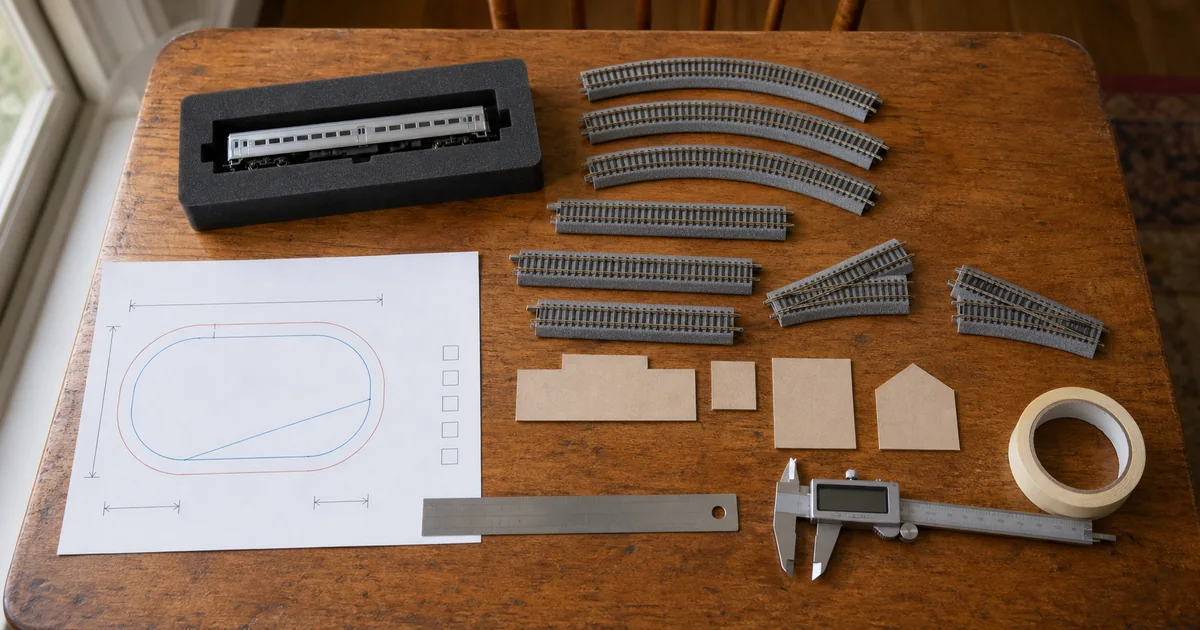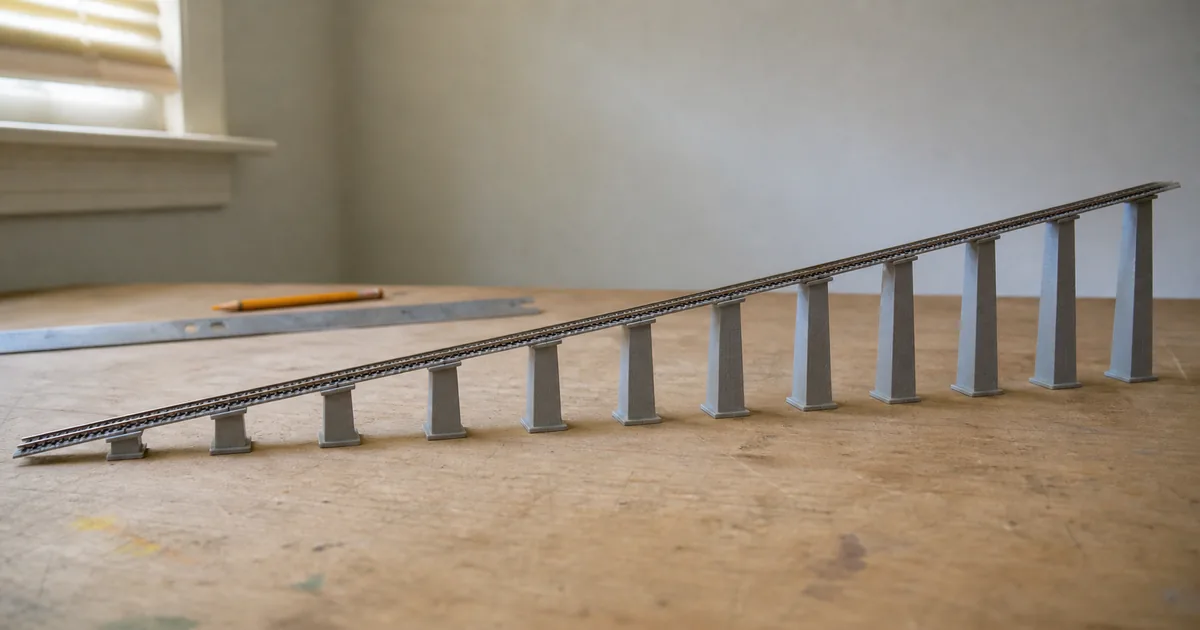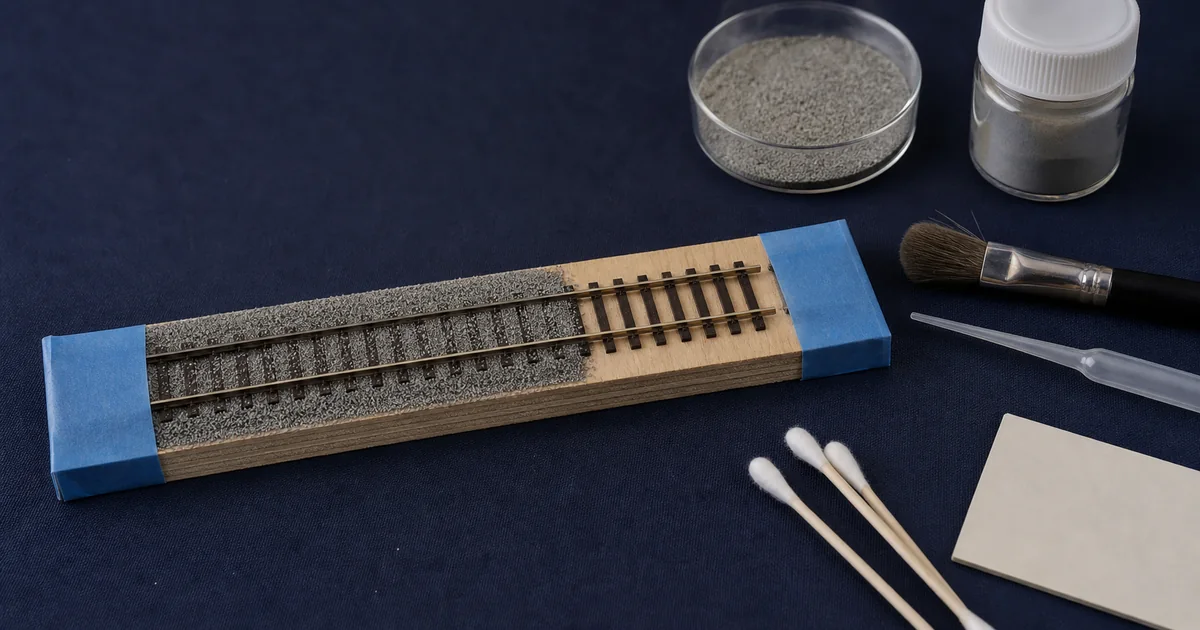
Freeze the route first with the track-planning guide. Choose the track form in the flex vs sectional guide, then use the ballasting workflow only after the support stack has passed.
Cork, foam, sheet and integral roadbed compared
| Roadbed form | Best-fit route | Evidence to release it | Main failure to prevent |
|---|---|---|---|
| Cork strip | Fixed main line or branch with a raised shoulder. | Flat sanded top, sealed where moisture warrants, staggered joints and measured railhead. | Hump, squeezed joint, brittle strip or moisture movement. |
| Foam strip/roll | Curved fixed route where a flexible manufactured strip fits the adhesive system. | Exact SKU dimensions, compatible adhesive, cured test coupon and supported turnout zone. | Compression, adhesive incompatibility or an unsupported boundary. |
| Sheet roadbed | Yard, station, industry or other common-level track field. | Same finished elevation across routes, turnout access and platform/clearance proof. | Unexpected step to raised main line or trapped mechanism. |
| Integral roadbed | Temporary, modular or permanent sectional systems such as UNITRACK and Fine Track. | Flat support, fully seated system joints and a measured transition to any plain track. | Adding an assumed underlay that creates a height or stiffness mismatch. |
What the official sources establish
| Source | Verified point | What it cannot decide |
|---|---|---|
| NMRA | Roadbed is commonly placed between track and subroadbed; cork, foam and Homasote are three principal forms. It gives installation and moisture guidance. | Your route's best material or finished sound level. |
| Woodland Scenics | Its current N scale range includes sheets, strips and a roll; the catalog lists ST1475 at 3 mm × 1 1/4 inches × 24 feet. | The dimensions or adhesive behavior of another SKU or brand. |
| KATO | UNITRACK combines sectional track, a plastic roadbed and UniJoiners for temporary or permanent use. | Whether adding another layer improves your specific support stack. |
| TOMIX | Fine Track pieces are to be assembled on a flat surface and connected or separated horizontally. | That a twisted or stepped base is acceptable because pieces connect. |
| Network Rail | Prototype ballast supports sleepers and is redistributed and compacted to maintain track geometry. | A model-roadbed material, thickness or adhesive specification. |
The four-gate roadbed decision
1. Route gate
GO when main line, yard, station, turnout, removable section and integral-roadbed boundaries are mapped.
2. Stack gate
GO when subroadbed, roadbed, track base, railhead height, adhesive and fastening are recorded.
3. Environment gate
GO when moisture, temperature, portability and material/adhesive compatibility have a test coupon.
4. Operation gate
GO when the governing train clears and runs through every curve, turnout and height transition after cure.
Exclusive tool 1: roadbed transition calculator
Enter the two measured support-stack heights and the planned taper length. The tool reports the absolute height change and arithmetic slope. It does not declare a universal safe grade; vertical curves, vehicle clearances and the built test still govern.
Match the material to the route zone
| Zone | Likely starting point | Release evidence |
|---|---|---|
| Raised scenic main line | Cork or manufactured foam profile. | Centerline, smooth top, shoulder plan and governing-train run. |
| Yard or station field | Sheet roadbed at the required common elevation. | Turnout support, platform relationship and transition to main line. |
| Temporary floor/table route | Integral-roadbed sectional track on a clean flat surface. | Seated connectors, exact footprint and inspection after each assembly. |
| Turnout or crossing | Continuous flat support sized to the exact component. | Free throwbar, accessible drive, railhead level and slow-speed proof. |
| Mixed-system boundary | Measured shim or taper, never a forced rail joint. | Railhead, gauge, polarity, fastening and both-direction train test. |
Exclusive tool 2: support-stack release certificate
Record one certificate per construction zone. A successful straight coupon does not automatically release a turnout, curve or removable module boundary.
| Certificate field | Minimum record | Reopen trigger |
|---|---|---|
| Zone passport | Route function, limits, access and adjacent zones. | Moved boundary or changed operating use. |
| Stack passport | Subroadbed, roadbed SKU/material, thickness, adhesive, fastener and track. | Any substituted layer or bonding method. |
| Surface proof | Straightedge check, centerline, joint treatment and cured condition. | Visible hump, dip, compression, moisture or movement. |
| Boundary proof | Measured railhead change, taper length, gauge and accessible transition. | Re-cut track, new shim, ballast or system change. |
| Fleet proof | Governing trains, both directions, slow and representative speed. | New vehicle, consist, load, speed or operating move. |
Six steps from route zone to release
1. Divide the route by function
Mark main line, yard, station, turnout, removable module, temporary track and every boundary to integral-roadbed track before choosing a material.
2. Audit the exact roadbed system
Record the product, thickness, width, moisture guidance, adhesive guidance and whether the track already includes molded roadbed.
3. Make a height-transition passport
Measure the finished railhead height on both sides of every boundary and calculate the planned taper rather than forcing the track to bridge a step.
4. Build a representative test coupon
Install the chosen roadbed, adhesive, track and one boundary on the real subroadbed material; check flatness, gauge and access after curing.
5. Install by centerline and preserve service access
Lay roadbed to the verified centerline, stagger joints where appropriate, keep turnout mechanisms clear and correct bumps before track or ballast hides them.
6. Release the route before ballast
Hand-roll and power the governing trains in both directions, record the accepted build and reopen the decision after any material, thickness, moisture or alignment change.
Railway-culture answer: ballast is a geometry system
Network Rail describes tampers and ballast regulators redistributing and compacting stone beneath sleepers so the track maintains its geometry. The modeling lesson is narrow but useful: a realistic shoulder is not a substitute for a stable, measurable support stack. Prototype ballast and model roadbed are different materials serving different-scale systems.
Official and first-party sources
Checked 2026-08-25. NMRA supplies modeling practice, manufacturers establish only their own products, and Network Rail supplies prototype maintenance context. Prices are excluded because they change.
- NMRA — roadbed purpose, cork, foam, Homasote and installation guidance
- Woodland Scenics — current N scale Track-Bed range
- Woodland Scenics catalog — ST1475 published dimensions and product claims
- KATO — UNITRACK integral roadbed and UniJoiner system
- TOMIX — Fine Track flat-surface assembly instructions
- Network Rail — tamping, ballast regulation and track geometry
FAQ
What is the best roadbed for N scale?
There is no universal best material. Cork is easy to shape and sand, foam is flexible and sold in model-roadbed forms, sheet material suits yards and stations, and integral-roadbed track already supplies its own molded base. Choose by route function and prove the complete track-roadbed-subroadbed stack.
Do N scale layouts need roadbed?
Not every layout requires a separate strip, especially when using integral-roadbed track. NMRA explains that roadbed can reduce direct-on-plywood noise and create a raised prototype-style profile. The installed surface still must be flat, stable and testable.
Is cork or foam roadbed better for N scale?
Cork can be sanded to a precise surface and is widely used under fixed track; foam is flexible and avoids cork's drying concern. Neither claim proves your route. Compare thickness, adhesive, turnout support, moisture, fastening and repair access on a test coupon.
Does KATO UNITRACK need cork roadbed underneath?
KATO describes UNITRACK as sectional track with integral plastic roadbed, so a separate beveled roadbed is not required to create its base. An extra layer may still be used for layout design reasons, but it changes rail height and every transition must be measured and tested.
Does TOMIX Fine Track need separate roadbed?
Fine Track has a molded base and TOMIX instructs users to assemble it on a flat surface. A separate layer is therefore a layout decision, not a default requirement. If added, record the new height and keep joints level.
How thick is Woodland Scenics N scale Track-Bed?
Woodland Scenics' catalog lists the N scale ST1475 continuous roll at 3 mm thick, 1 1/4 inches wide and 24 feet long. Those figures apply to that named product, not every foam or cork roadbed.
Should new cork roadbed be soaked before bending?
NMRA says soaking is not necessary for new, soft cork. It notes that older cork may become brittle and may be soaked and dried to restore flexibility. Follow the condition and maker guidance for the actual material.
Should cork roadbed be sealed?
NMRA recommends two coats of latex paint after sanding when a layout is in a humid environment because porous cork can absorb moisture and distort attached track. Treat this as moisture control, then recheck flatness after curing.
What roadbed should be used in yards and stations?
NMRA suggests sheet cork of the same thickness as the mainline strips where tracks sit on a common flat level. Whatever material you choose, calculate transitions and verify platform, turnout and coupler geometry on the finished stack.
How should roadbed be installed under turnouts?
Provide a flat, fully supported surface without obstructing throwbars, motors or service access. NMRA notes that cork must be trimmed to fit turnouts and crossings. Build the turnout area as a testable zone before ballast or scenery.
Does roadbed make an N scale layout quiet?
Roadbed can reduce the noise of track fixed directly to plywood, but no material guarantees a universal sound reduction. Adhesive, fasteners, benchwork, hollow spaces, train speed and room acoustics all affect the result, so compare complete test coupons.
When should a roadbed decision be retested?
Retest after changing roadbed material or thickness, adhesive, subroadbed, track family, turnout, fastening, ballast, humidity exposure or a height boundary. A previous PASS belongs only to the recorded construction stack.