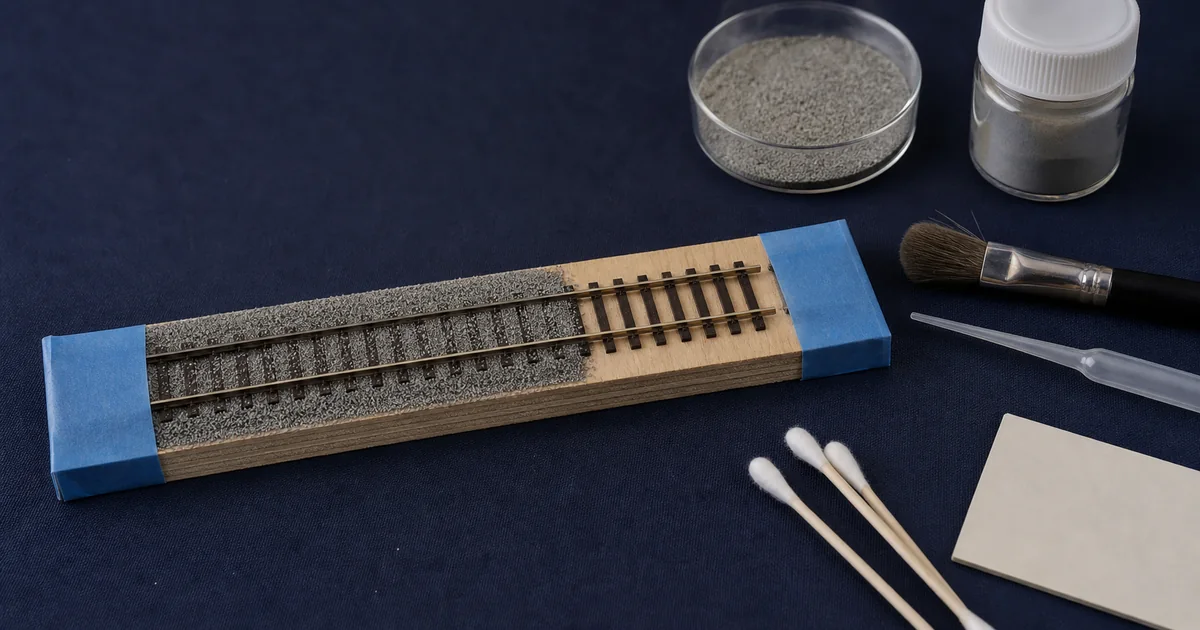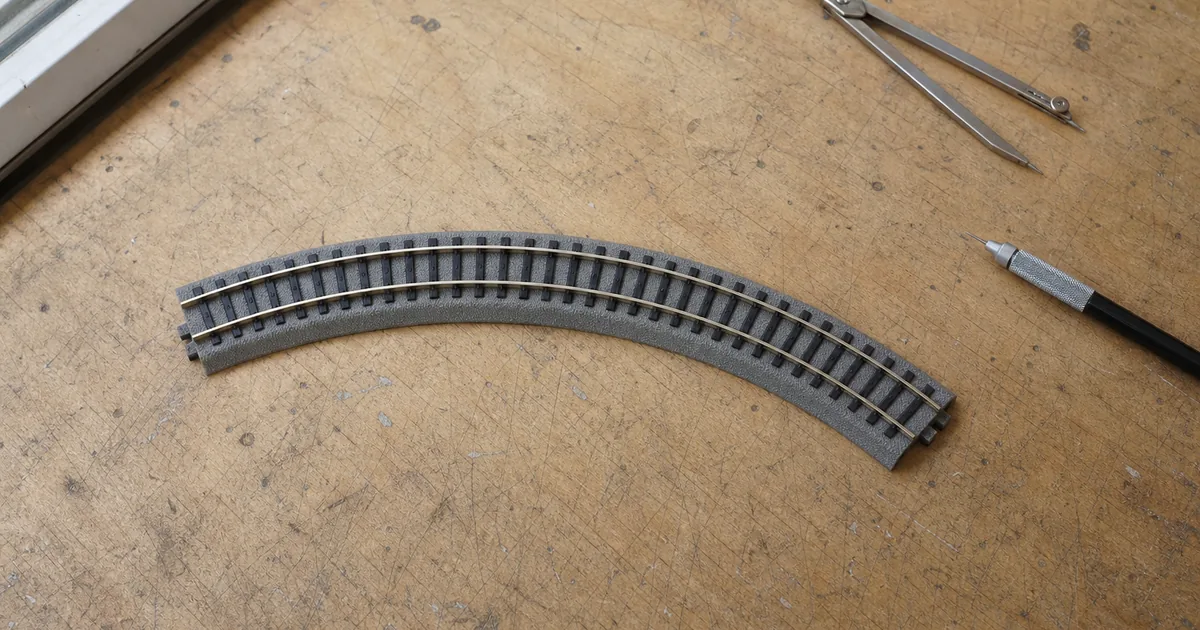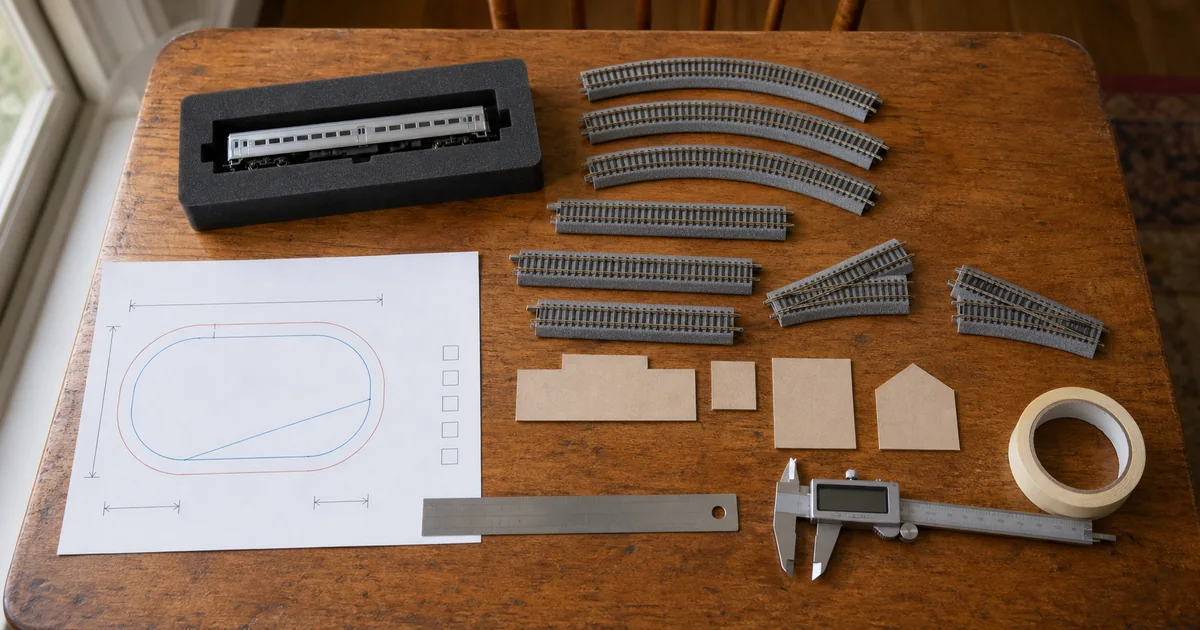
First define the route with the track-planning freeze. Use the radius certificate before bending flex track, and the rail-code guide before assuming two track families share a level joint.
Flex, sectional and integral-roadbed sectional track
| Decision | Flex track | Sectional track | Integral-roadbed sectional |
|---|---|---|---|
| Geometry | Custom radii, straight lengths and easements within the proven route limit. | Fixed lengths, radii and angles from the exact product catalog. | Fixed geometry plus a molded base and system connector. |
| Build work | Curve, cut, dress, join, gauge, fasten and add roadbed/ballast as required. | Select pieces, join, align and fasten; filler lengths may be needed. | Assemble on a flat surface; scenery treatment remains optional. |
| Change frequency | Best when the route is stable enough to justify custom work. | Useful when the plan changes or exact geometry must be reproduced. | Strong fit for floor, tabletop, temporary and modular use. |
| Main risk | Radius drift, kinked joints, poor cuts or gauge loss. | Forced closure, accumulated geometry error or many uninspected joints. | Unseated rail/roadbed connector, height boundary or hidden system assumptions. |
| Best evidence | Centerline template, gauge readings and the built route test. | Exact SKU geometry and an assembled plan that closes without force. | Manufacturer instructions plus flat-surface and connector inspection. |
What official sources actually establish
| Source | Verified point | What it cannot decide for you |
|---|---|---|
| NMRA beginner guide | Distinguishes sectional, integral-roadbed sectional, flex and hand-laid track; explains custom radii/easements and says many project layouts combine types. | Your minimum radius, skill level, exact boundary or fleet result. |
| Atlas N Super-Flex | Current Code 80 item 2500 is listed at 29.5 inches; Atlas describes its flexible line as formable and re-formable. | Compatibility with an unrelated roadbed, rail code or joiner. |
| PECO SL-300F | N Code 55 flexible track is listed at 914 mm and belongs to PECO's own Code 55 system. | That every 914 mm flex product shares its rail section or wheel claim. |
| KATO UNITRACK | KATO defines UNITRACK as sectional track with plastic roadbed and UniJoiners, intended for both temporary and permanent use. | That any custom curve can be forced from fixed pieces. |
| TOMIX Fine Track | TOMIX instructs users to lay pieces on a flat surface and join or separate them horizontally. | That a strained plan or lifted joint is acceptable because it closes. |
The four-gate topology decision
1. Operation
GO when the governing trains, radius, grade, clearance and switching moves are frozen.
2. Change
GO when route permanence, portability and expected rebuild frequency are explicit.
3. Craft
GO when cutting, gauging, joining, wiring and fastening skills match the chosen form.
4. Service
GO when every joint, feeder and mixed-family boundary remains testable and replaceable.
Exclusive tool 1: plain-track joint estimator
Enter one uninterrupted plain-track length and the usable length of each candidate piece. The estimator rounds up to whole pieces and reports internal joints between those pieces. Add turnouts, crossings, insulated gaps and route boundaries separately.
Where a hybrid route earns its boundaries
| Route zone | Likely fit | Release evidence |
|---|---|---|
| Temporary floor/table loop | Integral-roadbed sectional track | Flat assembly, fully seated connectors, exact footprint and repeated setup inspection. |
| Long visible curve | Flex track where a custom radius or easement is required | Full-size centerline, radius template, gauge through joints and governing-train proof. |
| Station throat or yard | Exact turnout family plus flex or sectional closure pieces | SKU geometry, frog/guard-rail test, powered and propelled moves. |
| Module interface | Host-standard sectional interface, even if the interior is flexible | Specified setback, height, centerline, polarity and repeatable mating test. |
| Hidden route | Whichever proven form preserves access | Recovery test, joint map, feeder proof and removable cover or opening. |
Exclusive tool 2: hybrid-route release certificate
Every route zone needs its own evidence. A PASS for one straight test board does not release a curve, turnout or height transition.
| Certificate field | Minimum record | Reopen trigger |
|---|---|---|
| Topology passport | Zone map naming flex, sectional, roadbed and every transition. | Moved boundary or new route function. |
| Geometry passport | Centerline, radius, easement, turnout SKU, grade and clearance. | Re-cut rail, shifted track or substituted component. |
| Joint ledger | Location, joiner, railhead/gauge check, feeder and accessibility. | Solder, ballast, roadbed or electrical change. |
| Fleet proof | Governing trains, both directions, slow and representative speed. | New wheelset, consist, load or operating move. |
| Closure proof | Plan closes without force; no kink, lift, twist or stretched connector. | Seasonal movement, module reassembly or visible misalignment. |
Six steps from route requirement to release
1. Freeze the operating requirement
Record the governing trains, minimum radius, turnouts, clearances, grades, route changes and whether the layout must be portable or reconfigurable. Do not choose track from appearance alone.
2. Divide the route by function
Mark temporary areas, fixed scenic curves, stations, yards, hidden track and module interfaces. Allow different track forms only where a named function justifies the boundary.
3. Audit the exact product families
Record rail code, gauge, roadbed height, joiner, turnout geometry, feeder method and available lengths for every candidate. Manufacturer compatibility statements apply only to the products they name.
4. Estimate joints and cuts
Use the calculator to screen plain-track piece and internal-joint counts, then add turnouts, crossings and unavoidable boundaries separately. Treat the count as workload evidence, not a reliability score.
5. Build and test one representative route
Lay a full-size template, cut and dress flex rail if used, align every joint, check gauge, then hand-roll and power the governing trains through both directions at slow and representative speeds.
6. Issue a route release certificate
Record the accepted products, joint map, geometry, train results, electrical proof and access plan. Reopen the decision after any track, wheel, alignment, ballast, feeder or operating change.
Railway-culture answer: fewer joints create a new maintenance system
FRA says railroads using continuous welded rail must maintain formal procedures for installation, adjustment, inspection and maintenance—including joints within CWR territory. The modeling analogy is limited but useful: removing routine joints does not remove change control. Long flexible alignments still need restraint, inspection and an accessible boundary plan.
Official and first-party sources
Checked 2026-08-25. NMRA explains modeling track forms; manufacturers establish only their own product facts; FRA supplies prototype governance context. Prices and availability are excluded because they change.
- NMRA — beginner's guide to sectional, integral-roadbed and flex track
- Atlas — N Code 80 Super-Flex item 2500 and published length
- PECO — SL-300F N Code 55 flexible track specification
- KATO — UNITRACK sectional-roadbed system and UniJoiner description
- TOMIX — Fine Track assembly and maintenance instructions
- FRA — continuous-welded-rail installation, adjustment, inspection and maintenance plans
FAQ
Is flex track or sectional track better for N scale?
Neither is universally better. Flex track suits custom radii, easements and long fixed alignments; sectional track suits repeatable geometry, temporary layouts and product-system accessories. NMRA notes that many projects use a combination. Prove the exact route and fleet.
Is flex track suitable for an N scale beginner?
Yes, if the beginner practices cutting, dressing, curving, gauging and joining on a sacrificial section first. NMRA describes flex track as a beginner option but notes that it takes care to install. Do not make the permanent route the first practice piece.
Does flex track make any curve radius?
It can form many custom radii and easements, but it does not make every radius acceptable. The governing train, turnout, clearance and minimum-radius decision still apply. Draw a centerline template and prevent the curve from tightening at joints.
Does flex track always have fewer joints?
A long plain route normally needs fewer pieces than the same length built from short sectional units, but turnouts, crossings, feeders, insulated gaps and product boundaries remain. Use the estimator for the named plain length; do not treat joint count alone as reliability.
Can I mix flex track and sectional track?
Yes, when rail code, gauge, railhead height, joiners and roadbed are reconciled at an accessible transition. NMRA explicitly notes that many project layouts combine track types. Test the complete boundary with the governing train before scenery.
Is KATO UNITRACK sectional track?
Yes. KATO describes UNITRACK as an assembly track system with integral plastic roadbed and UniJoiners. Its fixed pieces support temporary or permanent layouts. Record exact geometry rather than assuming a sectional system can make any alignment.
Is TOMIX Fine Track sectional track?
Yes. TOMIX describes Fine Track as a connectable system and instructs users to assemble it on a flat surface by joining pieces horizontally. Its product names encode lengths and radii, so the exact component list is part of the plan.
How long is Atlas N scale flex track?
Atlas currently lists its N Code 80 Super-Flex item 2500 as 29.5 inches long. Atlas also offers other rail-code families, so record the exact item rather than transferring one length or joiner assumption to every Atlas product.
How long is PECO N Code 55 flex track?
PECO lists SL-300F N Code 55 flexible track at 914 mm. The same page describes its visible rail height and joiner system. Use that exact product evidence; another PECO gauge or code may differ.
Should I use sectional track for hidden track?
Choose by access and proven operation, not visibility alone. Hidden track needs reliable alignment, power and recovery access. A sectional joint or flex joint should not be buried where it cannot be inspected, cleaned or replaced.
Should flex-track joints be placed in the middle of a curve?
Avoid an unsupported or unverified joint at the highest-risk part of a curve. If a joint is unavoidable, keep the intended radius through it, align and gauge both railheads, secure the approach, and test before ballast.
When must a flex or sectional route be retested?
Retest after changing track family, rail code, joiner, turnout, roadbed, curve, feeder, ballast, wheelset, train length or operating direction. A previous PASS belongs only to the documented build state.