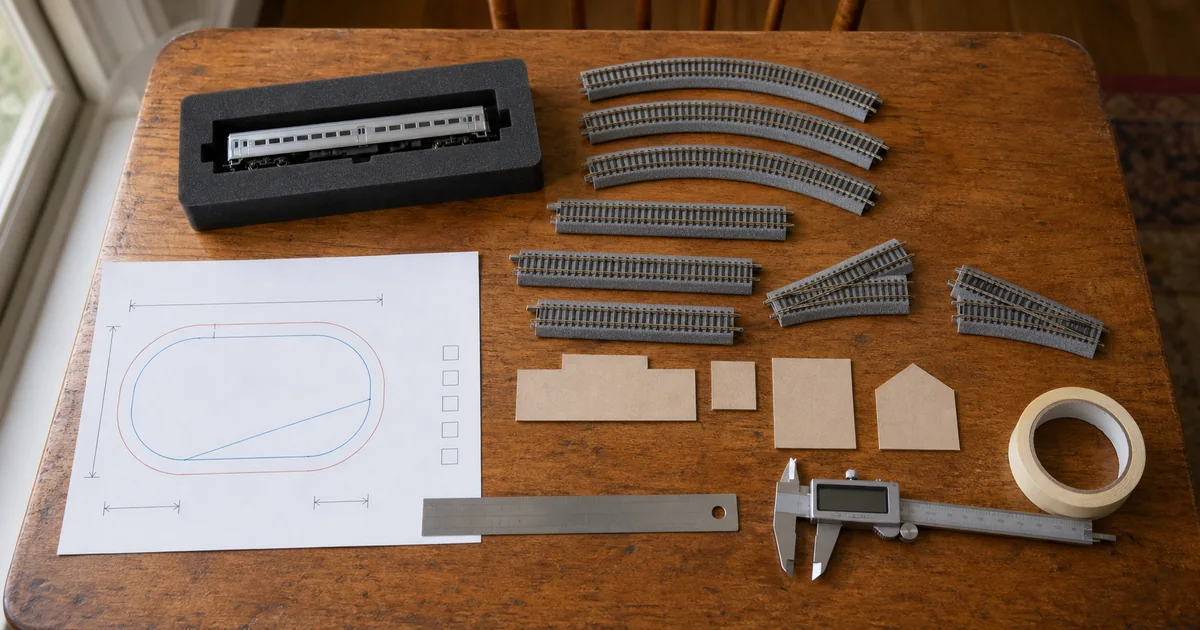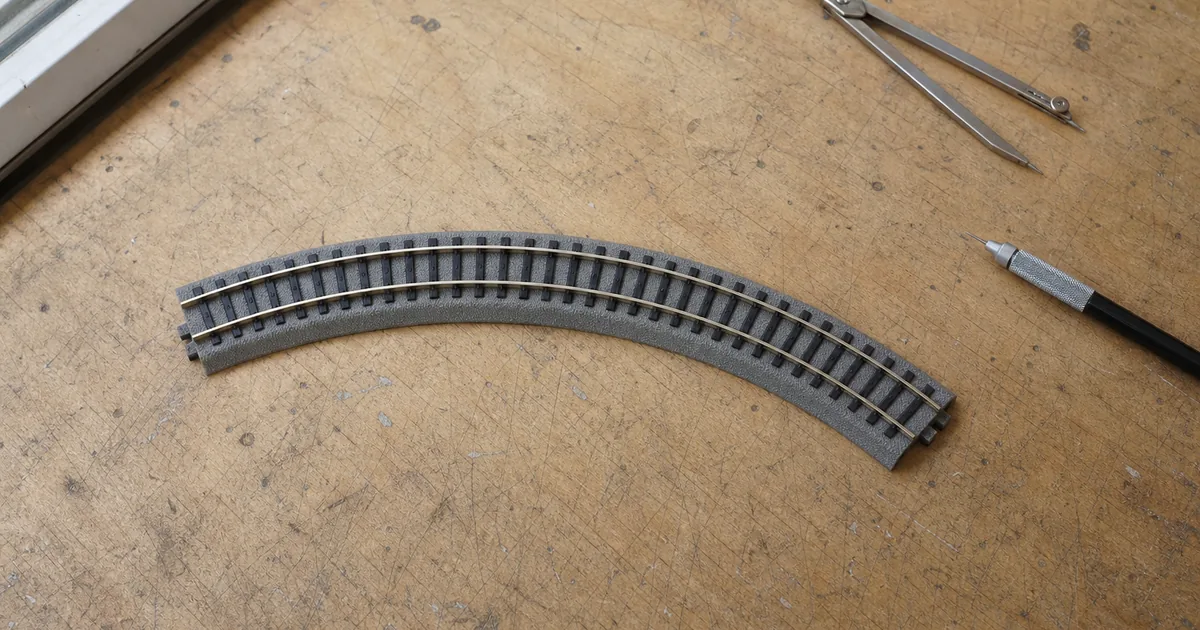
Freeze the route first with the track-planning gates. Then use the curve certificate for radius and the spacing calculator for parallel routes. Rail code cannot rescue an unsuitable curve or clearance plan.
What rail code tells you—and what it does not
The NMRA glossary defines rail code as the rail height in thousandths of an inch, written without the decimal point. Multiplying inches by 25.4 gives the metric heights below. This is useful, exact arithmetic; it is not a complete compatibility specification.
| Question | Code 55 | Code 80 | Decision limit |
|---|---|---|---|
| Nominal rail height | 0.055 in = 1.397 mm | 0.080 in = 2.032 mm | The difference is 0.025 in / 0.635 mm. |
| Visible effect | Usually the finer-looking option within one brand. | Usually the taller-looking option within one brand. | Tie size, rail profile, paint and ballast also affect appearance. |
| Wheel clearance | Must be checked on the exact molded track and turnout. | Must still meet gauge and turnout geometry. | Code alone does not state flange clearance. |
| Transition | May require railhead-height compensation—or may not, where the manufacturer explicitly designs both families to join. | Follow the exact manufacturer path and test the built joint. | |
Why “Code 55” is not one interchangeable product
| Official evidence | What the maker says | Safe interpretation |
|---|---|---|
| Atlas Code 55 | Atlas describes finer brown ties and smaller rail than its traditional Code 80, while claiming the same reliability and durability. | Appearance does not require accepting lower reliability, but the claim belongs to Atlas's system—not all Code 55 track. |
| Atlas Code 80 | Atlas describes black ties, nickel-silver rail and a wide selection of pieces. | Audit the actual catalog geometry you need; “Code 80” alone does not promise a particular turnout or curve. |
| PECO N Code 55 | PECO states a 1.4 mm visible height, a special rail section, all-brand N locomotive operation, and use of the same standard joiners as its Code 80. | Treat those as PECO-specific design claims. They do not transfer to Atlas, handlaid rail or another brand. |
| PECO 55/80 boundary | PECO states the two systems connect without compensation for rail-height change because of its rail profile and base molding. | Use PECO's components, then still inspect gauge, alignment, conductivity and the governing fleet. |
| NMRA S-3.2 | Defines N scale track-gauge, check-gauge, span, flangeway and flange-clearance limits. | Gauge and rail height are separate dimensions. A matching nominal gauge does not make two systems drop-in compatible. |
The four-gate rail-code decision
1. Range
GO when one exact product family supplies every required curve, turnout, crossing and joiner.
2. Fleet
GO when the deepest flange and longest rigid wheelbase clear plain track and specialwork.
3. Boundary
GO when every change of code or family keeps railheads level, gauge true and joints accessible.
4. Route
GO when governing trains pass in both directions, slowly and at representative speed, before ballast.
Exclusive tool 1: rail-height converter
Enter any rail code and modeling ratio. The calculator reports the physical model height and its simple scale-equivalent height. It does not approve wheels, a turnout, a transition or prototype rail weight.
Build a governing-fleet ledger before buying track
| Candidate | Why it governs | Evidence to record |
|---|---|---|
| Deepest flange | Most likely to contact molded spike or tie detail. | Exact vehicle and wheelset, measured/gauged condition, plain-track result. |
| Longest rigid wheelbase | Most sensitive to gauge and frog geometry. | Forward/reverse, hauled/propelled and lowest repeatable speed. |
| Smallest tread or lightest car | May expose railhead, joint or pickup problems. | Turnout route, crossing, transition and electrical continuity. |
| Most valuable vehicle | Avoids approving a system that excludes a must-run model. | Handling limit, approved route and any prohibited specialwork. |
Age and brand are screening clues, not verdicts. PECO's published all-brand claim for its Code 55 system is relevant to PECO; a forum report about another manufacturer's molded fasteners is not evidence against PECO. Keep every claim attached to its product family.
Exclusive tool 2: track-system release certificate
Release one system—or one mixed-code boundary—only after every row is recorded. A blank field is HOLD.
| Certificate field | Minimum record | Reopen trigger |
|---|---|---|
| Track passport | Brand, range, rail code, SKU, turnout/crossing and joiner. | Any substituted component or changed supplier. |
| Fleet passport | Governing vehicles, wheelsets, direction and train state. | New model, replacement wheel or modified truck. |
| Mechanical boundary | Railheads level, gauge checked, joiner seated, no flange strike. | Movement, soldering, roadbed or ballast change. |
| Electrical boundary | Continuity, polarity and slow-speed powered crossing in both directions. | New feeder, insulated joint or turnout wiring. |
| Service boundary | Transition visible or accessible for inspection and replacement. | New tunnel, platform, fascia or fixed scenery. |
Six steps from shortlist to released track
1. Record the exact track family
Record manufacturer, range, rail code, product numbers, turnouts, crossings, joiners and roadbed. Do not treat all products carrying the same code as structurally identical.
2. Convert code without over-interpreting it
Convert the code from thousandths of an inch to millimeters and, if useful, scale-equivalent height. Treat the result as rail-height geometry, not a promise of wheel compatibility or a prototype rail-weight classification.
3. Name the governing fleet
List the oldest, deepest-flanged, longest-wheelbase and most valuable vehicles that must use the route. Inspect and gauge the actual wheels rather than accepting age or brand as a substitute for evidence.
4. Build one sacrificial boundary
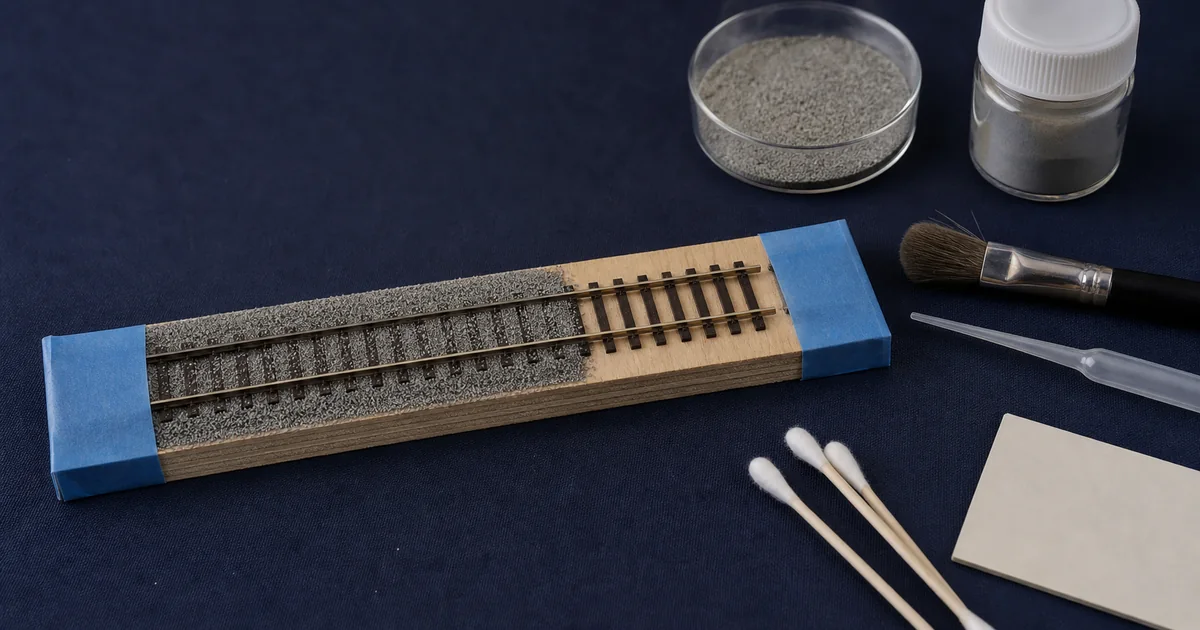
Assemble a straight test section with the exact joiners, turnout and any Code 55-to-80 transition. Align railhead height and gauge; do not hide a vertical step with solder, force or ballast.
5. Run the four-gate acceptance test
Hand-roll and power the governing vehicles in both directions through plain track, frogs, guard rails and the transition. Test hauled and propelled movements at slow and representative speeds.
6. Issue a track-system certificate
Record the accepted track family, fleet, boundary build, electrical test and date. Reopen the decision after any new wheelset, turnout, joiner, roadbed, ballast or alignment change.
Railway-culture answer: the rail profile is maintained, not merely installed
Network Rail explains that track care includes measuring for flaws and grinding part of the rail head to restore a clean profile and smoother ride. That does not turn prototype maintenance limits into model specifications. It does reinforce one useful habit: judge the running interface as a measured system of rail, wheel and route—not as a code number in isolation.
Official and first-party sources
Checked 2026-08-25. NMRA defines terms and track relationships; Atlas and PECO describe only their own systems; Network Rail supplies prototype maintenance context. Prices and availability are excluded because they change.
- NMRA — beginner's glossary definition of rail code
- NMRA S-3.2 — N scale trackwork gauge, flangeway and clearance relationships
- Atlas — N scale Code 55 system description
- Atlas — N scale Code 80 system description
- PECO — N Streamline Code 55/80 structure, joiner and compatibility statements
- Network Rail — track inspection and rail-head profile treatment
FAQ
What does Code 55 or Code 80 mean?
NMRA defines rail code as rail height in thousandths of an inch without the decimal point. Code 55 is therefore 0.055 inch, or 1.397 mm; Code 80 is 0.080 inch, or 2.032 mm. Code alone does not describe the full rail profile, tie system or compatibility.
Is Code 55 better than Code 80 for N scale?
Neither is universally better. Code 55 can provide a finer visible rail appearance, while Code 80 gives a taller rail system and often a broader legacy ecosystem. Choose the exact product family whose wheels, turnouts, joiners and geometry pass your acceptance test.
Does Code 80 run more reliably than Code 55?
Rail height alone does not establish reliability. Atlas states its Code 55 line has the same reliability and durability as its Code 80 line. Installation, gauge, wheels, turnouts, joints, power and maintenance still govern the result.
Will older N scale wheels run on Code 55 track?
Do not decide from age alone. Deep flanges may contact molded detail on some Code 55 designs, while PECO explicitly states that all brands of N gauge locomotives run on its own Code 55 system. Test the exact wheelset on the exact brand and turnout.
Are Atlas Code 55 and PECO Code 55 the same?
No. The shared code identifies rail height, not an identical track system. Atlas describes finer ties and smaller rail than its Code 80 line. PECO describes a special rail section and base molding with 1.4 mm visible height and compatibility with its Code 80 system.
Can PECO Code 55 connect directly to PECO Code 80?
PECO says its N Code 55 and Code 80 systems can connect without compensating for rail-height change and use the same standard joiners. That is a manufacturer-specific claim; still verify gauge, alignment, power and your governing vehicles at the assembled boundary.
Can Atlas Code 55 connect directly to Atlas Code 80?
Do not assume a direct level joint merely because both are Atlas N scale. The rails have different heights and their joiners and geometry are product-family specific. Build a documented transition that aligns railheads and gauge, then test it before scenery.
Do Code 55 and Code 80 use the same track gauge?
Rail code and track gauge are different measurements. NMRA S-3.2 gives the N track-gauge limits, while code describes rail height. Two tracks can share nominal N gauge yet still differ in rail profile, joiner, tie, turnout and roadbed geometry.
Does Code 55 represent a particular prototype rail weight?
Not by code alone. A simple scale conversion gives an equivalent height, but prototype rail weight also depends on the complete cross-section. Use photos and engineering references for appearance; do not label model rail by prototype weight from height alone.
Can I use Code 55 on the visible main line and Code 80 in hidden track?
Yes, if every boundary is accessible, aligned and proven with the governing fleet. Hidden track also needs recovery and cleaning access. Record the transition instead of burying it under a tunnel portal or fixed scenery.
Should I replace all wheelsets before choosing Code 55?
No. First create a fleet ledger and test the governing vehicles on the exact Code 55 track and turnout family. Replace only a wheelset that fails a confirmed clearance, gauge or running requirement and can be replaced with an approved part.
When must the Code 55 or Code 80 decision be retested?
Retest after adding a new vehicle, changing wheels, turnouts, crossings, joiners, roadbed, soldered joints, ballast, alignment or operating direction. A prior PASS belongs only to the recorded fleet and assembled route.